
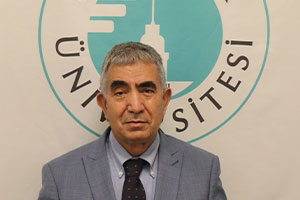
Senior Engineer Mehmet Alkan completed his primary and secondary education in Sarıkamış and his high school education at Erzurum High School in Erzurum. After graduating from Erzurum High School in 1972, he enrolled in the Chemical Engineering Department of Karadeniz Technical University (K.T.Ü.) and graduated with good academic standing in 1976. In 1980–1981, he attended the preparatory school at Boğaziçi University. In 1997, he completed his Master's degree in the Materials Department of Istanbul Technical University (ITU), Faculty of Chemistry and Metallurgy, earning the title of Senior Engineer. He has advanced proficiency in English, intermediate proficiency in French, and good proficiency in Russian.
He began his industrial career in November 1976 at the İzmir Refinery, Turkey's largest industrial facility, with a crude oil processing capacity of 11 million tons, as a Refinery Control Engineer in the Inspection Department. He held this position until 1982. From 1982 until June 1984, he worked as an Operations Engineer in the refinery's most important unit, the Platformer (gasoline unit).
In 1984, he was transferred to the Kırıkkale Refinery, which was under construction and belonged to the same organization. During the refinery's construction and installation phase, he was assigned responsibility for commissioning the Power Plant. During the installation and commissioning of these units, he received training at the Romanian company responsible for the refinery's design and construction, in Romania, in 1986. In 1987, he became Chief Power Plant Engineer of the same complex.
In 1988, he was appointed Chief Petroleum Movements Engineer. In 1991, he became Utilities Operations Manager. At the end of 1992, he additionally assumed responsibility as Refinery Process Units Operations Manager. On September 26, 1993, he commissioned Turkey's first Hydrocracker Unit in cooperation with the Japanese company JGC.
In 1994, he was appointed Deputy Refinery Manager, and in 1997, he became Kırıkkale Refinery Manager.
At the end of the same year, he was transferred to the İzmir Refinery as Deputy Refinery Manager. Together with the Korean company GS, Turkey's first Diesel Hydrotreater Unit was commissioned, making it possible to produce low-sulfur diesel fuel in Turkey for the first time.
In February 2007, he was appointed Energy Optimization Manager at TÜPRAŞ General Management. During this assignment, major energy-saving projects were implemented in the energy and process units of all four refineries.
Between 2006 and 2013, feasibility studies and detailed engineering projects aimed at product, energy, and fuel savings were carried out in 13 process units.
He played a leading role in securing all first-place awards over six consecutive years in Turkey's Energy Efficiency Projects organized by the Ministry of Energy between 2007 and 2013. On February 15, 2013, he retired from TÜPRAŞ as a senior executive.
From February 20, 2013, to 2015, he worked abroad in Turkmenistan as EPC Project Director, responsible for the engineering, installation, and commissioning of the Delayed Coker and Propane Deasphalting units.
Between 2016 and 2018, he served as EPC Project Director for the 5-million-ton-per-year-capacity automatic railway wagon loading unit at the Turkmenbashi Refinery in Turkmenistan. In cooperation with Germany's Scherzer company, he was responsible for the engineering, installation, and commissioning of this important facility.
In 2009, energy optimization programs were implemented at Turkey's two largest refineries, İzmir and İzmit, to ensure efficient energy consumption through refinery energy requirement analysis, energy monitoring, and optimization programs.
Between 2010 and 2012, heat integration between the crude oil and vacuum units was achieved using Pinch Technology. An article on this work was published internationally in the October 2010 issue of PTQ Magazine.
Between 2010 and 2012, the process furnace used for heating the crude oil unit's stabilizer column feed, which consumed 10,000 tons of fuel oil annually, was taken out of service. Its function was replaced by a heat exchanger utilizing the heat of a hot diesel stream.
For the first time in Turkish industry, 690 V was used instead of 380 V low voltage, resulting in reductions in both investment and operating costs.
By implementing the latest technological applications in reciprocating compressors, centrifugal pumps, and other major equipment, significant improvements in energy efficiency were achieved.