
Social Work Department
We train social workers who touch lives, empower society, and build the future together.
What is the Social Work Department?
Social work is an applied science and profession dedicated to preventing and resolving social, economic, psychological, and environmental issues that affect the lives of individuals, families, groups, and communities, based on the principles of human rights, social justice, equality, and social solidarity. The primary objective of social work is to enhance the well-being of individuals and society, improve the living conditions of disadvantaged and vulnerable groups, support individuals in realizing their potential, and increase their social functionality.
Social workers work with different segments of society, primarily children, youth, the elderly, individuals with disabilities, women, families, immigrants, disaster-affected individuals, and groups at risk of poverty and social exclusion. The profession aims not only to intervene in emerging problems but also to improve the quality of life for individuals and society through protective, preventative, developmental, and empowering social work practices. Accordingly, social workers assume active roles in counseling, advocacy, case management, psychosocial support, resource development, social policy implementation, and community development efforts.
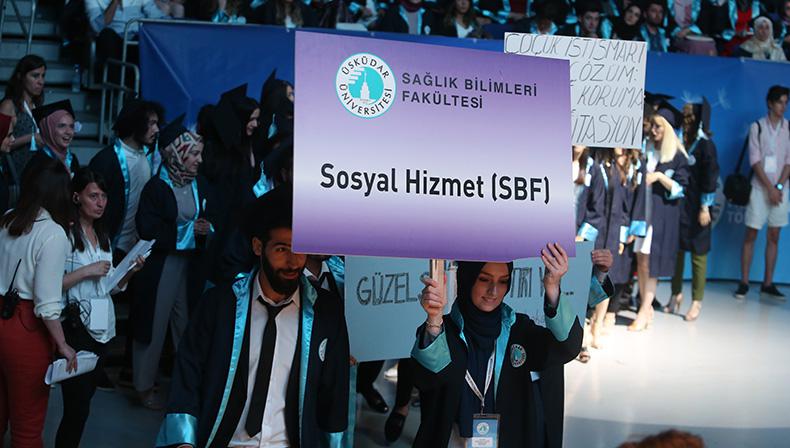
Üsküdar University Department of Social Work adopts an educational approach that integrates the universal values of social work with scientific knowledge, ethical responsibility, and practical experience. Our department aims to train social workers who respect human dignity, value cultural diversity, think critically, conduct research, develop evidence-based practices, and approach social problems from a holistic perspective.
Our educational program offers rich content fed by different disciplines such as psychology, sociology, law, and health sciences, alongside social work theories, human behavior and the social environment, social policy, social work legislation, research methods, and applied professional courses. Our students develop their professional knowledge and skills by supporting their theoretical education with field placements carried out in public institutions, healthcare organizations, local governments, and non-governmental organizations.
In line with Üsküdar University's research- and practice-oriented educational approach, our department encourages its students toward scientific production, community contribution activities, and lifelong learning. Our graduates are equipped with the qualifications to work in public institutions, local governments, healthcare organizations, the justice system, educational institutions, non-governmental organizations, and international organizations as social workers who are committed to ethical principles, center human rights, contribute to the strengthening of social justice, establish effective cooperation with interdisciplinary teams, and develop innovative solutions to the changing needs of society.
What is the Educational Content in the Social Work Department Like?
The Üsküdar University Undergraduate Program in Social Work offers a comprehensive educational program aimed at developing students' theoretical knowledge and practical skills with a holistic approach. Within the scope of the program, students take courses directed at the core areas of the profession, such as social work theories, human behavior and the social environment, social policy, social work legislation, social work research, interviewing techniques, report writing, social work ethics, case management, and social work practices with individuals, families, groups, and communities. In addition, through courses taken from disciplines such as psychology, sociology, law, health sciences, and behavioral sciences, students are aimed to gain a versatile perspective. Thus, students acquire the professional competencies to evaluate the biopsychosocial needs of individuals and society and plan scientific and evidence-based interventions. Thanks to the practical training that forms an important component of the program, students find the opportunity to make observations and gain professional experience in different fields of application of social work, primarily public institutions, healthcare organizations, local governments, and non-governmental organizations. Field placements contribute to students developing their professional identities by integrating their theoretical knowledge with real-life experiences. Throughout their undergraduate education, our students have the opportunity to participate in academic studies that support their scientific research, critical thinking, and project development skills. Furthermore, thanks to collaborations carried out with international universities within the scope of the Erasmus+ exchange program, they can also have the opportunity to study abroad and experience social work practices in different cultures.
What are the Fields of Work for Social Workers?
Social workers serve in a wide variety of areas where protective, preventative, developmental, and rehabilitative services are provided for the enhancement of the well-being of individuals, families, groups, and communities, and the prevention and resolution of social problems. Our graduates work with different age groups and client systems, carrying out psychosocial support, counseling, case management, advocacy, social investigation, crisis intervention, social policy implementation, and community-based work.
Social workers can take on roles in public institutions—primarily the Ministry of Family and Social Services, the Ministry of Health, and the Ministry of Justice—as well as hospitals, mental health services, the child protection system, elderly and disabled care services, social service centers, violence prevention and monitoring centers, child monitoring centers, probation services, penal execution institutions, municipalities, and governorates and district governorships. In addition, social workers have the opportunity to work in non-governmental organizations, international organizations, local governments, private healthcare organizations, care and rehabilitation centers, special education and counseling organizations, and in the fields of social responsibility and corporate social impact. In line with increasing societal needs, there are also significant career opportunities in specialization areas such as migration, disaster and emergency management, mental health, school social work, aging, disability, child protection, family counseling, addiction, medical social work, and forensic social work.
Graduates who wish to pursue their academic development can continue their graduate education and serve as academicians and researchers at universities, contributing to scientific research, project development studies, and social policy production processes.


