

[No new students will be admitted to the Department of Orthotics and Prosthetics for the 2026-2027 academic year.]
Training Competent Healthcare Professionals for the Sector
What is the Department of Orthotics and Prosthetics?
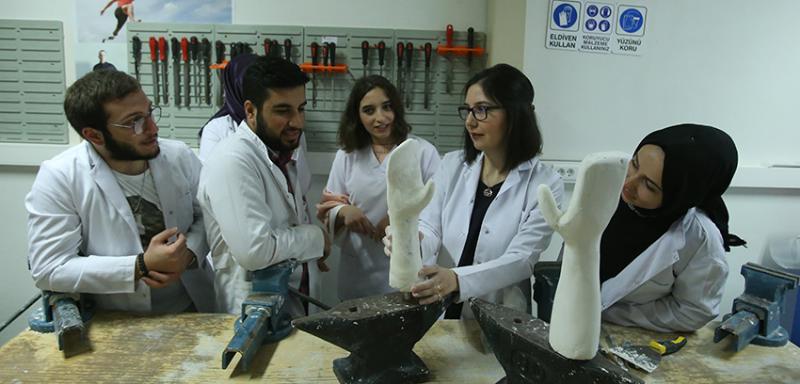
The undergraduate education in Orthotics and Prosthetics aims to train healthcare professionals equipped not only with the skills to manufacture assistive and complementary devices needed by individuals with neurological or orthopedic conditions or orthopedic disabilities, but also with the knowledge and skills to design them, and who can take part in the R&D teams of companies producing and marketing medical supplies.
Orthotist and prosthetist candidates who know human anatomical structure and physiological functioning, have been trained in internal, neurological, and orthopedic diseases, and have a command of trauma psychology, are trained to be equipped with both technician qualifications and partial engineering knowledge. While developing their fine motor skills through workshop learning and studying orthosis-prosthesis manufacturing, they simultaneously acquire planning skills through computer-aided drawing and model design courses. Beyond going from the part to the whole, thinking habits are developed to see deficiencies by breaking the whole into parts and reassembling them appropriately. A program has been created for students to be constructive and inquisitive individuals who, upon graduation, can identify, understand, and find solutions to disruptions arising from personalized differences during biomedical product manufacturing stages. Graduates will be competent in producing functional and cosmetically satisfying orthoses and prostheses to serve humanity and without forgetting the user story, as well as developing biotechnological product design concepts.
What are the Courses Taken in the Department of Orthotics and Prosthetics?
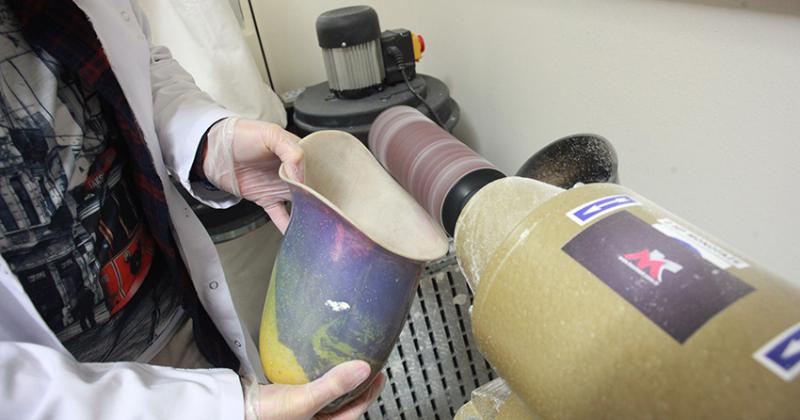
In the first year of education, alongside basic courses such as anatomy, physiology, physics, and mathematics, our students are introduced to the versatility of being university students through courses in positive psychology, university culture, and vocational orientation. The Orthotics and Prosthetics Science courses, which start in the second semester of the first year, continue to develop in the second and third years. In the second year, there are courses in Biomechanics and Kinesiology, Three-Dimensional Design and Computer-Aided Drawing, Information Technologies and Software, Materials Science, Internal-Neurological-Orthopedic Diseases, and Amputation Techniques. In the third year of the program, Model Design courses begin, becoming increasingly detailed and lasting until the final term of the senior year. Technical-weighted courses such as Biomaterials, Bioelectricity, Reverse Engineering, and Productivity increase in the third year. In the fourth year, Clinical Practice courses are provided, giving our students the opportunity to apply what they have learned, and they are enabled to prepare graduation projects.
Are there additional educational opportunities for students of the Department of Orthotics and Prosthetics?
Students in our department can pursue a double major (DMP) in the undergraduate departments of Physiotherapy and Rehabilitation, and Ergotherapy, provided they meet the necessary conditions. If they wish to do a double major in an associate degree, they can choose one of nine different programs, again by meeting the necessary conditions.
What are the job and career opportunities for graduates of the Department of Orthotics and Prosthetics?
Orthotists and prosthetists who complete the four-year undergraduate program can work in universities with orthotics-prosthetics workshops, and in public and private hospitals; upon the request of managers in these institutions, they can establish orthotics-prosthetics workshops. They will also have the chance to open their own businesses. They can find jobs in the fields of research, development, marketing, and sales in companies engaged in biotechnological production. If they wish, they can step into academic life by pursuing a master's degree.


