
About the Program
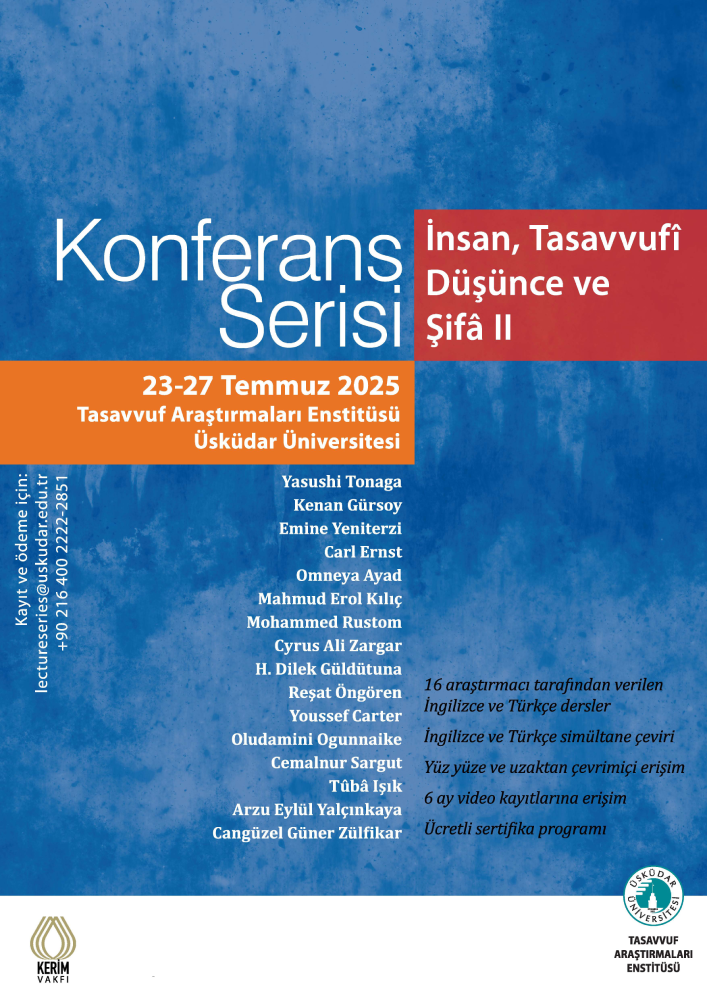
Uskudar University Institute For Sufi Studies , with the support of the Kerim Foundation, will hold, between July 23-27, 2025, a training program in the format of a lecture series titled “Human Being, Sufi Thought and Healing II" . The program will be held in person at the Nermin Tarhan Conference Hall of Uskudar University. The languages of the program are English and Turkish.
Application deadline: Tuesday, July 22, 2025
This is a fee-based training program organized by the Uskudar University Institute For Sufi Studies.
Participants will be awarded a Program Certificate by Uskudar University.
In the program, 16 researchers will deliver a total of 16 lectures , 11 of them in person.
The lectures can also be followed online .
Participants will have the opportunity to meet these researchers in person and to ask questions in person or online.
All lectures will be provided with Turkish and English simultaneous interpretation .
After the program, video recordings of the lectures will remain available for 6 months to participants.
All interested parties may apply to the program via lectureseries@uskudar.edu.tr .
Contact phone numbers: 0090 216 400 2222 - 2851
For program details, CLICK HERE
Program Application
Applications will open on June 13, 2025 .
Students enrolled in or graduated from Uskudar University graduate programs can complete their registration simply by paying the program fee using the “online payment” option on the Institute For Sufi Studies website.
Except for students enrolled in or graduated from the graduate programs of the Uskudar University Institute For Sufi Studies, those wishing to register for the program must fill out the application form and send their CV, a copy of their ID/passport and, for EFT payments, the receipt showing that they have paid the program fee to lectureseries@uskudar.edu.tr .
1. For the application form, CLICK HERE
2. A photocopy of the Turkish ID card and/or, for non-Turkish citizens, the first page of the passport
3. Program fee payment receipt
For all your questions and comments, you can reach the Institute For Sufi Studies via lectureseries@uskudar.edu.tr and/or by phone at 0216 400 2222/2851 .
Program Fee
A. Applications from Türkiye
Program fee:
For Uskudar University students and alumni, 10 200, 00 TL (VAT included).
For other participants, 16 500, 00 TL (VAT included).
All participants can pay in 4 or 6 installments with Yapı Kredi, Garanti, all World and all Bonus credit cards.
B. Applications from Abroad
Program fee: 600 $
For participants who have previously received a certificate from at least one of the International Summer School Programs of the U.U. Institute For Sufi Studies, the fee is $500.
Online payment page: https://tasavvuf.uskudar.edu.tr/online-odeme
Speakers:
Yasushi Tonaga: Professor Tonaga is a professor at the Graduate School of Asian and African Area Studies, Kyoto University. He is also the director of the Kenan Rifai Center for Sufi Studies and the Center for Islamic Area Studies at Kyoto University. He graduated from the University of Tokyo and completed his doctorate at Kyoto University. His main research focus is Ibn Arabi and the Akbarian school. He is also the president of the Japan Association for Middle East Studies.
Kenan Gürsoy: Prof. Dr. Kenan Gürsoy completed his higher education at the University of Rennes and Paris-Sorbonne (Paris IV) University in France. He began his career as a research assistant in the Department of Philosophy, Faculty of Letters, Atatürk University. He received the titles of Doctor of Philosophy in 1979, Assistant Professor in 1982 and Associate Professor in Systematic Philosophy and Logic in 1983. In the meantime, he was assigned to conduct research for another year in the Department of Philosophy at Paris-Ouest-Nanterre-la-Défense (Paris X) in France (1981-1982). From November 1984, he served as an Associate Professor in the Division of History of Philosophy, Department of Philosophy, Faculty of Languages, History and Geography at Ankara University, where he became a Professor in January 1989. From 1997 to 2009, he worked at Galatasaray University, first at the Faculty of Communication and then as a faculty member in the Department of Philosophy, Faculty of Arts and Sciences, and served as Dean of the Faculty of Arts and Sciences at Galatasaray University between 2000 and 2009. Prof. Dr. Kenan Gürsoy, who was the Ambassador of the Republic of Türkiye to the Holy See between 2009 and 2014, continued to serve at the Ministry of Foreign Affairs for some time after returning home in 2014, and retired from public service as an Ambassador in 2015. From 2015 to June 2017, he served as a faculty member at Istanbul Aydın University and Director of the Center for Western (Occidental) Studies. Since 2013, Prof. Dr. Kenan Gürsoy has been serving as Chairman of the Board of Trustees of the Cenan Foundation. His work focuses mainly on Moral Philosophy, Comparative Religious Ethics, Phenomenology, Existential Philosophy and Sufism.
Emine Yeniterzi: Professor Yeniterzi graduated from the Department of Turkish Language and Literature, Faculty of Letters, Selçuk University in 1981. In the field of Classical Turkish Literature, she completed her master's degree (1983) with her thesis titled “The Names and Attributes of the Prophet in Divan Poetry - Esmâ-i Nebî” and her doctorate (1989) with her thesis on “Na'at in Divan Poetry.” She continued her academic career at Selçuk University between 1981 and 2011 and at Istanbul Medeniyet University between 2011 and 2015. She currently works at the Uskudar University Institute For Sufi Studies. Her main fields of study are classical Turkish poetry, textual commentary, religious-moral-Sufi masnavis, religious genres in verse, and Mawlana Jalal al-Din Rumi. She has nine books, articles published in scientific journals, and papers presented at national and international scientific meetings.
Carl W. Ernst: Professor Ernst became known for his studies in comparative religion at Stanford University in 1973. Having received his doctorate from Harvard University in 1981, Ernst taught at Pomona College between 1981 and 1992. Focusing on West and South Asia, Ernst's published works, based on research in Arabic, Persian and Urdu, fall mainly into three areas: general and critical issues in Islamic studies, premodern and contemporary Sufism, and Indo-Muslim culture. In 2005, Ernst was awarded the “DOST Award for Service to Islam” for his book Following Muhammad: Rethinking Islam in the Contemporary World, which has been translated into Turkish. In 2009, he established the Ken'an Rifai Chair of Islamic Studies on behalf of the Department of Religious Studies at the University of North Carolina at Chapel Hill, in partnership with TÜRKKAD. His work on Sufism has focused on the literary, historical and contemporary aspects of Islamic Sufism, particularly in the context of the Indian subcontinent and Iranian culture. He is co-director of the UNC Center for Middle East and Islamic Studies and associate editor of the Islamic Civilization and Muslim Networks Series of the University of North Carolina Press.
Omneya Ayad: Asst. Prof. Dr. Ayad, immediately after completing her undergraduate studies in Journalism and Mass Communication at the American University in Cairo, studied at the Academy of Sufi Arabic and Islamic Studies at Al-Azhar University. After completing her master's degree at the American University in Cairo, she began her doctorate at the Institute of Arab and Islamic Studies at the University of Exeter in the UK. She received her doctoral degree with her thesis titled “Ibn Ajība (d. 1224/1809) and the Vast Expertise of the Qur'an: Love in the Moroccan Sufi Tradition.” During her master's studies, she worked as a research assistant in Islamic History at the American University in Cairo. She also served as a research assistant at the Institute of Arab and Islamic Studies at the University of Exeter for the last two years and taught Arabic courses to undergraduate students.
Mahmud Erol Kılıç: Mahmud Erol Kılıç was born in Istanbul in 1961. After graduating from the Faculty of Political Sciences at Istanbul University (1985), he completed a master's degree in Islamic Philosophy at Marmara University (1989) and then defended his doctoral dissertation on the thought of Ibn Arabi (1995). He served as head of the Museum of Turkish and Islamic Arts in Istanbul (2005-2008) and was then appointed Secretary General of the Parliamentary Union of the OIC Member States (PUIC, Tehran) between 2008 and 2018. Following this, he was appointed Ambassador of the Republic of Türkiye to the Republic of Indonesia (2019-2021). He currently serves as Director General of the Research Centre for Islamic History, Art and Culture (IRCICA), a cultural subsidiary organ of the Organisation of Islamic Cooperation (OIC). Ambassador Kılıç is married and has two children and one grandchild.
Mohammed Rustom: Mohammed Rustom is Professor of Islamic Thought and Global Philosophy at Carleton University and Director of the Carleton Centre for the Study of Islam. An internationally recognized scholar whose work has been translated into more than ten languages, Professor Rustom focuses his research on Islamic philosophy, Sufism, Qur'anic exegesis and cross-cultural philosophy. He is the author, translator and editor of a total of thirteen books, including the recently published Inrushes of the Heart: The Sufi Philosophy of 'Ayn al-Qudat and A Sourcebook in Global Philosophy . Professor Rustom is also the editor of Equinox Publishing's “Global Philosophy” series and a member of the Editorial Board of the Library of Arabic Literature.
Cyrus Zargar: He serves as the Al-Ghazali Distinguished Professor of Islamic Studies in the Department of Philosophy at the University of Central Florida. Zargar's research focuses on the metaphysical, aesthetic and ethical intersections between Sufism and Islamic philosophy. His most recently published books include Religion of Love: Sufism and Self-Transformation in the Poetic Imagination of ʿAttar (2024); The Ethics of Karbala: Myths, Modernity, and the Virtues of Nobility (2024); and The Polished Mirror: Storytelling and the Pursuit of Virtue in Islamic Philosophy and Sufism (2017). Zargar currently serves as associate editor of the journals Journal of Sufi Studies and Islamic Intellectual Traditions , published by Brill. He also serves as Director of Research at the Institute for Advanced Islamic Studies in New York.
H. Dilek Güldütuna: Asst. Prof. Dr. Güldütuna graduated from the Cerrahpaşa Faculty of Medicine at Istanbul University. She completed her specialization in Anesthesiology at Koşuyolu Heart and Research Hospital. She completed three years of Arabic education at Prof. Fuat Sezgin's Institute for the History of Arabic-Islamic Science in Frankfurt. Between 2005 and 2011, at Johann Wolfgang Goethe University Frankfurt, she completed her doctorate in Islamic Studies with her thesis titled “Konstruktionen des weiblichen bei Ken'ân Rifâî: Das weibliche als Spiegel der göttlichen Wirklichkeit” (Woman as the Mirror of the Divine in Ken'an Rifai), and her master's degree in the Department of Islamic and Religious Studies at the same university with her thesis titled “Buchstabensymbolik bei Ibn Arabî” (Letter Symbolism in Ibn Arabi). She currently teaches courses on Sufism at Johann Wolfgang Goethe University Frankfurt. Her main areas of interest include symbolism, letter symbolism in Ibn Arabi, the role of women in Islamic Sufism and femininity and masculinity as symbols, and the role of Islamic culture in the history of thought and science and its influence on the West.
Reşat Öngören: Professor Öngören graduated from the Faculty of Theology at Marmara University in 1988. He completed his master's degree in 1990 and his doctorate in 1996 in the Division of History of Sufism at the Institute of Social Sciences of the same university. Between 1996 and 2000, he worked as a Sufism researcher at the Center for Islamic Studies (İSAM) of the Turkish Religious Foundation. In January 2001, he was appointed Assistant Professor at the Faculty of Theology at Istanbul University. He became an Associate Professor in November 2001 and a Professor in November 2007. In the 2004-2005 and 2005-2006 academic years, he served as a visiting faculty member at the Higher Islamic Institute in Sofia. Reşat Öngören, who has published many articles, papers, encyclopedia entries and book chapters in his field, is the author of the books Osmanlılar'da Tasavvuf: Anadolu'da Sûfîler Devlet ve Ulemâ (Istanbul 2000, 2003, 2012, 2016) and Tarihte Bir Aydın Tarîkatı Zeynîler ([İstanbul 2003], Âlimlerin Gözdesi Bir Tarikat: Zeyniyye, Istanbul 2012). He has also prepared entries for the 44+2 volume Encyclopedia of Islam (DİA) published by İSAM and for the Arabic encyclopedia Mevsûatu a‘lâmi’l-ulemâi ve’l-udebâi’l-Arabi ve’l-müslimîn published in Tunisia. He continues to serve as a faculty member at the Uskudar University Institute For Sufi Studies, to which he was appointed on June 17, 2019.
Yousef Carter: He is an assistant professor of Religious Studies and the Kenan Rifai Fellow in Islamic Studies at the University of North Carolina at Chapel Hill. He is a member of the advisory board of the “Black American Muslim Internationalism Project,” which is also supported by the Center for Global Islamic Studies at George Mason University. He also serves as academic advisor to the Muslim Students Association and the newly founded Black Muslim Collective at UNC. Carter's academic work concentrates on Muslim life and networks in the Black Atlantic, with a particular focus on religious empowerment. In addition to his other projects, he is currently working on a book project titled Vast Oceans: Remembering God and the Self in the Mustafawiyya Tariqa . This work is a multi-sited ethnography of a transatlantic Sufi network of African American and West African Muslims in South Carolina and Senegal.
Oludaminni Ogunnaike: He serves as an associate professor of African Religious Thought at the University of Virginia. He specializes in the intellectual and artistic dimensions of West and North African Sufism and Yoruba Orisha traditions. He completed his doctorate in the Department of African and African American Studies at Harvard University and received his bachelor's degree, also from the same university, in Cognitive Neuroscience and African Studies. His published works include: Deep Knowledge: Ways of Knowing in Sufism and Ifa, Two West African Intellectual Traditions (This book won the Best First Book Prize awarded by ASWAD (Association for the Study of the Worldwide African Diaspora)) (2020); Poem of the Prophetic Perfection: West African Panegyrics and Examples (2020), The Book of Clouds (2024). Ogunnaike is currently working on a podcast and book project on Sufi poetry and poetics, as well as a book on Yoruba mythology.
Cemalnur Sargut: After completing her university education in chemical engineering, she worked as a chemistry teacher. She currently serves as President of the Istanbul Branch of the Turkish Women's Cultural Association (TÜRKKAD). For more than thirty years, she has carried out multifaceted work in the field of Sufism in Türkiye and abroad. Under the umbrella of TÜRKKAD, she has pioneered many international symposia, the Dost Awards for Service to Islam, and initiatives in Islamic studies. She enabled the establishment of the “Kenan Rifai Distinguished Professorship on Islamic Studies” chairs at the Department of Religious Studies of the University of North Carolina (2009) and at the Institute for Advanced Humanities of Peking University (2011), as well as the Kenan Rifai Center for Sufi Studies at Kyoto University in 2015. Cemalnur Sargut founded the Kerim Education, Culture and Health Foundation in 2013 to support studies in the field of Sufism and to expand the ground for the study of Sufism at universities. With this initiative, she joined forces with Uskudar University Founding Rector Prof. Dr. Nevzat Tarhan to establish the Uskudar University Institute For Sufi Studies in 2014. Her nearly 30 published works focus on studies based on the interpretations of the great Sufis on the Holy Qur'an and on commentaries on Fusus al-Hikam. For more than 20 years, she has been holding public talks on the Masnavi and Fusus al-Hikam in Istanbul. She regularly gives seminars on Islamic Sufism in countries such as Germany, the United States and India. She currently serves as Advisor to the Rector of Uskudar University and teaches courses at Uskudar University.
Tuba Işık: She serves as a professor of Islamic Religious Education and Practical Theology at the Berlin Institute for Islamic Theology at Humboldt University. Her research interests include religious education and pedagogy, virtue ethics, Muslim women and comparative theology. Işık holds a master's degree in international public law and pedagogy from Georg-August University of Göttingen and a doctorate from Paderborn University, and studied Catholic Theology in Paderborn and Rome. In addition, she pursued advanced studies in Islamic Education at Osnabrück University and at the Faculties of Theology in Bursa and Ankara. Işık is co-editor of the first textbook on the didactics of Islamic Religious Education written in German (2022). Her monograph on character building was published in 2022. In the recently published work Islamic-Aesthetic Education edited by Işık, various authors address different dimensions of learning through aesthetic experience.
Arzu Eylül Yalçınkaya: Arzu Eylül Yalçınkaya is a faculty member at the Uskudar University Institute For Sufi Studies. Her research examines the intersections of Sufism with modernity and secularism and focuses on Sufi movements of the late Ottoman period. Having written her master's thesis on the Maturidi discourses of Ken'ân Rifâî (d. 1950), Yalçınkaya then took graduate courses in religious studies at Harvard Extension School for three years. Her doctoral dissertation, which examines the life, works and Sufi thought of Ken'ân Rifâî, was published as a monograph (2020). She is currently a visiting researcher at the Center for Middle Eastern Studies at Harvard University, conducting postdoctoral research on “The Bridging Role of Sufi Intellectuals Between the Late Ottoman Empire and Early Republican Türkiye.” Her recent work on 19th-century Sufi acoustic spaces has led to events on Sufi music and poetry at Harvard Divinity School, the Department of Near Eastern Languages and Civilizations and other relevant venues. Her forthcoming article titled “In Pursuit of Truth: The Perception of Happiness in Jalal al-Din Rumi's Masnavi-i Ma'navi” and her book on the monograph of Ahmad al-Rifa'i (d. 1182) are in the publication process.
Cangüzel Güner Zülfikar: Asst. Prof. Dr. Zülfikar graduated from the Department of General Turkish History at the Faculty of Languages, History and Geography (DTCF), Ankara University. She completed her doctoral dissertation titled “The Founding and First Century of the Aziz Mahmud Hüdayi Complex” in the Department of History at Hacettepe University. She has taught courses on Sufism and Islamic Civilization at the University of North Carolina at Chapel Hill and Duke University. She worked as associate director at the Center for the Study of the Middle East and Muslim Civilizations at UNC-Chapel Hill (2006-2010). She founded the Turkish Studies Program at UNC-Chapel Hill (2009) and continued to teach in the program until December 2013. She currently teaches courses at the Uskudar University Institute For Sufi Studies.