

Innovative, Research Oriented and Scientific Thinking
Department of New Media and Communication
About
Department of New Media and Communication, which is based on a new media-oriented academic and scientific education-teaching approach, continues its activities with a mission and vision in line with the requirements of the digital age. With its comprehensive curriculum created through the new media phenomenon, which is the modern expansion of the field of communication sciences and media, our department not only responds to the conditions of the present but also turns its face to the future.
Offering its academic perspective, theoretical knowledge and practical approaches to the students as a whole, the Department of New Media and Communication aims to bring academics and researchers into the academic field of communication sciences, while at the same time, it is in an effort to train media professionals who are suitable for private sector. Considering the point where today's mass communication stands along with rapid digitalization all around the world, the Department of New Media and Communication can be considered as the intersection of all areas of communication. Accordingly, in the Department of New Media and Communication, we train qualified professionals and educate future researchers from all fields of communication, from communication sciences to mass media, from social media expertise to digital broadcasting, from journalism to television, and to the media industry.
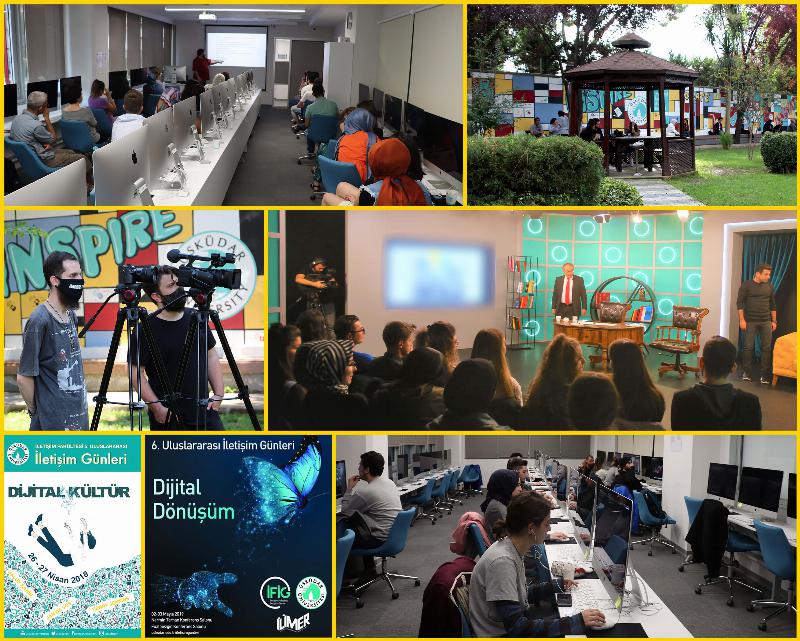
Courses
Undergraduate diploma program in the Department of New Media and Communication is four years. In the first year of the program, students are offered core courses for them to gain basic social sciences knowledge. In the second year, courses on communication sciences are mainly offered. In the third year, both elective and compulsory courses are given as well as applied courses for communication and media specialization becomes rather intensive. In the fourth year, while advanced courses in the field of media and new media sector are given on one side, it is also ensured through the internship and graduation projects that the student reinforces their knowledge and experiences which were gained during their period of education. The courses given in the fourth year also aim to provide a basis for the students to make career planning after graduation. Namely, students who seek to work at main stream media or new media related companies mostly focus on their internship practices in the last year of the program by carrying out their graduation projects where they can experience professional practices. On the other hand, those who wish to seek an academic career in communication sciences are encouraged to complete their graduation projects (thesis) on a more scientific basis.
New Media and Communication Occupations
With their strong educational background on traditional media, new media, social media etc., students can find employment opportunities in related fields after graduation. They can work in various units in various fields of the media such as radio and television journalism / programming, journalism, social media expertise, corporate communication expertise etc. On the other hand, graduates can also make an academic career. Graduates who continue postgraduate education after four years of undergraduate education can find employment opportunities as academicians in various specialties in the field of communication. Students who benefit from the department's international exchange programs and Erasmus opportunities can find their postgraduate studies abroad as well.


