

Under the title of “Crisis Communication in the Digital Age” Üsküdar Üniversitesi Faculty of Communication organized for the 8th time this year, the International Communication Days hosts important names in its field. Prof. Dr. Paul A. Argenti, who participated as a speaker from Dartmouth University in the USA, stated in his speech titled “Crisis Communication in the Pandemic and Digital Age” that during crises, the focus should initially be on opportunities, and then the danger should be averted. Argenti stated that the Covid-19 crisis has not yet ended, and the crisis is still ongoing in Turkey, adding, “But it will eventually end. When this crisis ends, the next crisis should be considered, because this will help with the next crisis.”
Content
Prof. Dr. Paul A. Argenti: “In times of crisis, opportunities should be focused on and danger should be averted”
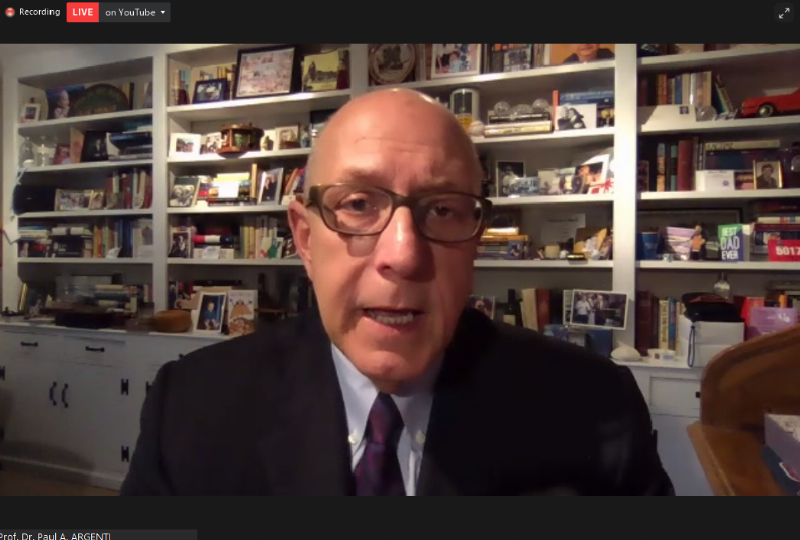
Prof. Dr. Paul A. Argenti, who participated in the International Communication Days organized for the 8th time this year by Üsküdar University Faculty of Communication, from Dartmouth University, one of the prestigious universities in America, gave a speech titled “Crisis Communication in the Pandemic and Digital Age.” Prof. Dr. Paul A. Argenti highlighted important points to be implemented before and during a crisis, also referring to an example from Turkey that he deemed successful.
First, focus on opportunities during a crisis
Prof. Dr. Paul A. Argenti stated that 50% of the population in the United States is currently vaccinated, adding, “Therefore, I can say that the vaccination effort is not going badly. As a result, the concept of social distancing in the United States is gradually becoming a thing of the past. As someone who has done many academic studies on crisis and worked with many companies, I talk about the dangers and opportunities in a crisis and always start by explaining crisis with this sentence; The President of the United States states that in Chinese, crisis is written with two characters, one meaning danger and the other meaning opportunity. Therefore, the most important thing you can do during a crisis is to initially focus on opportunities.”
Averting danger is very important
Prof. Dr. Argenti pointed out that a significant majority of crises, including pandemics, are preventable, stating, “Because we all actually knew this crisis would happen. At one of the institutions I worked for, a hospital had no internet access for 30 days. This happened to a hospital in the United States. So, how do we take advantage of opportunities in a crisis? First, we need to establish adaptable institutions and organizational structures. Many of my colleagues at Harvard Kennedy School say it is very important to first recognize dangers and then set priorities to avert these dangers. Averting danger is a very important concept.”
Hospitals couldn't cope with the crisis
Prof. Dr. Paul A. Argenti emphasized that the capacity to prevent dangers and threats and to react in the face of a bad situation must be questioned, stating, “Unfortunately, a significant majority of institutions fall short in crisis management. We saw this very clearly during the pandemic. Many hospitals could not cope with the crisis; in Seattle, for example, some hospitals were very well-prepared, but we also saw that many hospitals lacked personal protective equipment. Therefore, it is very important to first prevent the danger, the problem, or if we cannot prevent it, to be prepared for how we will react when we encounter it.”
The Covid crisis is still ongoing
Prof. Dr. Paul A. Argenti stated that in situations where dangers are overcome and crises are managed, it is necessary to evaluate what has been learned and what organizational learning means, saying, “The Covid crisis is still a crisis we are experiencing. We may have started to see the light at the end of the tunnel, but we need to consider these issues; What have we learned from the Covid crisis? Can we become better managers with what we have learned? Can we make our institutions more adaptable in a potential crisis? We will constantly face threats and try to prevent them. If we can prevent them, we need to look at what we understand and what we learn from it. The same applies when we cannot prevent a crisis. We need to evaluate how we managed the crisis we could not prevent and what we learned organizationally from crisis management so that we can be better prepared for the next crisis.”
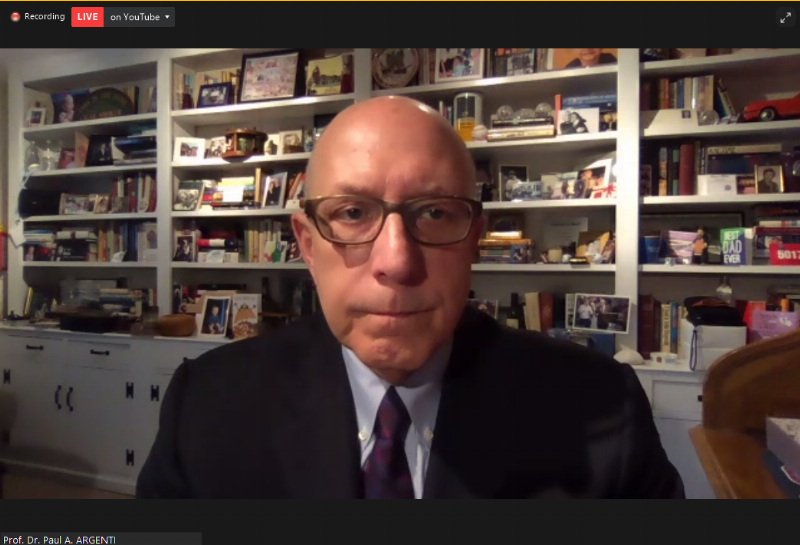
Small regional crises can become global
Prof. Dr. Paul A. Argenti continued his words by saying, ‘The first thing we need to understand is what reputational risks we face in crisis management so that we can develop a corresponding communication strategy’: “We must question what to do and what not to do in a crisis, and whether there is a communication strategy while doing so. Strong global brands will likely become targets for non-governmental organizations, but if we can cooperate with NGOs on important issues, we will be one step ahead in crises. Let us not forget that small regional crises can become global crises. We will need to focus not only on crises within our own sector and country but also on more global crises. Furthermore, it is not just a matter of communication; if trust is to be re-established, action must be taken. Re-establishing trust is very important, and frankly, it can be done through actions, not just words. Because words spoken without action will have no meaning, and to be prepared for crises in advance, we need a strong communication strategy. When the storm hits, you will need experts who can implement the right communication strategy to get through it.”
Corporate risk must be measured when preparing for a crisis
Prof. Dr. Paul A. Argenti stated that if a strategic plan can be implemented, then it cannot be called a crisis, adding, “If the reputation is not comprehensively affected, it is most likely not a crisis. It should be questioned whether employees are also affected by this process. If very important employees are affected by this process, then there is a crisis situation. Also, one needs to look at the scale of the crisis. If one or more questions are answered yes, there is a crisis situation, but if not, the event is being exaggerated, meaning it is just drama. When preparing for a crisis, corporate risk should be measured first. What is the risk the institution faces? By measuring this, we will then see what we should and should not do. The communication playbook for a potential crisis should be defined. It is necessary to determine which channel messages will be conveyed through, for different teams to respond to different crises, to address the crisis in a more centralized manner, and to create a draft plan. This will be like muscle memory. We have created a plan, which does not mean we will blindly adhere to it, but just as marathon runners have a strategy, a framework, a similar plan needs to be created for a crisis.”
Band-aid solutions should not be produced
Prof. Dr. Argenti underlined that during a crisis, companies must first be able to manage their media relations and have a strategy when presenting this situation to their employees, stating, “A number of tactics and strategies need to be developed to strengthen the brand. The goals in crisis communication will be the same. Re-establishing trust on a global scale is very important, and we will need to strengthen reputational capital by making the necessary changes. If opportunities rather than dangers are seen in a crisis, it will be necessary to immediately think about how to profit from this crisis. Unfortunately, very few brands can do this, and when solving a problem, its long-term effect needs to be considered. A band-aid solution should actually not be produced. Producing short-term solutions will be of no benefit.”
In crisis communication, the problem must first be defined
Prof. Dr. Paul A. Argenti stated that for communication to be established during a crisis, the problem must first be defined, adding, “One must look at what the problem is and which problem is trying to be solved. Unfortunately, companies often fail to understand the problem. When the wrong problem is solved, it is called a ‘Type 2 error’ in statistics. Einstein states that ‘the most important thing in anything is defining the problem.’ He says, ‘If I had an hour, I would spend 5 minutes solving the problem and 55 minutes defining the problem, because only after defining the problem can I gather the necessary information.’ During a crisis, centralizing communication and, along with it, being one step ahead of the media and media organizations is very important. Being able to think from their perspective and communicate directly with affected units is very important. Things should not stop.”
Turkish Airlines is a very successful example
Prof. Dr. Paul A. Argenti continued his words by stating that centralizing communication teams is very important in the first stage: “During a crisis, teams of 30-40 people are formed to steer the crisis. During a crisis, during a pandemic, employees are very important. Unfortunately, many companies viewed employees as a liability rather than an asset and fired their employees. This was their biggest mistake. Maintaining constant communication with customers and reassuring shareholders is very important. Saying, ‘We are managing the crisis this way, everything will be fine, don’t worry’ and acting proactively is very important. One of the first success stories belongs to Turkish Airlines. At the beginning of the pandemic, Turkish Airlines immediately contacted its main stakeholders. This was what needed to be done with employees and customers, and the THY CEO remained in constant communication. They tried to show that no one would be forgotten during this crisis, and videos were uploaded to YouTube, which is accessible to more people. The form of communication is truly a great success story. They explained very clearly how the plane and passengers would be kept safe.”
Messages from the institution must be consistent
Prof. Dr. Argenti stated that considering the opportunity that comes with a crisis might seem counterintuitive, saying, “It’s possible to think, ‘I’m in the middle of a crisis right now, should I look for an opportunity?’ Yes, because how a crisis is responded to is also a second crisis. If the response to the crisis is botched, it means there is a second crisis to deal with. There is no problem with decentralized management, but what is important here is to maintain strategically consistent communication during a crisis. It is necessary to speak in harmony. It is extremely important that messages coming from the same institution are consistent with each other. My third message is that identifying foreseeable surprises can help prevent crises and present opportunities. In other words, one needs to know how to detect emerging threats. At this point, potential situations that may be encountered and the opportunities that arise with this crisis should be considered.”
Be prepared for new crises
Prof. Dr. Paul A. Argenti stated that institutions should also think strategically about marketing and communication, especially during a crisis, saying, “This is strategic thinking in marketing and communication. Lessons should be learned from this crisis, and communication plans for the next crisis should start to be created. We have not yet reached the end of the Covid-19 crisis. The crisis is still ongoing in Turkey, but it will eventually end. When this crisis ends, the next crisis should be considered because this will help with the next crisis.”
Symposium to continue for two more days
You can follow all other sessions of the symposium, which will be held on Thursday, May 27, and Friday, May 28, at the following address, and watch the broadcasts by clicking the Zoom links at the top of the programs: https://ifig.uskudar.edu.tr/uploads/content/files/ifig-2021-program-kitapcigi-v4.pdf
Share
Update Date: February 27, 2026
Creation Date: May 27, 2021
Request a Call
Other News
- The book that read today's digital threats in 2014: Being a Conscious Family
- Experts warn: 'Instead of memorizing letters, teach pencil grip, scissor use, and coloring'
- School fear and school love both start in the family!
- Family is not merely transforming, it is being battered under a serious assault
- Artificial intelligence opens the door to early diagnosis in autism!