

Üsküdar Üniversitesi Faculty of Communication addressed crisis management methods during the pandemic at the 8th International Communication Days, held this year under the theme of “Crisis Communication in the Digital Age.”
Content
Prof. Dr. Nevzat Tarhan: “Those with Prior Preparation Overcome Crises More Easily”
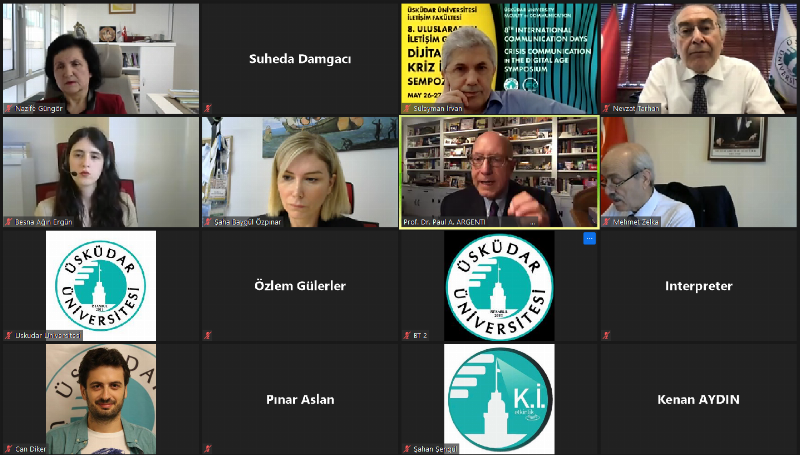
Üsküdar University Founding Rector, Psychiatrist Prof. Dr. Nevzat Tarhan, stated that crisis management usually develops based on the individual's position towards the crisis and how they react, adding, “Life is like a chain. If you ask where the strongest part of a crisis is, it is its weakest link. In crises, breaks occur at those links. However, those with prior preparation overcome the crisis more healthily; those who react quickly and take the right position overcome the crisis more easily.”
At the symposium, which also featured academics from various universities around the world, Prof. Dr. Paul A. Argenti from Dartmouth University in the USA gave a speech titled “Pandemic and Crisis Communication in the Digital Age.”
The main theme of the 8th International Communication Days, organized annually by Üsküdar University Faculty of Communication with a different theme, was determined as Crisis Communication in the Digital Age. The symposium, held online due to the pandemic, featured nationally and internationally renowned invited speakers.
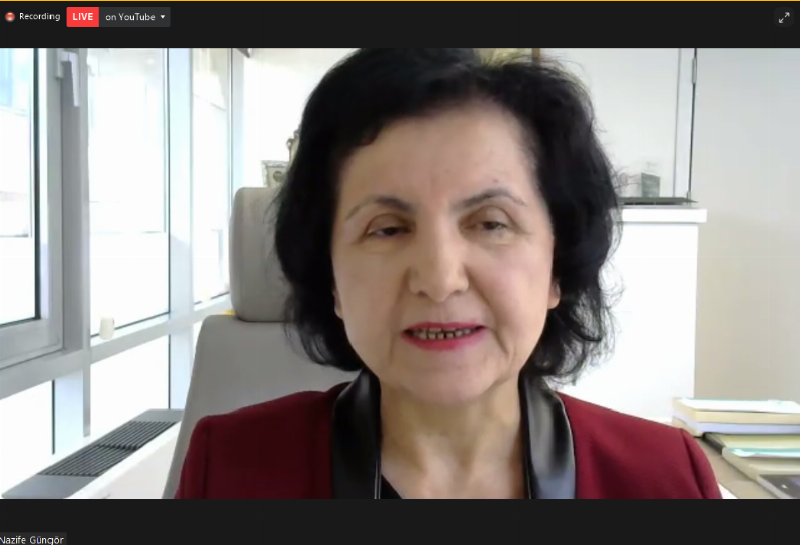
Prof. Dr. Nazife Güngör: “Communicators have a great responsibility during the pandemic”
The Chair of the Symposium, Dean of Üsküdar University Faculty of Communication Prof. Dr. Nazife Güngör, stated in her opening speech that the pandemic, which has affected the whole world for approximately 1.5 years, not only spread the fear of illness but also impacted many areas of life along with the fear of illness and death, causing life to evolve in a different direction.
Prof. Dr. Nazife Güngör noted that the pandemic suddenly entered the agenda of the economy and social life and began to heavily influence cultural life, stating, “People suddenly isolated themselves in their homes and experienced a process of poverty, unemployment, fear of epidemic, fear of death, and social isolation from each other. This social dimension of the crisis effectively brought psychological and, especially from our field's perspective, communicative dimensions to the forefront. The need for crisis management emerged in every aspect of life. Therefore, a great responsibility fell upon us communicators, a huge task for the communication community. Because, in such situations, communicators had a major role in keeping society morally calm and alleviating the panic. Therefore, both the media sector needed to effectively address crisis management, and communication academics needed to express their views and conduct research on this matter, because the world turned into a complete laboratory. Therefore, we wanted to discuss the topic in its various dimensions on a broad platform at this symposium.”
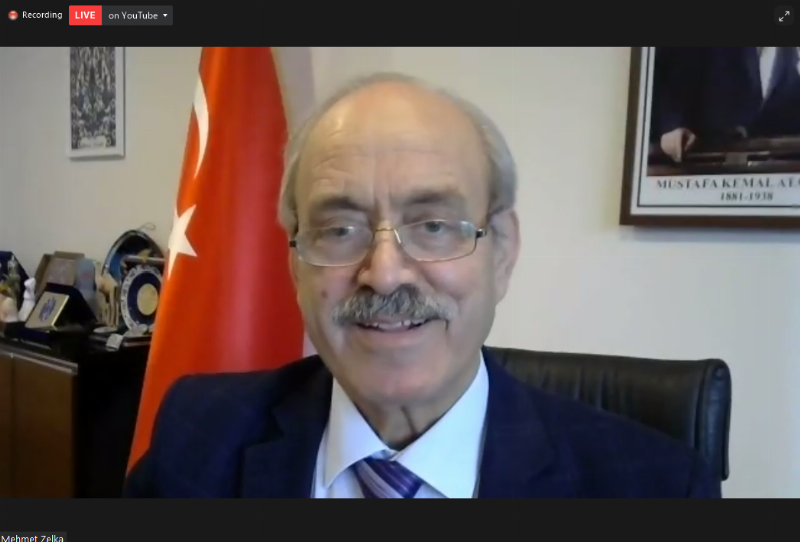
Prof. Dr. Mehmet Zelka: “Communication played an important role in the pandemic”
Üsküdar University Acting Rector Prof. Dr. Mehmet Zelka stated that the pandemic, which has rapidly spread and affected the entire world since early 2020, created a crisis environment by impacting all areas of life, especially economic, social, and educational life. Prof. Dr. Mehmet Zelka said, “Communication played an important role in sharing information regarding the development and resolution of this crisis among individuals in society, as well as at national and international levels. In this regard, I find it meaningful that the main theme of the symposium was determined as crisis communication in the digital age.”
Prof. Dr. Mehmet Zelka: “We invested 500 thousand dollars in education during the pandemic”
Prof. Dr. Mehmet Zelka noted that during the Covid-19 pandemic, the necessity arose for education to be conducted digitally due to the inability to proceed face-to-face, and Üsküdar University developed and successfully implemented a digital system, considering offering education both face-to-face and digitally during this period. Prof. Dr. Mehmet Zelka stated, “Although our technical infrastructure was quite strong, a 500 thousand dollar investment was made in 2020 to prevent any disruption due to heavy load, and our infrastructure was further strengthened. Thanks to this, our university delivered 90% of its education digitally without interruption at the beginning of the crisis. In evaluations conducted among universities on this matter, Üsküdar University was ranked among the top 3% of successful universities as an example of good practice.” Prof. Dr. Mehmet Zelka also stated his belief that the symposium would provide significant added value in areas covering a wide range of themes such as digitalization, crisis communication, health communication, social media, as well as public relations, cinema, television, advertising, and journalism.
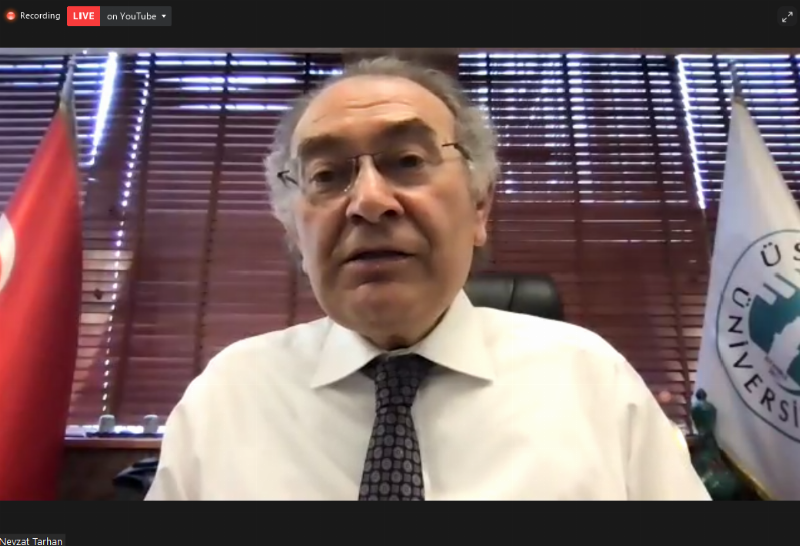
Prof. Dr. Nevzat Tarhan: “We published a digital manifesto during the crisis”
Honorary Chairman of the Symposium, Founding Rector of Üsküdar University Prof. Dr. Nevzat Tarhan, stated in his opening speech that before the pandemic crisis began, Üsküdar University had been prioritizing digital transformation, and continued: “We had a plan to conduct 30-40% of our courses digitally. In the crisis, we reacted quickly and achieved significant results by fully transitioning to digital transformation. We were able to deliver lessons live. While many university infrastructures provided courses by assigning homework, uploading content asynchronously, and then listening to student presentations, we conducted them live. All our instructors actively participated, and we continue to do so. But we did something else. Last year in June, when the first wave eased and the weather was good, we held a vision meeting in the garden, a brainstorming session on crisis and digitalization. Approximately 100 faculty members, including instructors from other administrative units and communication sciences departments, participated in this vision meeting, where everyone shared their ideas on an equal footing. They divided into groups, and the instructors discussed topics. Finally, we compiled it into a declaration, prepared a digital manifesto related to the crisis, and published it.”
Prof. Dr. Nevzat Tarhan: “The strongest point of a crisis is its weakest link”
Tarhan stated that crisis management usually develops based on the individual's position towards the crisis and how they will react, saying, “There is no difference between a crisis and a flood. When a flood comes, some people complain, ‘Why did it come?’; some people give up and go with it; and some people look for a log in the flood and hold onto it to move towards their goals. These crises are similar during difficult times. Life is like a chain. If you ask where the strongest part of a crisis is, it is its weakest link. In crises, breaks occur at those links. If the family structure is dysfunctional, a breakdown occurs in the family within society; if the social structure is dysfunctional and there are cultural conflicts, breakdowns occur there. If the economic situation is bad, a breakdown occurs from there. However, those with prior preparation overcome the crisis more healthily; those who react quickly and take the right position overcome the crisis more easily.”
Prof. Dr. Nevzat Tarhan: “It is necessary to be able to manage risks”
Prof. Dr. Nevzat Tarhan noted that they have determined crisis management principles, stating, “One of the principles of crisis management is risk management. When risks are identified, it is necessary to be able to manage them. If there is no risk management, one can be caught in a storm at any moment during a crisis. For example, a captain needs to perform risk management when leaving port. A management, a leadership, needs to foresee potential future risks and prioritize them accordingly. Because we performed our risk management in this crisis, we saw the direction the world was heading, and within this direction, we saw the importance of digitalization. As top management, we were caught a little more prepared. Since we built our infrastructure by foreseeing risk management, we quickly adapted to the new situation. Üsküdar University performed significantly well in this regard. We are still actively continuing to do so.”
Prof. Dr. Nevzat Tarhan: “25% of society can believe in conspiracy theories, lies”
Prof. Dr. Nevzat Tarhan said, ‘According to our perceptions, statistically, in countries where vaccination is complete, though normalization may not be fully complete, deaths due to Covid-19 have now fallen below 100,’ and continued: “This can be considered a good sign. It is important not to let individuals or society fall into despair on this issue. In Turkey, even if a bit slowly, everyone who wants to be vaccinated will be vaccinated. Currently, there is a segment of society, about 20-25%, who state in the Ministry of Health’s appointment guide that they do not want to be vaccinated. This is not a small number, and unfortunately, it's like this all over the world now. 25% of our society can believe in conspiracy theories, in lies.”
Prof. Dr. Nevzat Tarhan: “Predictability is very important in crises”
Prof. Dr. Nevzat Tarhan, questioning why communication is important, said, “As a psychiatry professional, we have a significant professional sensitivity regarding the predictability of crises for individuals, families, and society in crisis management. Predictability is very important in crises. Because we deal with problems and pathologies, when a crisis comes to us, its precursors have already started long ago. A suicide crisis is coming, a crisis stemming from divorce in the family is coming. A cultural conflict is coming in a society; for example, the person who led the efforts to end IRA terrorism in England is a psychiatrist named John Alderdice, who is now in the House of Lords. He was given the title of Lord for his significant leadership against the IRA terrorist organization and his support in resolving the existing crisis. Psychiatry has consultations and global work in this area.”
Prof. Dr. Nevzat Tarhan: “Humans are not coded to live alone”
Prof. Dr. Nevzat Tarhan stated that humans are relational beings and continued:
“Humans are not genetically coded to live alone. Living alone is contrary to human biological nature. When a human is left isolated, for example, if a child is isolated immediately after birth, a feral child case occurs. There are currently about 50-60 feral child cases in the literature. For example, there is the case of Oxana Malaya from Ukraine. This child's mother and father were alcoholics, living in a house by the forest. The child disappeared at the age of 3 and lived with dogs. Because the mother and father did not care, the child lived among dogs and was found at the age of 10. When found, she was seen barking like a dog, eating, washing, and putting her head in the water exactly like a dog. Since she likely experienced neglect until the age of 3, she could not learn any human values, including speech. However, skills like sight and hearing were not impaired; she learned these from animals. Later, through special education, they were only able to teach her to walk upright and speak at the age of 20. In other words, a human exists if there is communication; if there is no communication, a human ceases to be human. If they live in the forest, they become a child of the forest, or of whatever creatures they live among.”
Prof. Dr. Nevzat Tarhan: “Humans are born open to learning”
Prof. Dr. Nevzat Tarhan stated, as a fact predicted by neuroscience, that a child learns social skills while living in society: “A child’s brain undergoes significant blooming between the ages of 0-3 and for about 2-3 years during adolescence. Synaptic branching in nerve cells occurs rapidly, like flowers blooming in the brain. It's like everything suddenly turning green in spring for 2-3 weeks, and then the child prunes this in their environment through social interaction. If not pruned, their brain becomes like those of individuals diagnosed with autism. The period of the brain re-firing and forming networks occurs during the 1-2 year adolescent process of rapid growth and hormone activation. During that period, a child is already physically male or female, but may not be spiritually ready for it. That spiritual maturation also happens through social learning. Because an animal cub is born having learned, while a human child is born open to learning. A human child is born prematurely, socially and communicatively prematurely, meaning early. This is why communication is very important.”
Prof. Dr. Nevzat Tarhan: “We give positive psychology lessons”
Tarhan stated that they have implemented a mandatory rectorate course called ‘Positive Psychology, Communication Skills’ in the University’s Faculty of Communication, explaining, “Because when we look at cases presenting as psychiatric conditions, we see that the vast majority are individuals who have not developed problem-solving skills. Many also, significantly, in interpersonal relationships, family communication, and parent-child relationships, use negative communication more than positive communication; communication techniques are formed not by confronting but by moving towards a common goal together. We teach these to our students early on in class as a problem-solving method so that they can resolve issues when they arise with their loved ones. In fact, in our 14-week credited courses, we take learning outcomes at the end of the 14 weeks. In that learning outcome, we ask the student, ‘What did this course add to you?’ Some questions are asked in the form of a survey. In some, we see examples like ‘my relationship with my friend improved,’ ‘I used to use substances, I quit,’ ‘my relationship with my father improved,’ ‘I forgave myself.’ That's why learning communication skills is important.”
Prof. Dr. Nevzat Tarhan: “The human brain communicates nonverbally”
Tarhan emphasized that the human brain communicates nonverbally rather than verbally, stating, “Mirror neurons have been identified in the brain related to this. When a person lifts an arm or a leg, the other person pays attention, and the same region in their own brain becomes active. The person does this with mirror neurons. The relevant brain region works as if it had lifted its own arm, even without actually lifting it. Similarly, there are emotional mirror neurons. People's brains read the anger, resentment, and emotions of the other party in the form of emotional literacy. We call this emotional literacy. 80% of communication is nonverbal communication. After reading, the person performs a quick analysis and responds with an emotional expression. Thus, emotional transfer occurs. In fact, the communication we use more than verbal communication consists of facial expressions and gestures, micro-mimic expressions. Our tone of voice, subliminal emphases, and speaking style all account for eighty percent. Nonverbal communication occurs more than verbal communication.”
Prof. Dr. Nevzat Tarhan: “Patients now prefer remote therapy”
Tarhan stated that the most comprehensive neuropsychiatric hospital in Turkey is within Üsküdar University, saying, “At that hospital, we had been trying to do teletherapy for years, but our doctors were not very keen on it, and our patients directly requested face-to-face sessions. We were trying to provide a limited number of teleneuropsychiatry services within our infrastructure for those who were very far away. We developed software, created ethical norms. Just as we were doing this, the crisis came. As a hospital, our infrastructure was ready for this, so we reacted very quickly. Currently, a significant portion of our patients say, ‘This is more comfortable; let's continue this way instead of coming and waiting there.’ The American Psychiatric Association also published something on this. That consensus includes roadmaps, ethical rules, ethical standards, procedures, and principles. Furthermore, communication is easier because there are no masks.”
Prof. Dr. Nevzat Tarhan: “Emotional transfer occurs in the digital environment”
Prof. Dr. Nevzat Tarhan pointed out that emotional transfer can occur in the digital environment, stating, “A new reality has emerged in the digital world in terms of communication. Digital is no longer just for crisis communication; it has become indispensable in our lives. What does Industry 4.0 say? Among the elements of digital transformation are the Internet of Things and simulations. On the other side, there are autonomous robots and 3D printers. Most importantly, there is big data. The stronger the big data, the stronger one can be. This was announced at Davos 2018. It was said that those with large big data have become the new rulers of the world. Discussions about digital dictatorship arose. Harari even said, ‘We are the last free generation.’ All of this accelerated mandatory digitalization. The characteristic of crises is to accelerate certain situations anyway. This also accelerated it. Not only those with capital, but everyone globally had to digitize.”
Prof. Dr. Nevzat Tarhan: “Students without digitalization in their minds will not be able to graduate”
Tarhan stated that within the adventure of transitioning from the classical School of Press and Broadcast Communication to the Faculty of Communication, they taught digitalization to every student in journalism, saying, “We decided not to graduate any communication student who lacks digitalization. We want to create two clusters among the 8 departments in the Faculty of Communication. The first cluster will be departments where design is emphasized. There are departments like Digital Game, Game and Design, Advertising and Visual Design. The second cluster will be where social media and new media are prominent and taught as fundamentals. For example, when a student chooses journalism, we don't want them to perceive, ‘I chose journalism, but new media isn’t being taught to me.’ We will teach them this too. Our laboratories are quite active right now. We have acquired special programs for design. There are digital game and animation design laboratories, and there's journalism that includes social media. There are departments that include social media and new media. If a student doesn't have digitalization in their mind, they shouldn't come to communication, because they won't be able to practice communication.”
Prof. Dr. Nevzat Tarhan: “A digital generation is coming”
Prof. Dr. Nevzat Tarhan pointed out that young people are more successful in communication than adults, saying, “A digital generation is coming. The digital generation is already born into the world. All students who choose the Faculty of Communication are social young people who know the importance of communication; they are enthusiastic and eager. There are people who choose the Faculty of Communication after the age of 40. You see that they are people with high social intelligence. If a test were conducted at the university, the department with the highest social intelligence would be the Faculty of Communication, and the lowest would be the Faculty of Engineering. The Faculty of Communication in this regard is an open department that adapts quickly and reacts quickly. We also need to give credit to the Faculty of Engineering. They provide us with significant infrastructure support.”
Prof. Dr. Nevzat Tarhan: “There will be three-dimensional meetings”
Tarhan stated that when 5G and 6G emerge in a few years, meetings could be held in three dimensions, saying, “For example, our speakers participating from abroad will appear in three dimensions and be able to walk among us and speak. We are moving towards this. In such a situation, we can say that communicators are the professional fields that adapt most quickly to the new digital transformation.”
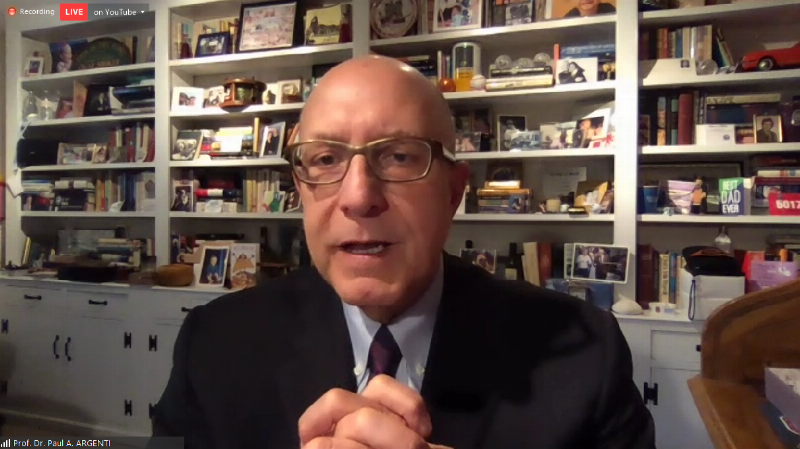
Prof. Dr. Paul A. Argenti explained “Pandemic and Crisis Communication in the Digital Age”
Prof. Dr. Paul A. Argenti from Dartmouth University in the USA delivered a speech titled “Pandemic and Crisis Communication in the Digital Age” at the opening program, where he participated as an invited speaker. Prof. Dr. Paul A. Argenti emphasized the importance of focusing on opportunities in the first stage of a crisis and drew attention to how opportunities should be utilized during a crisis. Prof. Dr. Paul A. Argenti highlighted the importance of recognizing danger, taking precautions against dangers, crisis management, and organizational learning in crises.
Academics from foreign universities will also present
During the three-day symposium, in addition to academics from many universities in Turkey, Prof. Dr. Simon Cottle from Cardiff University will present “Pandemic Reporting in the Media,” Assoc. Prof. Dr. Gregory Simons from Uppsala University will present “Digital Resistance Against the Mandatory Coronavirus Isolation Narrative from a Crisis Communication Perspective,” and Prof. Dr. Dmitry Gavra and Assoc. Prof. Ekaterina Akimovich from Saint-Petersburg State University will present “Business and Saint-Petersburg Government Crisis Communication in the Second Wave of Covid-19.”
6 sessions were held on the first day of the symposium
On the first day of the symposium, six sessions were held titled “Information Seeking and Infodemic During the Pandemic”; “Management, Strategy, and Leadership in Times of Crisis”; “Corporate Reputation and Crisis Communication Strategies”; “Media, Daily Life, and Social Transformation”; “Political Communication and Media”; and “Strategic Media Communication in Times of Crisis.”
The symposium will continue for two more days
You can follow all other sessions of the 30-session symposium, which will be held on Thursday, May 27, and Friday, May 28, and watch the broadcasts by clicking the Zoom links at the top of the programs at this address: https://ifig.uskudar.edu.tr/uploads/content/files/ifig-2021-program-kitapcigi-v4.pdf
Share
Update Date: February 27, 2026
Creation Date: May 27, 2021
Request a Call
Other News
- The book that read today's digital threats in 2014: Being a Conscious Family
- Experts warn: 'Instead of memorizing letters, teach pencil grip, scissor use, and coloring'
- School fear and school love both start in the family!
- Family is not merely transforming, it is being battered under a serious assault
- Artificial intelligence opens the door to early diagnosis in autism!