

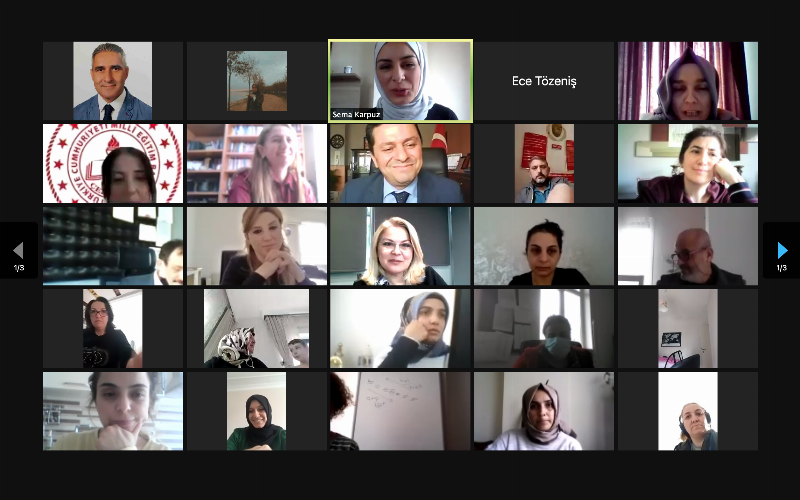
Üsküdar Üniversitesi Faculty of Humanities and Social Sciences Dean Prof. Dr. Deniz Ülke Arıboğan was a guest at the program titled 'Goodness, Evil, Transparency', organized by the Çekmeköy District Directorate of National Education. Addressing the feelings of goodness and evil within humans, Arıboğan stated that goodness and evil are concepts exclusive to human beings.
Content
Prof. Dr. Arıboğan: "Goodness and evil are exclusive to human beings"
"Our perceptions are blurry because we live in a world of information"
Arıboğan, stating that the issues of goodness, evil, and transparency are very subjective; "Regarding what is good and what is evil, whether what we perceive as transparent is truly transparent, and what it leads us to, we live in a world completely covered by a cloud of gas and dust. We have a very blurry environment. Our perceptions are blurry because we live in a world of information. We live within values. These values are specially produced for us and sent to us. For instance, the sum of all information an Englishman living 200 years ago possessed in his lifetime, when looking beyond the fences of his garden, is equivalent to the body of information found today in just a weekend supplement of the New York Times magazine. The amount of information we possess and that is transmitted to us has increased so much that sometimes the knowledge we acquire in a single weekend is equivalent to the knowledge an individual living 200 years ago possessed throughout their entire life."

"Humans must suppress the evil within themselves"
Arıboğan, stating that evil is mostly nourished by a system of bad behavior; "Evil can also exist as a part of human nature. Plato tells a story in his work titled 'The Republic'. This is the story of a shepherd named Gyges, who lived in the kingdom of the Lydian king. Gyges was one of the most beloved, most trusted, and good people in the village. The only thing he knew was to take the sheep, graze them, and bring them back. He knew nothing else. He also got along with the other shepherds in the village. One day, while Gyges was grazing his sheep, an earthquake occurred. During that earthquake, the ground split open, and there was a strange monster inside, and within it, a body. In its hand was a massive ring. Gyges took that ring and put it on his finger. When he wore it, he noticed that by turning the ring downwards while playing with it, he became invisible. He found this very entertaining. Because Gyges was invisible thanks to the ring on his hand, no one could touch him. With the ring, he could make himself visible and invisible as he wished. After a while, he believed he was capable of doing anything. He began stealing people's possessions and killing them. Then he went and killed the Lydian king, had relations with his wife, and became king. Eventually, the people would have lynched him. But when he became invisible, that is, when he eliminated the factors that suppressed his evil, he transformed into a terrifying monster. Socrates tries to explain this. There is evil within humans, and they must suppress it. The reason for suppressing it is the fear of God."
"Goodness and evil are exclusive to human beings"
Arıboğan also touched upon whether evil and goodness are individual or societal; "As individuals, can we be good or evil independently of everything else? If one's mental health is not impaired, it is accepted that human beings are intrinsically good. They do not commit evil spontaneously or plan it, but something happens such that a normal person becomes a mother-in-law and cannot stop themselves from doing evil to their daughter-in-law. Their essence might be good. They might have done good for so many years, but then jealousy enters a person's heart. They feel like doing evil because they are sharing their son. Similarly, a brilliant young girl can do the exact opposite. Spouses can marry out of love but later commit evil against each other. We live in a country with the highest rates of femicide. He says he killed because he loved her. He kills out of love. This is described as a lack of masculinity. Because he saw it that way from his father, it is not perceived as evil. Goodness and evil are exclusive to human beings. It is something only related to us.'"
Share
Update Date: February 27, 2026
Creation Date: April 19, 2021
Request a Call
Other News
- Experts warn: 'Instead of memorizing letters, teach pencil grip, scissor use, and coloring'
- School fear and school love both start in the family!
- Family is not merely transforming, it is being battered under a serious assault
- Artificial intelligence opens the door to early diagnosis in autism!
- Artificial intelligence doesn't end engineering, it transforms it!