

Üsküdar Üniversitesi Faculty of Health Sciences Head of the Department of Speech and Language Therapy Prof. Dr. Ahmet Konrot participated as a speaker in the program organized in cooperation with Kadıköy Guidance and Research Center and the Istanbul Branch of the Turkish Psychological Counseling and Guidance Association.
Content
One in 12 Children Experiences Speech and Language Disorders…
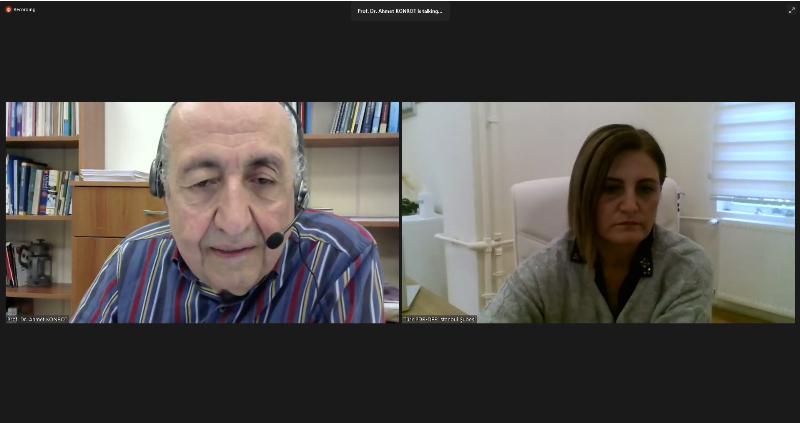
In the program organized for educators and held via Zoom Webinar, Prof. Dr. Konrot made important assessments regarding the topic of “Communication-Language-Speech Disorders in Educational Environments.”
“One in every 12 children is diagnosed with speech and language disorders”
Konrot, defining any disruption in deliberate human interaction, regardless of time, dimension, form, or severity, as a speech and language disorder, stated: “Speech disorders can be linked to prenatal causes, but they can also emerge at any point in our lives. While speech and language disorders can affect people of all ages, we find them in one out of every 12 children. In the context of speech and language, we can attribute these disorders to five reasons: communication, language, speech, swallowing, and voice.”
“The lack of a written system for sign language is a disadvantage”
Continuing his remarks on sign language, Konrot said: “Sign languages are different. Hand and arm movements vary from language to language. The sign language for each spoken language is distinct. A deaf Englishman cannot communicate using the same sign language as a deaf Turk. Everyone uses the sign language of their native language. Furthermore, sign language is not just visual signs used by the deaf. Speech itself is a sign language based on hand, arm, and facial movements. The biggest disadvantage for deaf individuals in sign language is the absence of a written system. Literature or mathematics books cannot be written with sign language. Deaf people cannot communicate without face-to-face interaction. This, unfortunately, is a disadvantage in this regard.”
“Disorders frequently observed in educational environments”
Addressing communication-language-speech disorders frequently observed in educational environments within the context of inclusion, Konrot stated: “There are several communication-language-speech disorders frequently observed in educational environments within the context of inclusion. We can categorize these as articulation disorder, phonological disorder, nasal speech, voice disorder, inability to express thoughts verbally, reading comprehension difficulties, misreading letters/syllables/words, excessively fast-disordered reading, and stuttering.”
Share
Update Date: February 26, 2026
Creation Date: October 23, 2020
Request a Call
Other News
- The book that read today's digital threats in 2014: Being a Conscious Family
- Experts warn: 'Instead of memorizing letters, teach pencil grip, scissor use, and coloring'
- School fear and school love both start in the family!
- Family is not merely transforming, it is being battered under a serious assault
- Artificial intelligence opens the door to early diagnosis in autism!