

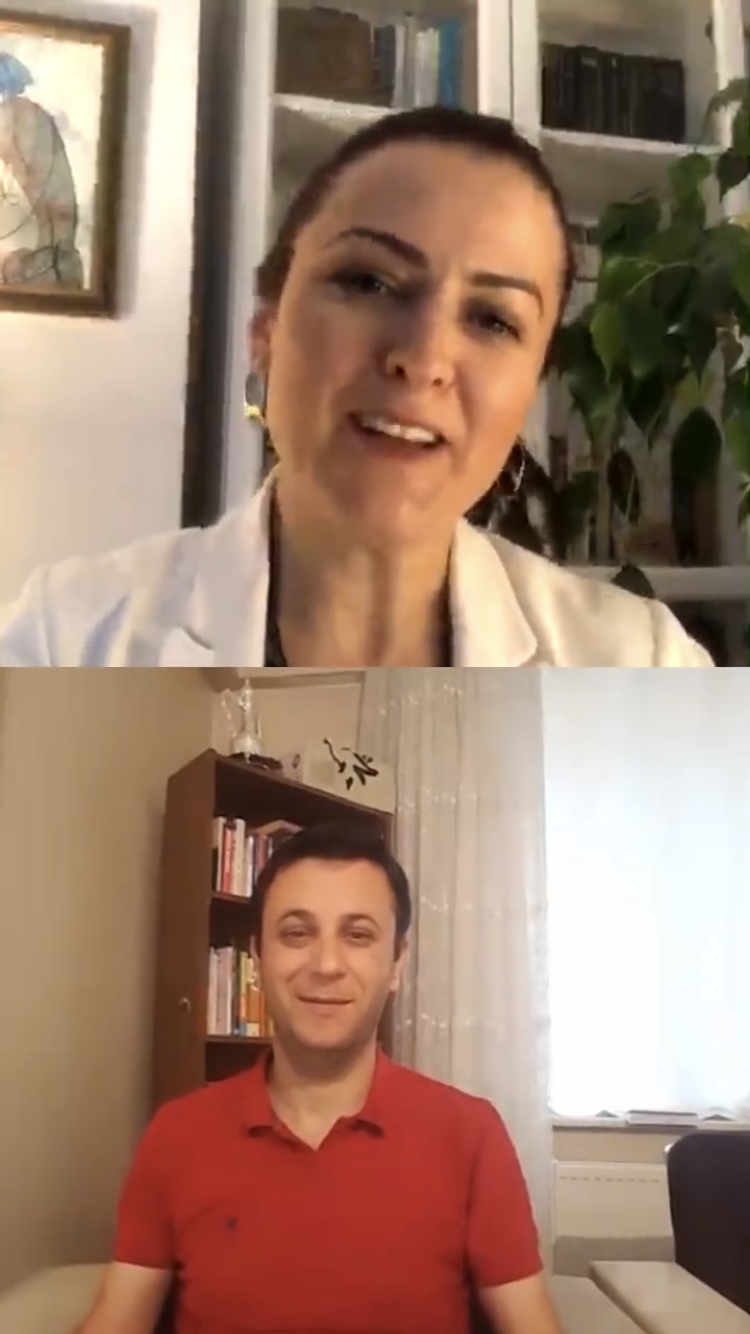
Üsküdar Üniversitesi Faculty of Humanities and Social Sciences Department of Psychology Assoc. Prof. Dr. Tayfun Doğan, Institute for Sufi Studies Lecturer Arzu Eylül Yalçınkaya's 'Power of Hope' program's Instagram live broadcast guest.
Content
Doğan: “Hope; It is Both Emotion, Thought, and Belief”
 “A person can be both hopeful and hopeless”
Stating that hope is one of the fundamental topics in psychology, Assoc. Prof. Dr. Tayfun Doğan said; “In psychology, hopelessness has generally been extensively addressed. They worked on hopelessness for a long time. With the advent of positive psychology, they started to focus more on the topic of hope. Because being hopeful and being hopeless do not seem to be complete opposites. That is, a person can be both hopeful and hopeless. Therefore, it is an interesting topic. It is very promising that it can be learned and developed. It is said that being hopeful can be learned.”
“Hope is the oxygen of the desperate”
Doğan, dwelling on the concept of hope, said; “What we call hope is not passively waiting for things. It involves being active and reaching desired goals. It is important to search for a way to get rid of inner troubles, to find that way, and to believe that this path can lead to an end. Therefore, what we call hope is both a thought and an emotion. It is also a belief. It is the belief that we will get rid of that trouble or achieve what we desire. Hope is a serious source of energy. They even say, 'Hope is the oxygen of the desperate.' It can also be characterized as a personality trait. There is a concept called false hope. If a person's expectations are not realistic, if their own resources are insufficient, and they lack sufficient power regarding what they hope for, having such hope will upset them. There needs to be a somewhat realistic hope. There are also negative thoughts about hope. For example, Nietzsche views the concept of hope negatively. He says, 'Hope merely prolongs suffering.' In fact, hope should also be in moderation. I think it is important for expectations to be realistic."
“Religious belief is also an important source of hope”
Assoc. Prof. Dr. Doğan, speaking about the religious dimension of hope, said; “Hope is a part of human existence. It is unique to us and has a strong cognitive aspect. I don't think animals have the concept of hope. Because it is related to cognition and thought, we can say it is unique to humans. Therefore, it is inherent in human nature. We are hopeful even in the most difficult situations. We actually need to look at the sources of hope. We have scales and we can measure hope. Some people are hopeful, some are hopeless. Religious belief is also an important source of hope. There are many expressions in our culture in this sense, such as 'May the morning bring good, never lose hope in God.' Believing in a supreme creator, relying on Him, and believing that everything is within the knowledge of His control increases a person's hope. When a person faces an insurmountable situation or has a problem, they can know that there is wisdom behind it. This comforts the person. At the same time, it increases their hope.”
“As people's perceptions of social support increase, so does their hope”
Emphasizing the importance of social support for hope, Tayfun Doğan said; “Another source of hope is social support. If people have social support, that is, if there are people around us who truly care about us and are interested, then their support increases our hope. Sometimes just talking can increase a person's hope. Social support can come from one's mother, father, friends, etc. It doesn't matter. As long as there is support from behind you, preventing you from falling. If we feel social support, this is also an important source of hope. As people's perceptions of social support increase, so does their hope. Additionally, those with strong problem-solving skills, those who do not panic, also have very high hope. They think they can overcome the problem. Because they solve the problem.”
Share
Update Date: February 26, 2026
Creation Date: December 03, 2020
Request a Call
Other News
- The book that read today's digital threats in 2014: Being a Conscious Family
- Experts warn: 'Instead of memorizing letters, teach pencil grip, scissor use, and coloring'
- School fear and school love both start in the family!
- Family is not merely transforming, it is being battered under a serious assault
- Artificial intelligence opens the door to early diagnosis in autism!