

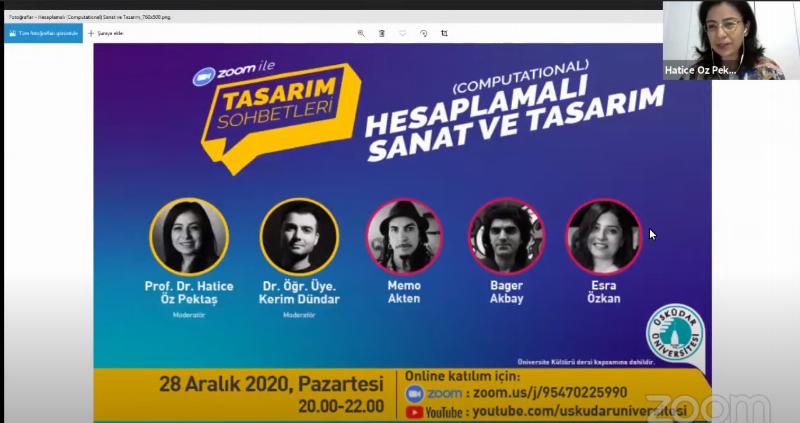
Üsküdar University Faculty of Communication organized an event titled "Design Talks: Computational Art and Design." The event, moderated by Prof. Dr. Hatice Öz Pektaş and Dr. Kerim Dündar from the Faculty of Communication, featured Memo Akten, Bager Akbay, and Esra Özkan as participants.
Content
"Design Talks: Computational Art and Design" Discussed
"Virtual can also exist inside the mind."
Memo Akten, who points out that the virtual things inside a computer and the virtual things inside our heads are different but both are virtual, says, "I started computer programming when I was ten years old. So you could say it was almost my first language. There, I'm not bound by the laws of physics. If I want gravity to be sideways, I make it sideways. Of course, there are other limitations. For example, memory issues. I generally use this second group of sentences to refer to technology. When we invent something, even the word 'invent' is somewhat inadequate. What we invent is a mechanism that enables the taming of nature. I don't think the word 'simulation' is appropriate here. For me, simulation is trying to create a replica of something that already exists, and we do that a lot. Right now, this is a simulation. So, we're trying to create the feeling that we're talking face-to-face, but this is being done in a digital universe where there are no simulations. So, we can go in very different, even completely different, directions than what we're used to in the physical world.
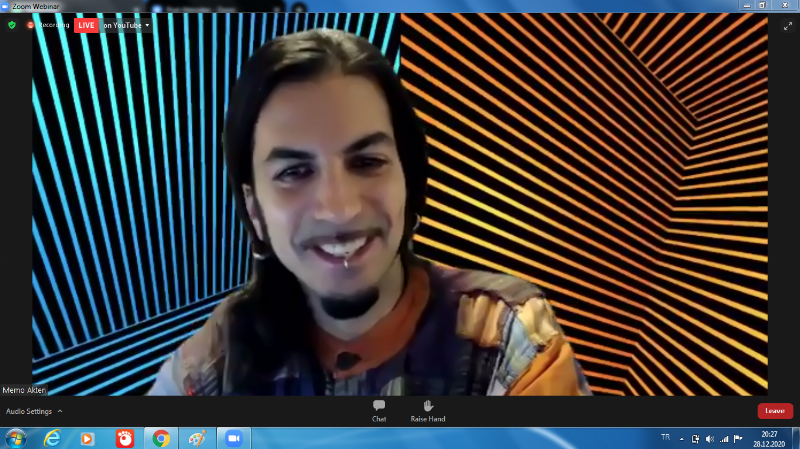
I don't want to discuss calling this a simulation anymore. Virtual can also be in the mind. When I imagine something, what's in my mind is also virtual. Therefore, the virtual thing in the computer and the virtual thing in my mind are different, but both are virtual."
“No work today can be as effective as a tool”
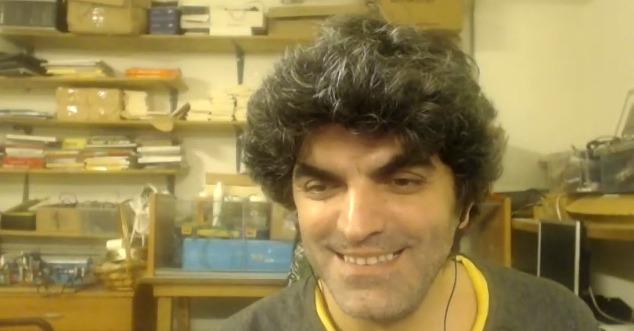
When we, as a people, write history, it will be a different history. That's why Bager Akbay, who says that these concepts change accordingly, adds: "For something big to happen somewhere, there needs to be a dictatorship. Without a dictatorship, big things don't happen. The distribution is more even, meaning the Mona Lisa is an exaggerated work. So there is no connection between the value attributed to the work and the value of the work itself. I'm saying that, I'm not saying the work is bad. Some people are writing history, and that's how it happens. If it hadn't been stolen, the Mona Lisa would probably still be sitting in a warehouse. If I were to look for the closest thing to it, I would say TikTok and Instagram. I would put the tool there. Because today, no work of art can be as effective as a tool. New media means art in the world, but in Turkey, it means communication. Communication means social media. Words like new, technology, and close are already super meaningless. I mean, they can be used, and if the name sticks, it sticks, but it doesn't mean anything. These are bad names, so history will be rewritten, and the names will be put more correctly. This has already been done and will certainly be done. History is something that is regularly rewritten anyway. Our approach to history is constantly changing. There is data. Data is data, but summarizing history is also a model. What is it actually for? Why is history summarized? It is summarized so that we can foresee our future. That's why we do it, but why is history written for a state authority? It is written to govern the future. Therefore, when we, the people, write history, it will be a different history. That's why these concepts change accordingly."
“We see it as an illusion because that’s how it reflects to us.”
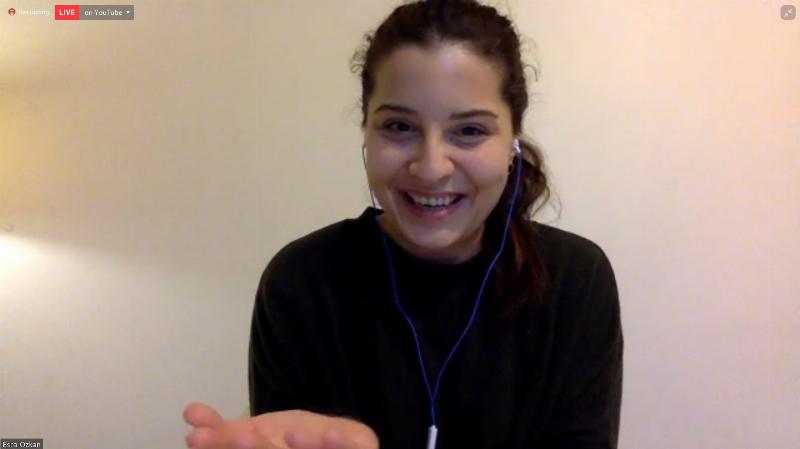
Esra Özkan, who states that we are in an illusion, says, "The subject we call language really depends on what we understand or what we see. First of all, we are in a world where we think that two times two equals four, but we don't see the number four in nature. Or we say four. We see the sun setting or rising, but we also see that as an illusion because that's how it appears to us. We live in a world where we do everything by calculating or thinking. For example, we're going to Mars. How are we going? What are we going with? We live in an illusory world, and we continue with mathematics, statistics, and other things by calculating things based on that. It's the same with language. At the point where it's said that this is not the case, for example, if they called a pipe a fork instead of a pipe, we would call it a fork right now. Language really has different meanings, but when we come to the human mind before language, that is, when we come to reasoning, the subject is divided into impressions and ideas. Impressions create perceptions, and there are experiences associated with this. There are colors, there are reflections. There are symbols formed in our minds. In fact, this whole story turns into judgments we are forced to make. For me, it's like that in calculation. That is, what we teach as a necessity and what the learner, like a human being, presents to us as an output, the things we take from the environment and learn, just like us. On the other hand, there are thoughts that come from ourselves, without anyone's influence." He said.
Share
Update Date: February 27, 2026
Creation Date: December 29, 2020
Request a Call
Other News
- Social responsibility courses moved to the field
- Erasmus+ Orientation Week completed at Üsküdar
- Prof. Nevzat Tarhan: “Brain secretes ‘dark glue’ in social media lynchers!”
- Prof. Nevzat Tarhan: “Every segment of society should be able to say, ‘This constitution is my constitution!’”
- OHS releases guide for safe operation of industrial robots