

Üsküdar Üniversitesi Faculty of Communication Assist. Prof. Dr. Aylin Tutgun Ünal participated as a speaker in the training of the "Istanbul Parent Academies" project organized by the Istanbul Provincial Directorate of National Education 50th Year Republic Feridun Tümer Vocational and Technical Anatolian High School. Ünal, sharing insights on the topic of "Social Media and Technology Use", stated that social media addictions have increased with the pandemic. Emphasizing that social media addiction should be considered a psychological problem, Ünal also reminded that attention should be paid to social media posts, and that we leave a trace on social media.
Content
Assist. Prof. Dr. Ünal: “We Leave a Trace on Social Media”
In the seminar held with the support of Kadıköy District Directorate of National Education, parents showed great interest in topics such as social media literacy, conscious use of social media, and digital health literacy.
“Addiction is Gradually Increasing”
Dr. Aylin Tutgun Ünal stated that social media addiction was previously at moderate levels, but during the pandemic, it has now reached more advanced dimensions. Ünal said; “Social media is used extensively worldwide. Especially younger generations, the 20 to 40 age group, including university students, were already using social media extensively. With the pandemic period and the increase in time spent at home, social media use further increased. The ways students, parents, and all age groups do their work changed due to staying at home. In addition to all sectors, teachers also started teaching via Zoom. The concepts of time and space became intertwined. This situation also creates dangers awaiting us. In our recent research, when we measured social media addiction levels, there was a moderate level of addiction, but it is gradually increasing. Along with these addictions, we are also facing psychological problems.”
4 Dimensions of Social Media!
Ünal emphasized that there are four dimensions to defining social media addiction; “In our generation research, we found that there is a moderate level of social addiction, and even that younger generations are approaching a high level. Social media addiction needs to be considered a psychological problem. 10-15 years ago, when I was doing research, I heard about a study in Korea where internet addiction was treated inpatient, and it caught my interest. Currently, some other countries, like Korea, are treating social media addiction as inpatients. In our country, we have outpatient clinics. This is a very serious problem. We need to carry out preventive work.”
Emphasizing that there are four dimensions when social media addiction is defined, Ünal made the following evaluations: “Firstly, 'preoccupation', which is a situation that keeps you mentally constantly connected. There are situations of curiosity like 'How many likes did my post get? Who looked at my profile?' Another dimension is 'mood regulation'. When you are upset, social media has the effect of distracting you from that problem. People temporarily forget that problem and become happy. This continues because it provides pleasure. This also reaches the level of addiction. Your work is disrupted, you cannot socialize with people. From friends to families, it becomes a situation where they cannot spare time for each other. This needs to be thought of two-way: if parents also spend too much time on social media, a situation of neglecting their children arises. Social media addiction leads to such problems. On the other hand, the 'repetition' dimension, wanting to reduce but not reducing, and the other is 'conflict'. As I just mentioned, social media communication becoming more appealing than face-to-face communication. Social media use should not hinder family communication. First, we will use it consciously, then we will explain it to our children. To change the world, we need to change ourselves. We can consciously use social media ourselves and explain the right way to those around us.”
“We Leave a Trace on Social Media”
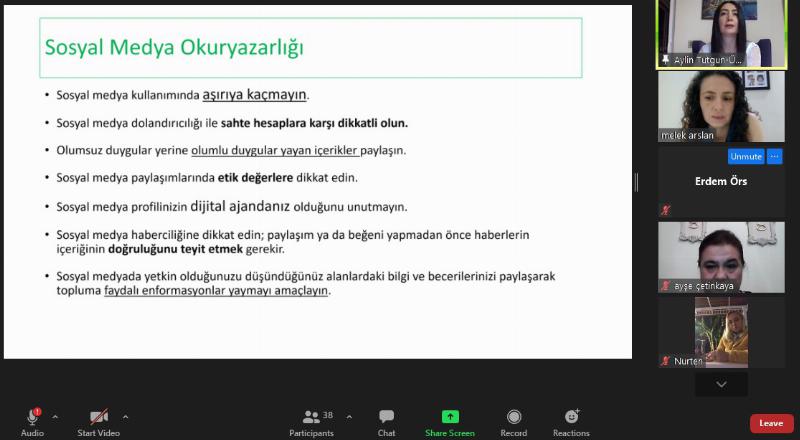
Continuing her speech with social media literacy awareness, Dr. Aylin Tutgun Ünal said, “We must be careful against fake accounts. We should especially pay attention to newly opened accounts. They frequently use periods of chaos. When content is shared, for example, a post saying 'Vaccine found' is made. We need to check if this news exists elsewhere. We need to curb our desire to share instantly. We need to share positive emotions instead of negative ones. Content you share can emotionally affect someone else. We call this 'emotional contagion'. Negative content spreads four times more than positive content. There are ethical values. For example, our elderly could not leave their homes. Some people caricatured this situation. Some took their photos outdoors. Benefiting from the entertainment of social media is a positive thing, but taking photos without permission is not ethical; we need to be careful. On the other hand, let's not forget that the content we share leaves a trace. Let's not share anything hastily without thinking. For example, in recruitments, people's social media posts can be checked. We leave a visible trace globally. We need to use it consciously." she said.
Share
Update Date: February 27, 2026
Creation Date: December 21, 2020
Request a Call
Other News
- Social responsibility courses moved to the field
- Erasmus+ Orientation Week completed at Üsküdar
- Prof. Nevzat Tarhan: “Brain secretes ‘dark glue’ in social media lynchers!”
- Prof. Nevzat Tarhan: “Every segment of society should be able to say, ‘This constitution is my constitution!’”
- OHS releases guide for safe operation of industrial robots