

Üsküdar Üniversitesi Faculty of Communication Visual Communication Design and Cartoon and Animation Departments held the “Artificial Intelligence and Art” event within the scope of ‘Design Talks’. The event, held online via Zoom, was moderated by Head of Visual Communication Design Department Prof. Dr. Hatice Öz Pektaş and Cartoon and Animation Department Lecturer Dr. Kerim Dündar.
Content
‘Artificial Intelligence and Art’ Event Held
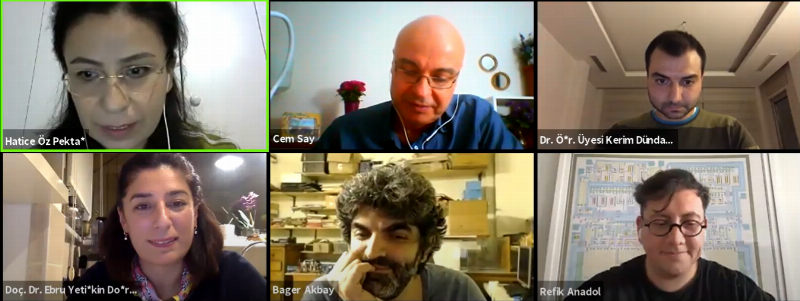
Speakers at the program included Boğaziçi Üniversitesi, Department of Computer Engineering Lecturer Prof. Dr. Cem Say, Artist Bager Akbay, Media Artist-Director Refik Anadol, and İstanbul Teknik Üniversitesi, Faculty of Arts and Sciences, Department of Humanities and Social Sciences Assoc. Prof. Dr. Ebru Yetişkin Doğrusöz.
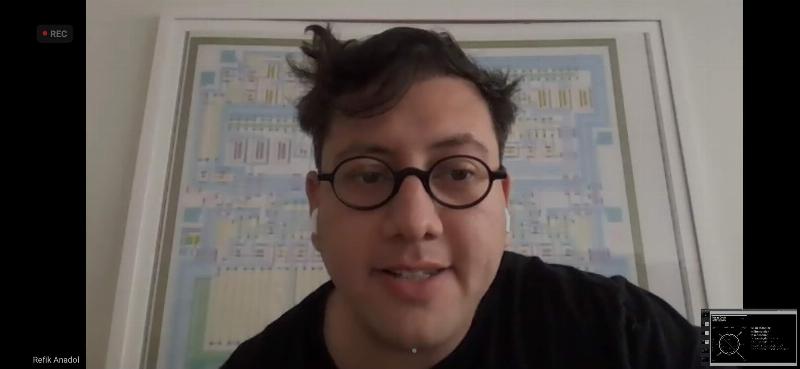
Refik Anadol: “We feel the possibility of the machine being a friend”
Refik Anadol, stating that algorithmic thinking is not just a systematic thing but also a part of dreaming, said: “There were a few points where I was lucky. I want to share more grounded memories by talking about my personal experiences. For example, before learning to read and write, at least in my time, you couldn't learn to play the piano in some way. For a student to play the piano, they had to know how to read and write. A very dear teacher of mine said, 'There are books from which music can be learned with colors and geometric shapes; is there a need to learn a language?' And indeed, algorithmic thinking is actually something like that. The place I draw the most inspiration from is not just algorithmic as a method of thought, but also dreaming. When you play a game, there is the possibility of a space existing in the machine's mind. That is, where do those games take place, why are there no walls in the game, why is there no beginning or end? These questions already start with questions that go as far as spatial perception. When we add this and feel the existence of the digital world, we feel the possibility of the machine being a friend. Algorithmic thinking started like that for me, and then creative tools helped immensely.”
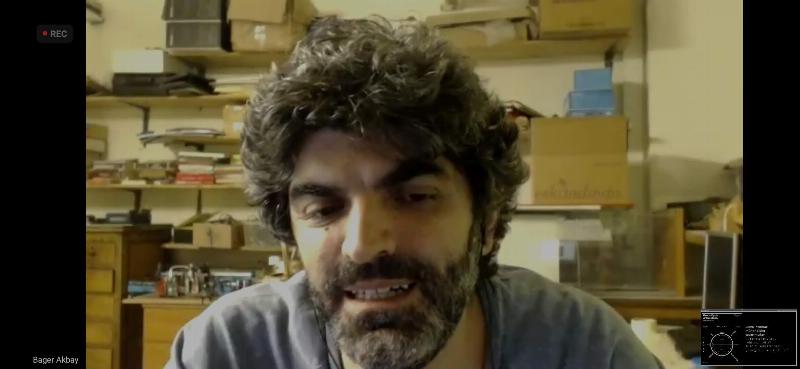
Bager Akbay: “We didn't design artificial intelligence for it to do things on its own”
Bager Akbay touched upon the issue of artificial intelligence taking over professions: “We praise artificial intelligence too much, but if we look at it from the perspective of a human producing something with their body and hands versus producing with a tool, a machine, the impact rate of artificial intelligence on the work might have reached forty percent. Perhaps it's an exaggeration, but we can still look at the human author from this perspective. If artificial intelligence is a tool to be held in one hand, and if there is an organism called a cyborg, a human-AI combination, then the cyborg is superior in every probability. Currently, an AI controlled by a human, as Kasparov says: ‘Reduce the number of moves an average chess player can make against it to 10, and it will beat all of us.’ So, even an average chess player, with a good AI, can make an AI that cannot beat the world champion, capable of beating everyone. We now call this a cyborg. Actually, it's a cyber object, a combined organized human plus artificial intelligence. This is still far superior to a purely artificial intelligence. Artificial intelligence is very useful. But the boss doesn't say, 'Let's leave the company's control to artificial intelligence, and we'll go to bed, go on vacation.' Let artificial intelligence do it and see how it manages. In reality, it manages these with a strategy. That's why we are still very far from that point. We designed software to be tools, not for artificial intelligence to do things on its own. That is, not for them to do things by themselves.”
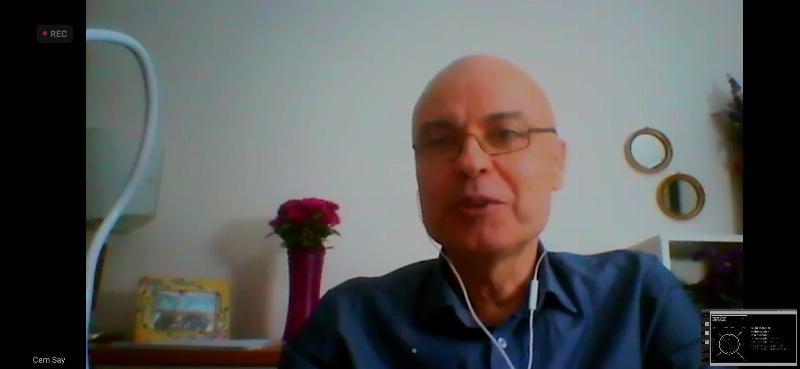
Prof. Dr. Say: “The artificial intelligence lesson has an algorithm we teach children”
Prof. Dr. Cem Say, touching upon the perception of a computer's computational power, said: “Let's consider chess-playing computers. There's an algorithm we teach children at the beginning of an artificial intelligence course. They need to calculate, 'Should I make this move, or that move?' Essentially, the move at the beginning of the chain determines where all those move sequences will lead after ten moves. But at the beginning of this process, the calculation takes ten seconds. Would it be wrong to say that during that time, the computer is 'thinking' about which move to make? Because what it's doing entirely is exactly this, and we've given it this name in our language. Because the event we've discovered and realized at that moment is actually the same task that computers perform.”
“We cannot change our way of thinking”
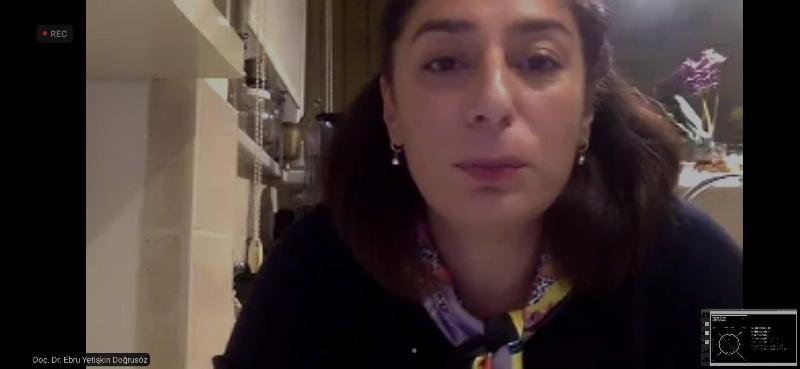
Assoc. Prof. Dr. Ebru Yetişkin Doğrusöz, delivering her speech titled “Does process-oriented design have a philosophical dimension?”, said: “As we transitioned to a heliocentric world, people realized that they were not actually at the center of the world. Unfortunately, we still cannot change our way of thinking. This appears as a problem for us in philosophy.”
Share
Update Date: February 27, 2026
Creation Date: December 15, 2020