

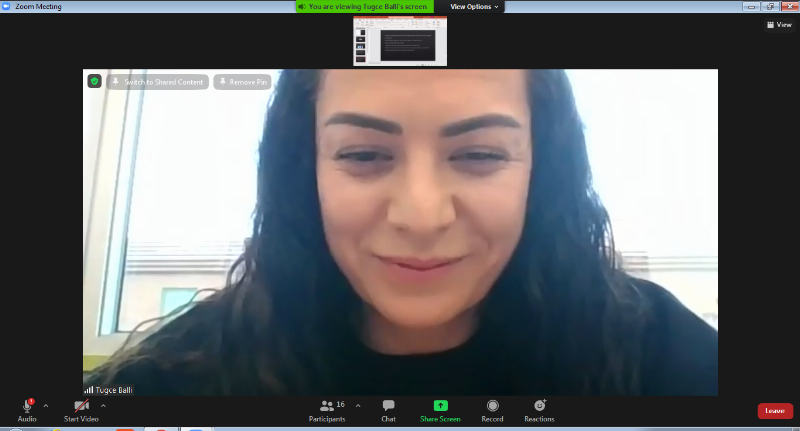
Üsküdar Üniversitesi Faculty of Engineering and Natural Sciences organized the “Prediction of Treatment Response in OCD Patients Using EEG Signals” event, which was held online. Üsküdar Üniversitesi Faculty of Engineering and Natural Sciences, Department of Software Engineering Assistant Professor Dr. Tuğçe Ballı Altuğlu took part as a speaker at the event.
Content
Altuğlu: “EEG Signals Have a Nonlinear Structure”
“As the degree of illness increased, our complexity decreased”
Altuğlu stated that an increase in the degree of illness reduced complexity, saying: “When we looked at the literature, we saw that EEG signal complexity in studies related to psychiatric diseases was lower in people with psychiatric disorders compared to healthy controls. This, in fact, gave us a consistent result. As the degree of illness increased, our complexity decreased.”
“EEG Signals Have a Nonlinear Structure”
Altuğlu stated that there were no consistent results when looking at the findings: “EEG signals are essentially signals that measure brain electrical activities. When we look at the general scope of these studies, they are based on band power extracted from EEG signals. When we examine their results, there are no consistent findings. In our own study, we conducted research using the approximate entropy method as an alternative to band power. Approximate entropy is essentially a nonlinear method that measures signal complexity. Considering that EEG signals also have a nonlinear structure in the literature, it is said to be a suitable method for EEG signals.”
“We have studies on OCD, but there are many different studies on EEG”
Altuğlu mentioned that there are many different studies on EEG: “We have studies on OCD patients, but there are many different studies on EEG. Especially recently, they have significantly increased. I will talk about the participants in this study. There are a total of 57 participants. Of these, 29 responded to treatment, consisting of 15 men and 14 women. Their ages ranged from 18 to 48. The remaining 28 did not respond to treatment, consisting of 9 men and 19 women, with ages ranging from 19 to 65. These participants did not use any medication two weeks prior to EEG recording. Treatment resistance was defined as no significant change in OCD symptoms after six months. Patients were grouped as not responding to treatment if the score measuring the severity of OCD did not decrease by 35%.”
Share
Update Date: February 26, 2026
Creation Date: October 30, 2020
Request a Call
Other News
- Social responsibility courses moved to the field
- Erasmus+ Orientation Week completed at Üsküdar
- Prof. Nevzat Tarhan: “Brain secretes ‘dark glue’ in social media lynchers!”
- Prof. Nevzat Tarhan: “Every segment of society should be able to say, ‘This constitution is my constitution!’”
- OHS releases guide for safe operation of industrial robots