

With digitalization, we are generating a colossal amount of data compared to the past. So, how will we store this data we produce, how will we preserve it? Would it ever occur to you that the alternative could be in DNA, which carries the code of life?
Content
Would you carry your data around your neck?
Storing data has been both important and somewhat difficult throughout history. Stones, gazelle skins, clay tablets were used. Then paper replaced them. Nowadays, we have chips that can hold millions of books. However, these chips are no longer sufficient.
They are not sufficient because we are generating and storing an enormous amount of data compared to the past. As technologies like Metaverse and blockchain develop, the amount of data we produce is rapidly increasing. Reality necessitates the question: What will happen to this immense data we produce in the future? How will it be stored, how will it be preserved? One of the options experts are focusing on is DNA…
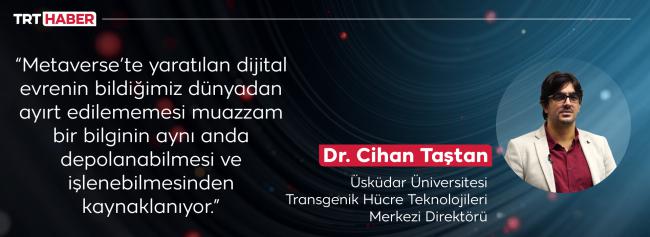
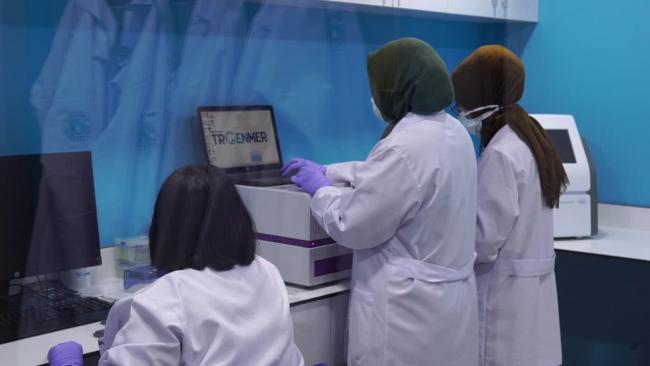
It might be surprising for some, but storing data in DNA is possible. So, how is data stored in DNA, is it secure, and what does this technology bring? Üsküdar Üniversitesi Transgenic Cell Technologies Center Director Dr. Cihan Taştan answers questions about this new alternative method.
Why DNA?
Consider an external disk, a flash drive, or cloud applications. We store our data in these areas. We can also view and read this data again whenever we want, with the help of a device such as a computer or a phone.
Scientists are working on enabling DNA to be used as a storage area, just like disks or cloud applications. Because DNA has an enormous data storage capacity. So much so that it carries all our genetic instructions, meaning billions of lines of data. A study conducted in previous years showed that hundreds of terabytes of data could be stored in 1 gram of DNA.
Furthermore, DNA occupies a very small space. Taştan’s comparison is noteworthy:
“When we bring together the DNA of all people ever born, it amounts to the size of a sugar cube, and a single human's DNA is measured in thousands of gigabytes. Therefore, you can store terabytes of information within a sugar cube. Think of a room full of hard drives. It's about being able to store all that in a sugar cube and retrieve and read any information whenever you want.”
DNA-based past and future
According to Taştan, just as we have a DNA-based past, a future more dependent on DNA than ever before awaits us. Because DNA does not degrade, it does not get lost, it can store high amounts of data, it takes up very little space, and it can be transferred from generation to generation. It is possible to think of DNA as a solid, tangible substance. Its small size and resistance to our environment also make it storable anywhere.
Taştan states, “These features have paved the way for us to encode all digital data, such as audio, video, and text, in DNA in the near future.”
How is digital data encoded in DNA?
Our digital data consists of 0s and 1s. To store data in DNA, these 0s and 1s need to be converted into the four letters of DNA, namely A, T, C, and G. DNA writing machines are being developed to accomplish this.
Taştan says, “All our texts, images, and sounds actually consist of binary codes, which we call 0s and 1s. DNA, on the other hand, has developed this dimension a bit further. Instead of two codes, we have four letters. This time, with the help of an arrangement, we convert the 0 and 1 codes from the computer into a four-letter coding system: Adenine, Thymine, Cytosine, Guanine.”
How will DNA be stored securely?
DNA can be stored in one place, and copies can also be placed in hundreds of different locations.
Taştan says, “There is also no possibility of anyone other than you finding the information you have written or wish to store. Because every side contains infinite possibilities. Therefore, no one else but you would know where the DNA is, allowing you to store and archive your data wherever you wish.”
He gives the following example:
“If you wish, you can encode your DNA into a flower in your room. Only you would know that you are actually storing all the data within that flower as you nurture it.”
Storing data within a living human
We understand that storing and preserving data in DNA is possible. Taking it a step further, is it possible to store data in the DNA of a living organism? Taştan’s answer is as follows:
“It is possible. Because we do something similar in genetic therapies. That is, we can inject DNA sequences produced by a machine from outside into the cells of people whose genetics are faulty, or sometimes non-functional, and store them there. This way, we can save people's lives. If we consider the exact opposite of this logic, you can still store data you deem valuable in DNA, within your own cells.”
Carrying your codes around your neck
Taştan asks us to pay attention to the necklace worn by a young scientist from the team. Inside this necklace, which looks no different from others, is the DNA of the person wearing it. They aimed to safely store the DNA of loved ones or memories like audio, video, and text for decades. For this purpose, they transformed the method they developed into a DNA keepsake necklace.
The DNA inside this DNA keepsake necklace has been designed to be detectable under ultraviolet light. This means it is possible to carry any data you want in a necklace around your neck without anyone noticing.
The future of data storage in DNA
We also ask Taştan about the future of this technology. He says, "Let's recall the early days when USB was first developed." Back then, a tiny bit of data, a few MBs, could be stored in a room-sized machine. The currently developed DNA writing device is also room-sized. It can convert 2 GB of data into DNA within a few hours. The advancement of this technology is evident.
Taştan states that computer giant companies are working on DNA writing devices. “They are currently working on producing DNA writers that can be like a printer in your room, in your home. This technology will be able to enter our homes in the coming years, and we will be able to see and transfer products for systems that can quickly write and read DNA.” he explains.
Source: TRT HABER
Share
Update Date: February 28, 2026
Creation Date: December 08, 2021