

Prof. Dr. Colin Paul Turner, Director of the International Muslim Theology Foundation, participated as a speaker in the “International Post-Materialist and Holistic Science Conference,” organized in collaboration with Üsküdar University’s Risale-i Nur Research Platform and the Conscience of the Age Student Club, on the occasion of the 63rd anniversary of Bediüzzaman Said Nursi’s passing. Prof. Dr. Colin Paul Turner stated that some things in life cannot be reduced to logic, and expressed that problems arise when science is reduced to highly complex human issues such as ethics, values, and morality. Turner also emphasized that ethics does not fall within the domain of science, and pointed out that it is not possible to derive any ethics from scientific principles, and that, although not applicable to Turkey, the Western world continues its life with an ethical capital remaining from the age of religion.
Content
Western Life Continues on Ethical Capital Inherited from the Age of Religion
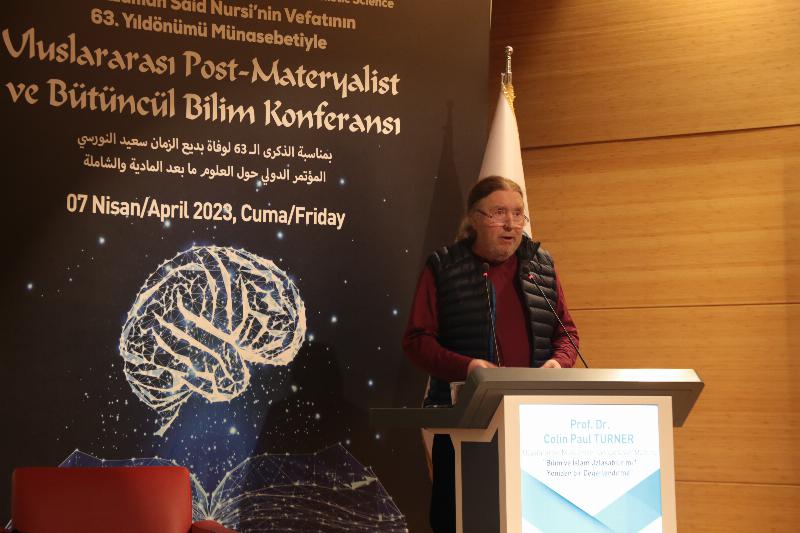
Problems arise when science is reduced to human issues…
Prof. Dr. Colin Paul Turner, Director of the International Muslim Theology Foundation, participated in the “International Post-Materialist and Holistic Science Conference,” organized in collaboration with Üsküdar University’s Risale-i Nur Research Platform and the Conscience of the Age Student Club on the occasion of the 63rd anniversary of Bediüzzaman Said Nursi’s passing, and delivered a speech titled “Can Science and Islam Reconcile? A Reassessment.”
Absolute assumptions are not conscious
Prof. Dr. Colin Paul Turner stated that no scientific and mental system operates without underlying assumptions, saying, “It is possible to say that nothing can establish itself. At the very least, a sentence is needed to explain it. In 1944, Oxford philosopher Robin Collingwood stated that every intellectual system must rely on certain absolute assumptions. There are always absolute assumptions we must make for a system to function. Absolute assumptions are not conscious; they derive their roots from a culture and are accepted as real. At this point, the only thing that can be done is analytical criticism and questioning.”
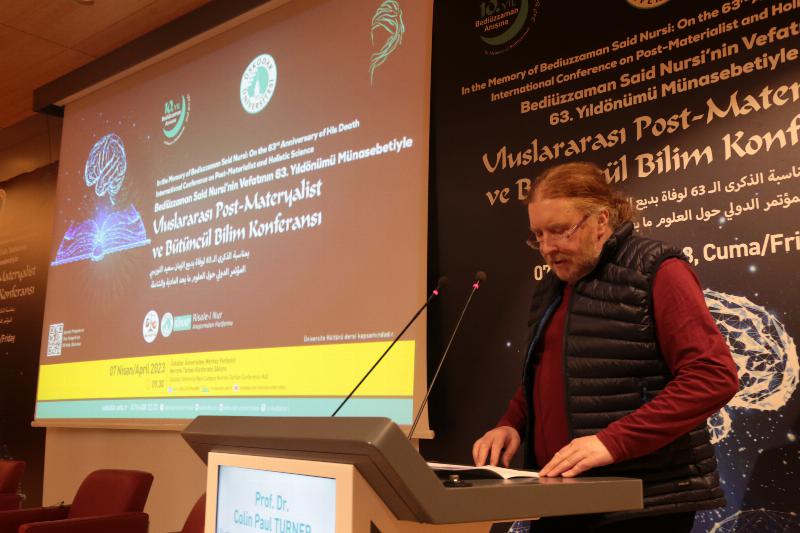
Problems arise when science is reduced to complex human issues
Prof. Dr. Colin Paul Turner stated that the assumptions in epistemology are actually at a reductionist point, saying, “Reductionist analysis is indeed the only preferred method for understanding complex problems. Observation and experimentation are the primary ways of acquiring knowledge. Theory follows observation and experimentation. Looking at theory, it is possible to see problems in logical analysis because logical analysis is binary. That is, it is either raining or not raining, the weather is bright or dark. But when we look at the world in general, the world does not operate so simply. Some things in life cannot be reduced to logic, so one should not fall into the ‘and,’ ‘or’ trap. When we reduce science to highly complex human problems such as ethics, values, and morality, problems arise. Yet, science almost considers complexity to be illegal.”
The West Lives with Ethical Capital Remaining from the Age of Religion
Turner emphasized that ethics does not fall within the domain of science, stating, “It is not possible to derive any ethics from scientific principles. I don't know if this is true for Turkey, but at least in the West, we are actually living with an ethical capital remaining from an age of religion. When we look at neuroscience, we see that it promises us a knowledge-based theory. Even in science, consciousness is actually a prerequisite for any meaningful expression, but it is not recognized or taken seriously. However, it needs to be said that it should be taken seriously. We observe that people can access the mental content of others without classical methods, that is, without talking to them or asking questions.”
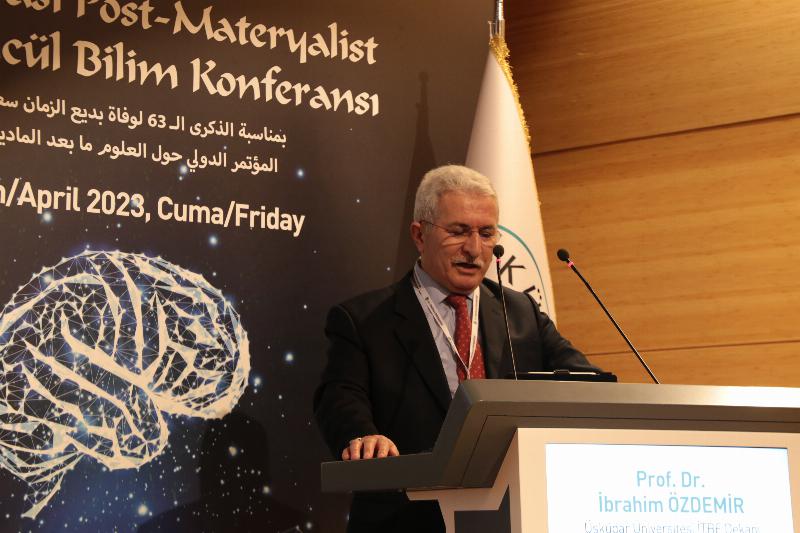
In the second session, titled “Post-Materialist Understanding of Science-1,” moderated by Prof. Dr. İbrahim Özdemir, Prof. Dr. Harald Walach, Researcher at the Institute of Other Societies, Kazimieras Simonavicius University, Vilnius, Lithuania, Germany; Founding Director of the Institute for Transcultural Health Sciences and Science, gave a conference titled “How Can a New Science of Consciousness Contribute to the Expansion of Science?” Prof. Dr. Necati Aydın, Vice President of the Institute for Holistic Science, participating in the conference from the USA, made a presentation titled “Towards a Holistic Science and Education Approach with a Literal Perspective.”
The conference continued with the third session titled “Post-Materialist Understanding of Science-2.” In the final session, moderated by Prof. Dr. İbrahim Özdemir, Prof. Dr. Marjorie Woollacott from the Neuroscience Institute at the University of Oregon, USA, participated online in the conference with her talk “The Transformative Effects of Spiritual Awakenings on Scientists and Academics”; David Lorimer, Director of the Scientific and Medical Network from the UK, with “Gnosis in the Future Science of Consciousness”; and Dr. Vasileios Basios from Université Libre de Bruxelle, Belgium, with “Towards a Self-Reflective Science on Origins.”
In the last session, Prof. Dr. Athena Despoina Potari from Harvard University, USA, participated online in the conference with her talk “A Call for the Renaissance of the Soul in Human Sciences”; Prof. Dr. Mohamed Bakari from the University of Nairobi, Kenya, with “On the Scientific Method”; and Dr. Olaniyan Adeola Seleem, a graduate of the Philosophy Department at the University of Ibadan, Nigeria, with “Positivism Self-Correcting: An Environmental Assessment of Scientific and Technological Breakthroughs.”