

Üsküdar University faculty members participated in the 10th National Congress of Molecular Biology and Biotechnology, held via the Zoom application. At the congress, which was attended by Prof. Dr. Muhsin Konuk, Assoc. Prof. Dr. Mesut Karahan, Asst. Prof. Dr. Cihan Taştan, Assoc. Prof. Dr. Pınar Öz, and Asst. Prof. Dr. Ebru Özkan Oktay, the session titled 'Current Topics in Biotechnology' was chaired by Prof. Dr. Muhsin Konuk.
Content
Üsküdar University presented at the 10th National Congress of Molecular Biology and Biotechnology…
Prof. Dr. Muhsin Konuk; “We have also revealed how much in silico studies and computers help us”
Üsküdar University Vice Rector Prof. Dr. Muhsin Konuk, evaluating the presentations made in the closing panel of the session, said; “You are doing such beautiful work, especially within an international network or framework. With today's panel, we have somehow demonstrated – to use Ebru's expression – how much in silico studies and computers help us in transforming studies that usually involve trial and error or testing certain theories into targeted work, without even entering the wet lab, and without using many chemicals, similar substances, raw materials, devices, or expending energy in the wet lab. I would like to thank all my fellow speakers, all the participants who listened to us, and the organizing committee, the congress organizing committee, again and again."
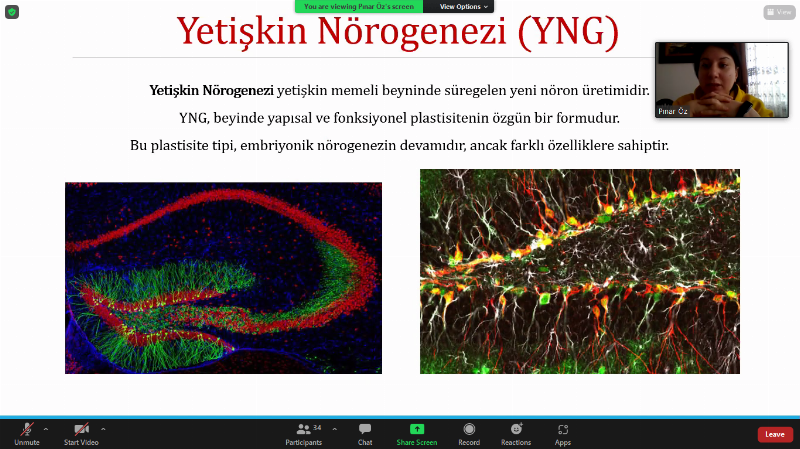
Assoc. Prof. Dr. Pınar Öz; “The initial differentiation occurs through asymmetric division”
Üsküdar University, Molecular Biology and Genetics Department Faculty Member, Assoc. Prof. Dr. Pınar Öz, who gave a presentation on 'in silico models of adult neurogenesis', said; “When we talk about adult neurogenesis, we are actually referring to the ongoing production of new neurons in the mammalian brain after embryonic development. We can say that adult neurogenesis continues in the brain as a structurally and functionally independent form. Embryonic neurogenesis is a process that continues with different mechanisms and is encountered only in limited regions of the brain. When we look at the processes in adult neurogenesis, we first talk about the stem cell pool here. We see that it goes into a quiescent state with age. We see that it initiates the process that will lead to rapid neuron formation through self-renewal via frequent symmetric divisions and differentiation via asymmetric divisions. Our main pool is the radial glia cell. The initial differentiation occurs through asymmetric division. It is also possible for different cell types to form. The cells in the second intermediate stage are mostly what we call transient cells. These are cells that divide and differentiate very quickly, and here we are talking about a transient population where undifferentiated cells also die. Our third population is neuroblasts, which can be considered the previous stage. After a rapid differentiation process, we reach an immature neuron.”
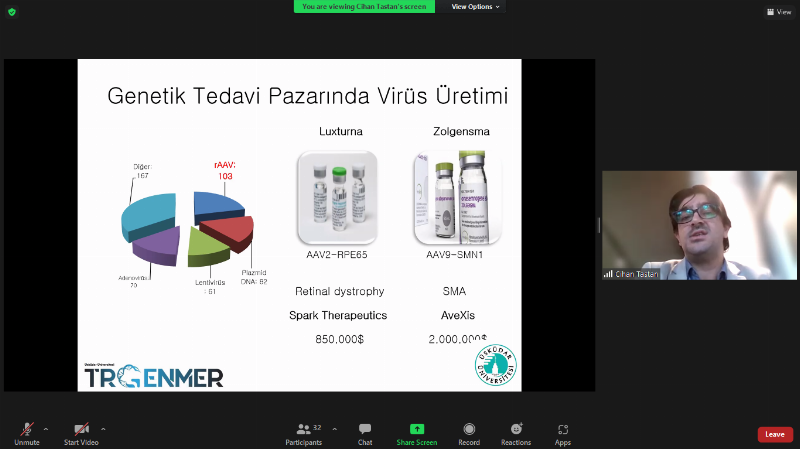
Asst. Prof. Dr. Cihan Taştan; “Genetic therapies actually require a multidisciplinary approach”
Asst. Prof. Dr. Cihan Taştan, Director of Üsküdar University Transgenic Cell Technologies and Epigenetics Application and Research Center (TRGENMER), who provided information on how engineering methods developed in recent years have shaped the bioindustry, said; “Genetic therapies actually require a multidisciplinary approach. We call the treatments that emerge as a result of the collaborative work of both doctors (medical professionals) and people specialized in molecular biology and genetics, genetic therapies. The aim here is, particularly, to produce specific proteins in non-functioning organs, tissues, or cells in the patient's body, or to treat mutations in genes encoding these proteins using the most effective genetic engineering techniques developed in recent years, foremost among which is CRISPR gene engineering. Subsequently, the ability to specifically transfer these genetic therapy methods to target tissues, cells, or organs after designing them is also one of the most important parts of this genetic therapy method. When we bring all genetic therapy studies together, especially the genetic therapy drug for SMA disease, which is currently the world's most expensive drug, costs approximately 2 million dollars. However, when we look at its content, it is based solely on the technique of transferring a functional copy of the SMN1 gene, which causes SMA disease, to motor neuron cells by a virus called adeno-associated virus. Of course, since a great deal of know-how is required in the production and follow-up process, prices can become this expensive. In Turkey, especially concerning the development of genetic therapy products, the mission of our Transgenic Cell Application and Research Center established at Üsküdar University is to research these genetic therapy methods and produce new products with new patents in Turkey.”
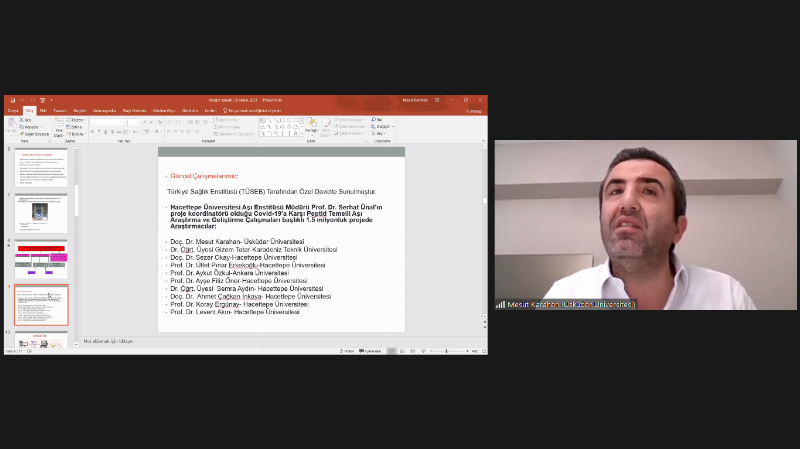
Assoc. Prof. Dr. Mesut Karahan; “When we compare, we are talking about a technology that is at least a hundred times cheaper”
Assoc. Prof. Dr. Mesut Karahan, Director of Üsküdar University Vocational School of Health Services, discussing the advantages of peptide vaccines in his presentation titled 'Peptide-Based Vaccine Models', said; “What could be the advantage of synthetic peptide vaccines that would allow them to be an alternative to current vaccines? That was the basic idea, actually. We had used biopolymers as adjuvants, either nano-structured or before they were nano-structured. Of course, as technology developed, we tried to create them by converting them to nanostructures and loading peptides onto our nano-structured polymers. Our vaccines did not contain live viruses in any way, which was a huge advantage for us. Because we didn't need a cold chain, and we had the chance to store them for as long as we wanted. We have the chance to use different adjuvants. As I just mentioned, we generally started with biopolymers, and we synthesized biopolymers with adjuvant effects, especially those with certain characteristics, and used them as adjuvants. Subsequently, there was a shift towards nanoparticles. As you know, studies with nanoparticles are very current topics right now; we kept up with them, achieved good results, and their lack of toxicity and independence from T cells offer many advantages. I believe the most important advantage, especially in the current global economic crisis, is cost. Its cost is very low because you are working with a peptide, not any live organism, and it's a study you can do in any laboratory environment. Therefore, when we compare its cost to other vaccines, we are talking about a technology that is at least a hundred times cheaper.”
Asst. Prof. Dr. Ebru Özkan Oktay; “Software research selection is also actually an important point”
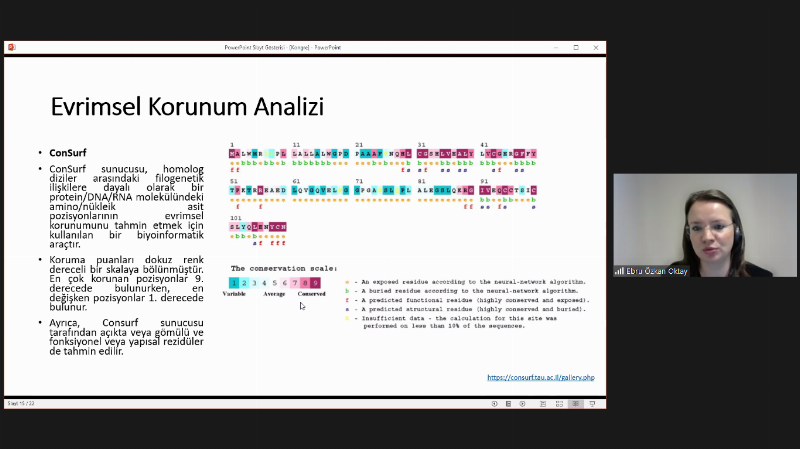
Asst. Prof. Dr. Ebru Özkan Oktay, Head of the Laboratory Technology Program at Üsküdar University Vocational School of Health Services, explaining in silico applications in molecular biology with examples, said; “An amino acid change might have no effect, or it could render the protein non-functional. With the in silico analyses we conduct, we predict these possible effects using software tools. That is, we analyze how the protein's function or stability structure might change with any amino acid variation, and what the effect of these variants might be. Now I would like to briefly mention these in silico variant analyses again. Of course, we use various bioinformatics tools for this purpose. Actually, in silico variant analysis appears in two distinct ways. The first is that we can use it to screen for potential harmful variants in a gene before conducting further research with wet lab techniques. That is, we first identify the variants in a target gene. Then, what are the effects of these variants on protein structure, function, stability, and the three-dimensional structure of proteins? These can be predicted by creating models. Secondly, variants obtained from the entire exon sequence can be evaluated in silico. Where is this purpose used? Now I want to talk about the first one. That is, a target gene, for example, could be a gene involved in an important pathway or linked to a disease. For the in silico analysis of variants in this gene, we follow such a workflow. First, data acquisition is performed. All variants in the gene, as well as information and data such as protein and amino acid sequences, are obtained. Subsequently, these units are used as input in software tools. There are various software tools for functional analyses and the relationship of variants with disease. This software research selection is also actually an important point.”
Share
Update Date: February 28, 2026
Creation Date: December 20, 2021
Request a Call
Other News
- The book that read today's digital threats in 2014: Being a Conscious Family
- Experts warn: 'Instead of memorizing letters, teach pencil grip, scissor use, and coloring'
- School fear and school love both start in the family!
- Family is not merely transforming, it is being battered under a serious assault
- Artificial intelligence opens the door to early diagnosis in autism!