

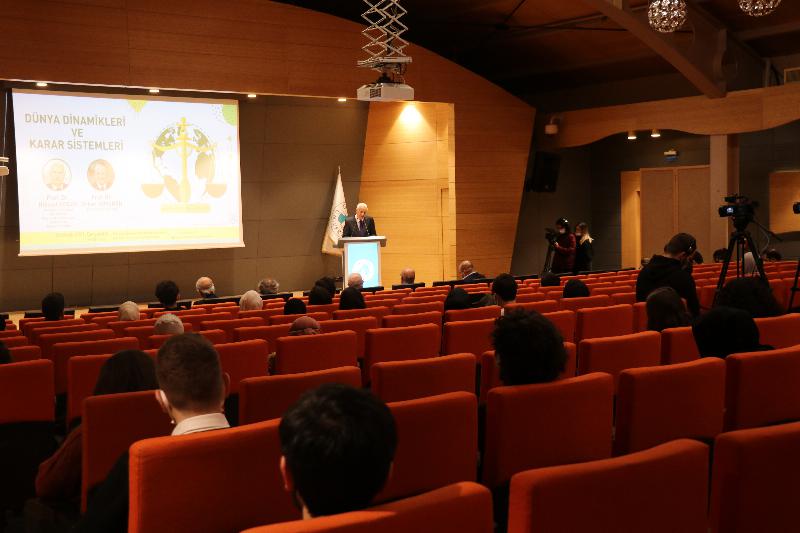
Üsküdar University organized an event titled “World Dynamics and Decision Systems” within the scope of the University Culture course. The event was held at Üsküdar University Nermin Tarhan Conference Hall. The guest of the event was the famous scientist and Former Ambassador Prof. Dr. Orhan Güvenen.
Content
Üsküdar University hosted the famous scientist!
Prof. Dr. Hikmet Koçak: “His life has always been spent working and serving; he is a true Istanbul gentleman”
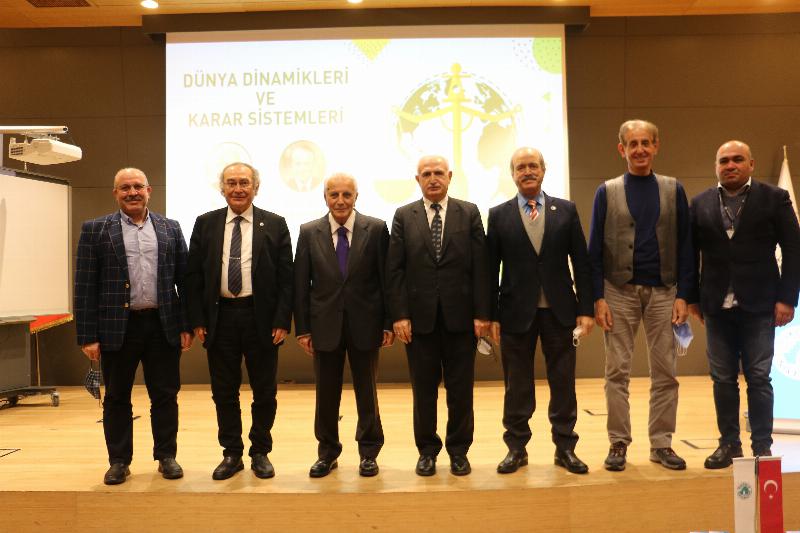
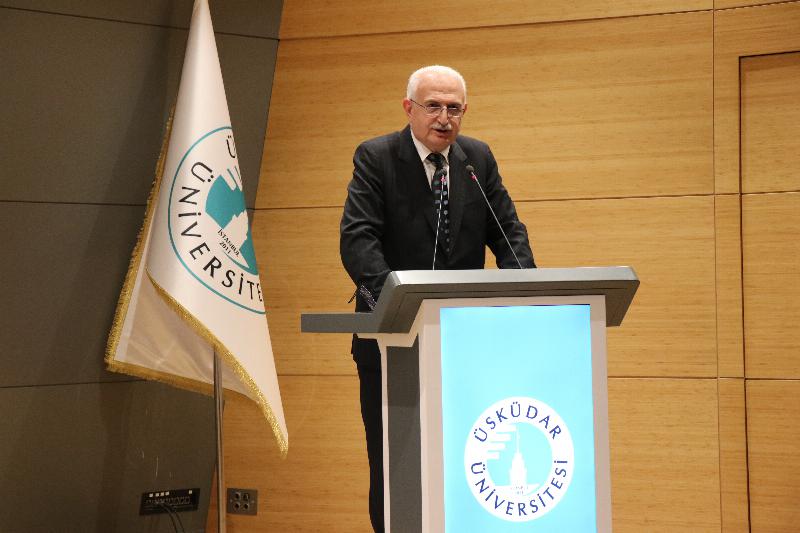
Üsküdar University Founding Rector, Chairman of the Board of Trustees Prof. Dr. Nevzat Tarhan, and Acting Rector Prof. Dr. Mehmet Zelka also attended the program. The opening speech was given by Üsküdar University Faculty of Medicine, Department of Cardiovascular Surgery Vice Rector Prof. Dr. Hikmet Koçak, who expressed his thanks and gratitude to the renowned scientist Prof. Dr. Orhan Güvenen with these words. Koçak said: “Our esteemed Prof. Orhan Güvenen, whose life is full of achievements, whose greatest concern is to serve his country, who has fundamentally adopted Anatolian culture and integrated it with European culture. I also want to mention this. Professor Orhan is a paragon of modesty. His life has always been spent working and serving; he is a true Istanbul gentleman. I know he doesn't like to be praised, but this is not praise, it's just stating the truth. He accepted our invitation and came, and I thank him.”

Prof. Dr. Orhan Güvenen: “Technology is not just a technical phenomenon; it also affects the lives of societies”
Explaining world dynamics in the context of technology, the famous scientist Prof. Dr. Orhan Güvenen said: “If we define the concept of world dynamics as a very simple function, what would be the explanatory variables we would use in an equation? These variables can include technologies, information systems, decision systems, value systems, ethics, culture, demography, energy, environment, land, water, and resource utilization. Why are we interested in or need to be interested in world dynamics? For our Turkey, in any situation, concerning science, culture, education, businesses, universities, every topic, and our private lives, we must ask what is happening in the world, and we must know it not just out of curiosity, but mathematically. Technology is not just a technical phenomenon; it is something very important that affects the lives of societies. Information and communication technologies are very important because they can suddenly move into completely different dimensions.”
“The subject matter of social sciences is human beings”
Drawing attention to the need to consider digital technologies with their general dimensions and impacts, Güvenen stated that the digital world would have large-scale effects in the coming years. Güvenen said: “From the phones we use, these bring great opportunities. At the same time, with great opportunities, Elon Musk says, 'there is no need anymore, we will be able to do all those analyses directly with the chips we will place in the brain.' But what could be one step beyond this? To what extent will they affect our brains? This means we must consider all technologies with their pros and cons, and their full dimensions. In other words, nothing is neutral, absolutely nothing is neutral. While bringing positives, they can also bring certain negatives. We should keep this in mind: we are in a country, and the question of what can be done for the optimal benefit of that country and for humanity must be asked. Therefore, we need to look at technologies and these world dynamics in this way. Direct intervention in the brain and behavior is now possible, with its advantages but also uncertainties. Information systems involve data, information, predictive perception, decision-making; this is where scientific methodology comes into play. Social sciences are difficult because the subject matter of social sciences is human beings. In human beings and society, uncertainty is high. These are fields of science that require great care.”
“The dominant phenomenon in the dynamic system of the world we live in is power and money”
Explaining the explanatory variables that determine decision systems, Prof. Dr. Güvenen said: “Technologies determine information, culture, and decision systems. When looking at world dynamics, I humbly see this, I have thought about it for years, and I may have been using the concept I am about to state for 40 years. I even discussed this at the Nobel awards, wondering if I was thinking incorrectly, but no one has ever contradicted or refuted it to this day. What I am trying to say is, I wish it weren't so. Currently, in the world we live in, we see that the phenomenon driving the dynamics of the dominant dynamic system is guided by power and money. I call this System Two. Our world is heading in this direction. I would very much like to be wrong, but as I said, no one has been able to contradict me for forty years. Of course, there will be, but fundamentally, it is guiding the system. There are some issues where, when you remove their packaging, you ultimately see that they are guided by the power of power and money at their source. Humanity today possesses the power, the weapons, to destroy the world many times over. With all these phenomena, we need to be very careful. We need to pay attention to humanity. We need to pay attention to the human optimal. And we need to shift System Two, the dynamic guided by the power of power and money, to System One. What is System One? It is knowledge, it is science. It is a system of values. It is culture; culture should never be underestimated. Culture is not just about shaving in the morning; culture carries fundamental faith, belief, everything, and the perspective on all universes. Culture should never be neglected. Art should not be neglected either. Because art and culture move between minus and plus infinity, while science develops by laying brick upon brick. It is very important.” he stated.
“I am of the opinion that revolutions in the human brain and sensibility could be the greatest revolutions”
Referring to the most important actors in decision systems and nation-states, Güvenen said: “Turkey, Italy, France, USA, Nigeria, whatever these countries are, countries in the United Nations, etc., international organizations are very important. Ultimately, the most important actors determining decision systems are nation-states and international organizations. I worked on the UNESCO Executive Board, etc., I won't go into too much detail, I have some scattered experience. These are very important institutions, but it is very difficult for them to bring about radical change in the world. Do you know why? Let's think mathematically, because the budgets of these organizations are provided by those nation-states. And when nation-states provide that, they inevitably want their own ideas to be reflected in the decisions. Indirectly, the more nation-states that are members there, the more pluralistic the ideas will be. And it will not always be at a level that leads to humanity's optimal. Therefore, while these institutions do very important work, it is difficult for them to achieve radical change oriented towards humanity's optimal. I believe it must come from other dimensions. I am of the opinion that revolutions in the human brain and sensibility could be the greatest revolutions.”
The organized event concluded with the scientist Prof. Dr. Orhan Güvenen answering questions and a group photo.
Reporter: Hilal Büyükyavuz
Share
Update Date: February 28, 2026
Creation Date: December 16, 2021
Request a Call
Other News
- Social responsibility courses moved to the field
- Erasmus+ Orientation Week completed at Üsküdar
- Prof. Nevzat Tarhan: “Brain secretes ‘dark glue’ in social media lynchers!”
- Prof. Nevzat Tarhan: “Every segment of society should be able to say, ‘This constitution is my constitution!’”
- OHS releases guide for safe operation of industrial robots