

Üsküdar Üniversitesi, Deputy Dean of the Faculty of Humanities and Social Sciences and Lecturer at the Department of Psychology (English), Assoc. Prof. Dr. Asil Özdoğru, participated in the 17th European Congress of Psychology with research conducted together with her students. The researchers' work was listened to with great interest at the congress.
Content
Üsküdar University Department of Psychology at the European Congress of Psychology with its Studies!
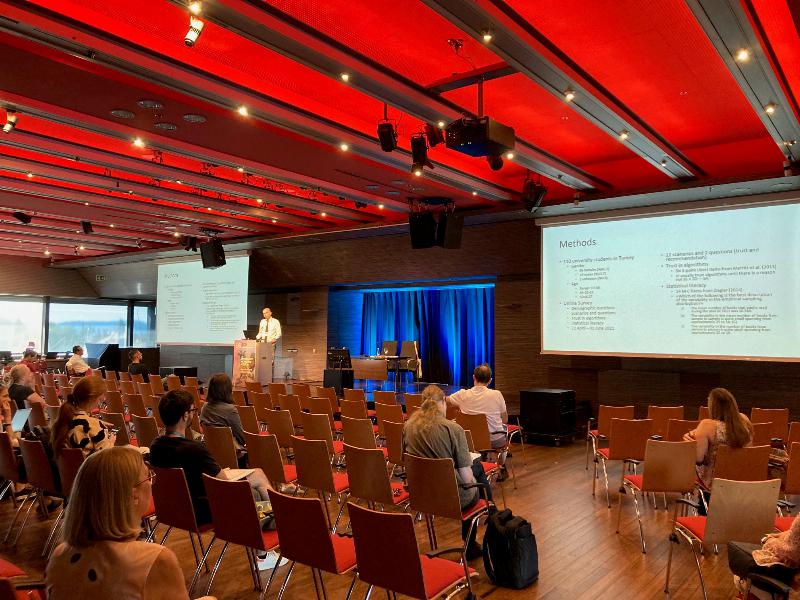
The 17th European Congress of Psychology, which was first held in Amsterdam in 1989 and has since been organized every two years in a different European city, is being held this year from 5-8 July 2022 in Ljubljana, the capital of Slovenia. Thousands of participants from 35 European countries and a total of 71 different countries are making 918 presentations over four days at the congress, organized by the host Slovenian Psychological Association under the patronage of the European Federation of Psychologists' Associations.
Özdoğru, who was eligible for support under TÜBİTAK's Program for Supporting Participation in International Scientific Events, personally attended the congress and presented her work in the form of three oral papers across three different sessions, and chaired one session. Özdoğru and fourth-year students from the Department of Psychology (English), Merve Büşra Çetin, Şahsenem Sarı, and Şevval Osmanoğlu, who were authors in the papers, made statements regarding the research.
"Algorithms have great social power"
Merve Büşra Çetin provided information about the first study; "Algorithms are present in many areas of our daily lives. For example, many things like our internet searches, online shopping, and cameras detecting human faces are shaped by algorithms. Algorithms have great social power in terms of influencing people's preferences and behaviors in the real and digital worlds. In this research, we examined whether people's trust in algorithms is affected by their levels of statistical literacy, their understanding of algorithms, and the context in which they use algorithms. Looking at the data we collected from university students through an experimental survey, we found that participants' trust levels were influenced by the importance level of the situation in which algorithms were used. For instance, people trust computer algorithms more for restaurant choices but less for recruitments." she said.
"Concretization of abstract concepts"
Şahsenem Sarı stated: 'The Body-Specificity Hypothesis claims that people's systematic interaction with their physical environment in different ways leads to the formation of different mental representations. In his 2009 study on this hypothesis, Daniel Casasanto from Cornell University showed that right-handed people associate the concept of "good" more with the right direction, and left-handed people with the left direction. In this research, we tested the same finding in a Turkish sample. As a result of our study, we showed that Turkish participants, similar to the original study, also defined good concepts more with their dominant sides.' she said.
"We also re-tested this study by applying it to a Turkish sample"
Şevval Osmanoğlu used the following statements regarding the third study: 'Death, as an uncertain experience that people cannot avoid in their lives, brings anxiety and and fear. According to Terror Management Theory, people tend to suppress the thought of death and avoid it. When the thought of death is suppressed, it initially occupies consciousness less, but after some time, it occupies it more. American psychologists David Trafimow and Jamie Hughes, in their 2012 study, showed the opposite: people exposed to the thought of death had more death-related thoughts at first, and fewer after some time. We also re-tested this study by applying it to a Turkish sample. As a result, although our findings did not align with the results of the original study, they contain important implications for new research.' she said.
Assoc. Prof. Dr. Asil Özdoğru stated that they experienced the pride of being able to participate and present their work at the European Congresses of Psychology in Milan 2015, Amsterdam 2017, Moscow 2019 with the support of Üsküdar Üniversitesi, and at this year's congress with the support of TÜBİTAK. Özdoğru added; 'Together with the students in the research group, they have carried out various scientific studies, many of which are based on international cooperation, with students participating as authors of papers and articles in most of them, and such experiences will be very beneficial for the education and development of the students.'
Share
Update Date: March 01, 2026
Creation Date: July 07, 2022
Request a Call
Other News
- Prof. Nevzat Tarhan: “Those with a mental filter are not afraid of the digital”
- Artificial intelligence doesn't eliminate the translator, it transforms their expertise!
- Social responsibility courses moved to the field
- Erasmus+ Orientation Week completed at Üsküdar
- Prof. Nevzat Tarhan: “Brain secretes ‘dark glue’ in social media lynchers!”