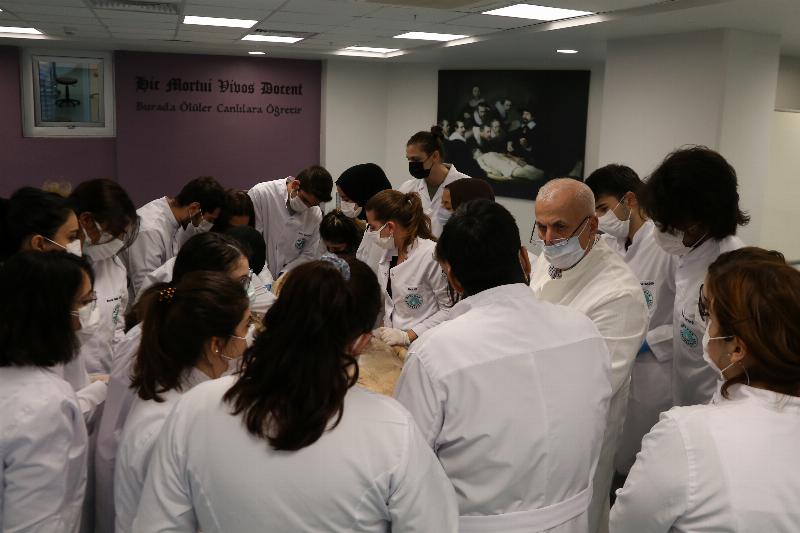
Üsküdar Üniversitesi Faculty of Medicine Head of the Anatomy Department Prof. Dr. Ahmet Usta has commenced cadaver examinations with second-year medical students. Prof. Dr. Ahmet Usta underscored the necessity of cadaver training in medical faculties, stating, “Being a doctor, practicing medicine, means healing people from human-related diseases. Therefore, your material is human. If you don't know the structure of what you are working on, you won't know how to treat it, nor will you understand it. Therefore, if what we are working on is human, teaching its structure is the job of anatomy.”
“New Cadavers are a Must for Medical Faculties Every Year”
Prof. Dr. Ahmet Usta stated that new cadavers should be acquired by medical faculties every year: “According to YÖK's definition, there should be one cadaver for every thirty students. They don't permit opening a faculty if there aren't at least two cadavers. We initially acquired three cadavers, not two. I had one opened because half of the students came for face-to-face education, and the other half will come in the summer, which I'm planning for them. But we can open a second one if needed because we have three cadavers.”
“This is Not a Task to Be Taken Lightly”
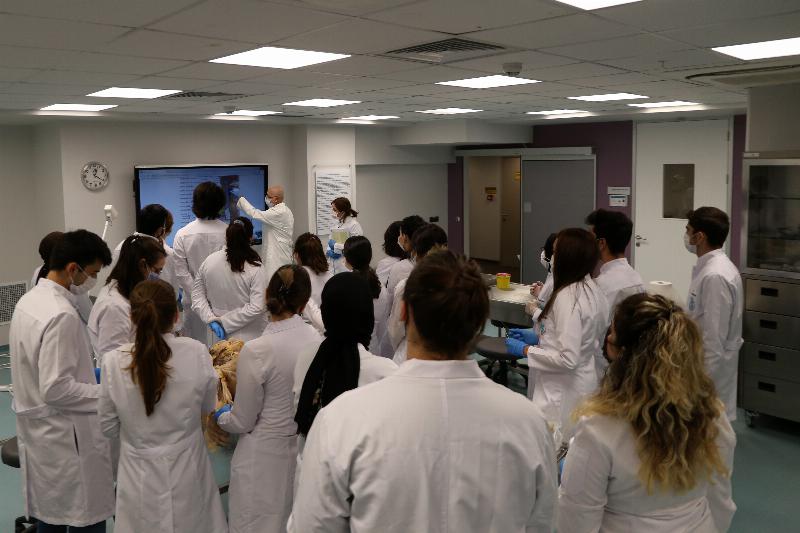
Prof. Dr. Ahmet Usta stated that if the structure of what is being worked on is unknown, it will be impossible to know how to treat it, emphasizing the importance of cadaver training for medical students. Usta said; “First-year students take anatomy lessons, but we start cadaver training in the second year. There are two reasons for this. First-year students haven't fully entered the atmosphere yet. Opening a cadaver is a serious job that requires responsibility. It is not a task to be taken lightly; it carries a certain gravity. Because you are dissecting and examining a human being. Being a doctor, practicing medicine, means healing people from human-related diseases. Therefore, your material is human. If you don't know the structure of what you are working on, you won't know how to treat it, nor will you understand it. Moreover, from a scientific perspective, you need to know even more detail. We delve down to a very molecular level, and we need to know these things. Therefore, if what we are working on is human, teaching its structure is the job of anatomy. Consider a machine engine; it would be impossible to repair it without knowing its parts. Similarly, here there are very fine and microscopic details. The starting point for these is anatomy. We call this ‘Gross Anatomy,’ meaning we show students the visually discernible information. There are excellent materials available, but you can never truly visualize what you read by encountering it in reality. You might do something, but it won't be precise. Its irreplaceable place is the cadaver lab.”
Cadavers are Indispensable in Medical Education!
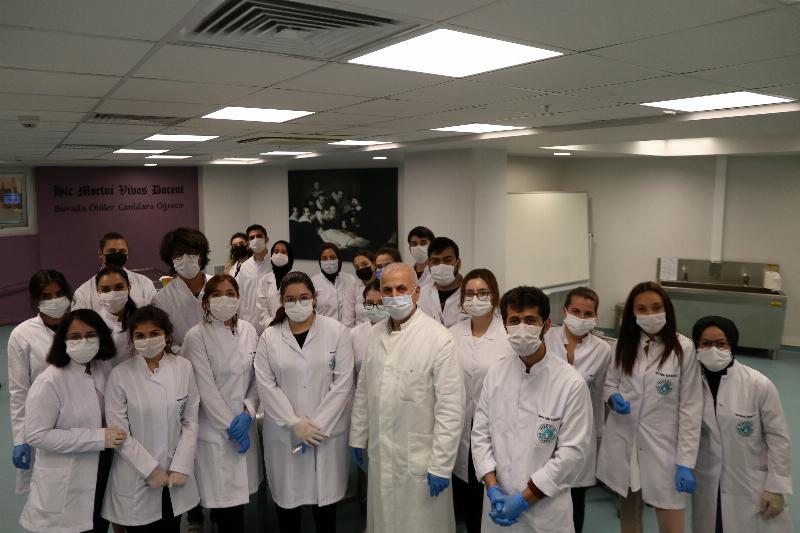
Usta stated that cadavers are an indispensable aspect of medical education and that no computer environment or virtual reality can replace them. “In cadavers, we call it dissection. Dissection means to separate, not to cut. The work done here is to separate, to make all structures visible by moving them apart from each other, and to see them in three dimensions. Also, one needs to touch the tissue. No matter how you explain what's there, it's impossible for a computer or anything else to imitate it. The most common thing is that students who finish school, enter residency, and specialize in surgery all come and ask, ‘Professor, can I work with a cadaver?’ They ask because they feel they didn't do enough in their time and are now operating on people. But the surgical field is small, and you have to be fast. Here, it takes hours and is broad. In surgery, you know the name of what you cut, but you can't see where it ends or begins. You work in very small areas. Therefore, learning new things there is very difficult. To learn and recognize that structure by working more extensively on a cadaver, especially if you want to develop a new surgical technique, you must work with a cadaver. Cadavers are indispensable in medical education. Computer environments, 3D models, virtual realities—none can replace them. They all have significant contributions, but none can, or ever have, replaced the cadaver.” he concluded.

