4 Ways to Reach Truth and Avoid Errors!
There are 4 methods for seeking truth in science. The first is experimentation and observation in positive science. The second is reasoning methods, based on causality. The third is intuition. Intuition holds special importance for some people. There are even studies called “The Neurobiology of Intuition.” They find truth through intuition. The fourth is beliefs. If a person cannot find answers through the first three methods, they find them through belief.
Why Within Reach?
This is how theoretical physics emerged. In theoretical physics initially, they said, “There must be particle physics.” Those involved in nuclear physics found it theoretically. The MRI device emerged 30-40 years later. The MRI device is the embodiment of theoretical physics. The rotation of electrons, theoretically, materialized as MRI. It emerged theoretically and was scientifically proven. For this reason, reasoning methods are among the most important methods in science. We also use this in psychiatry. The logical reasoning method tests a person's decision-making, attention maintenance, memory, and related visual, auditory, and memory processes. These methods can be used to understand creation.
Logic, used to reach truth, is one of the most important scientific methods. While mathematics, analytical thinking, reasoning, word generation, investigation of cause-effect relationships, calculation, and judgment are products of the left brain; products such as music, art, and painting belong to the right brain. Using logic also means activating the principles of thought in the left brain.
Brain Regions in Logic-Based Reasoning
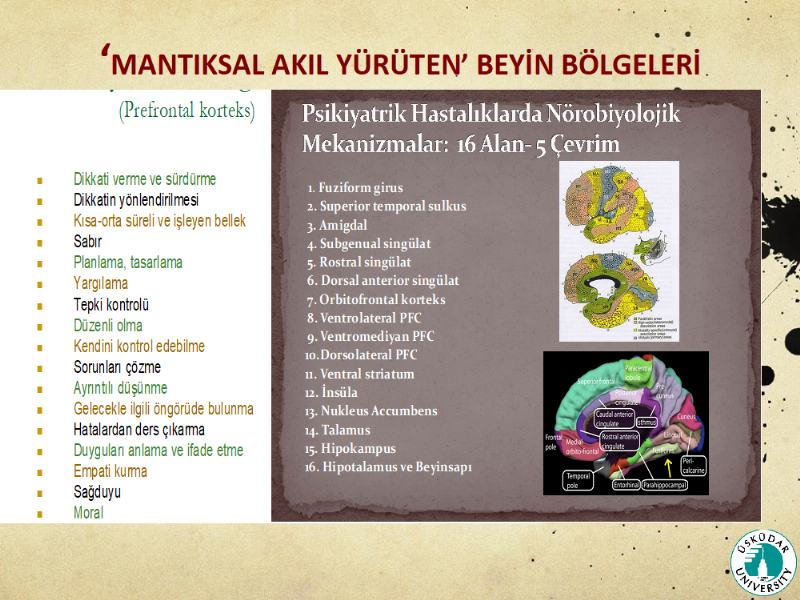
The frontal region of the brain includes attention, sustaining attention, directing attention, short-to-medium-term working memory, patience, planning, designing, judgment, impulse control, being organized, self-control, problem-solving, detailed thinking, predicting the future, learning from mistakes, and understanding and expressing emotions. Empathy, common sense, and morale are all characteristics of the frontal region of the brain.
There is a case in the literature known as Elliot. This case, highlighted in neuroscience, concerns a successful lawyer in the USA. He was very successful, with a house, car, yacht, etc. Around the age of 40, this person suddenly experienced a personality change. He missed trials, didn't go to work, etc. He lay around lazily, and after a while, he went to a doctor for a problem and had an MRI scan. A mandarin-sized tumor was found in the frontal region of his brain. After this tumor was removed, his personality somewhat recovered. However, it turned out that the personality change was caused by damage to the frontal region of his brain.
Abstract Thought, Conceptual Thought, Symbolic Thought
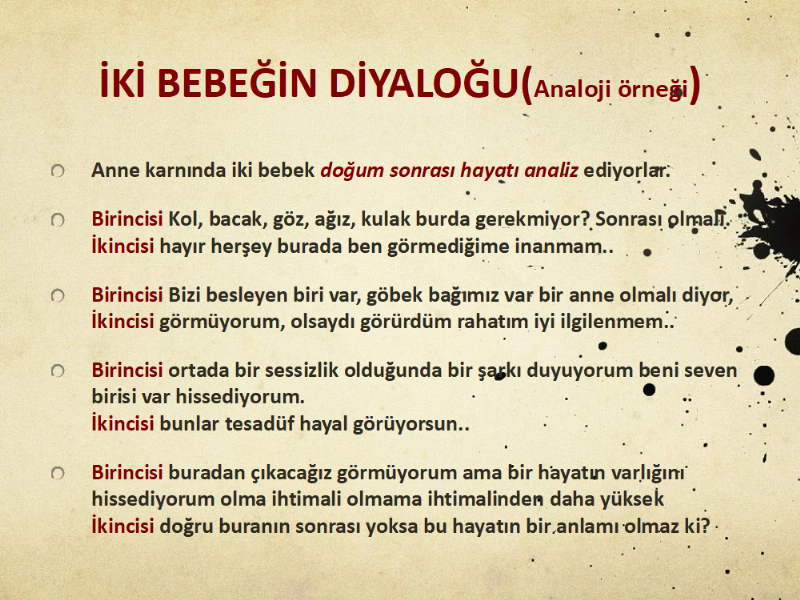
There is a causal relationship between the brain and abstract thought, conceptual thought, and symbolic thought. In the 1850s, a railway foreman was blasting a tunnel with dynamite. One day, while placing the iron rod, the dynamite exploded, and the rod entered through one eye, damaging his brain and exiting. The person fainted and lost one eye. He experienced epilepsy, but later regained consciousness, recovered, and was able to use his limbs. However, his personality changed. The disciplined man began to burp in public and make crude jokes. He came home late, slept late, and his personality completely changed. When these cases in the literature were combined, it was investigated whether “the region known as the 'silent area' of the brain is a region related to our behavior, morality, and personality?” In fact, our brain is not silent; it works unconsciously. What we call the unconscious or subconscious is implicit memory. If we think of it like a computer, just as system files run in the background, our brain also works without our conscious awareness. These features distinguish humans as a different species from other living beings.
Reasoning Methods, Evidence-Based Belief
Our brain characteristics also refute the thesis of evolutionary theory that advocates for coincidental existence. How can conceptual thought and symbolic thought based on comprehension arise by chance in a human being? This cannot be explained by the laws of physics. Therefore, this situation is currently an area where they cannot establish cause-and-effect relationships, similar to DNA. For this reason, there is a logic-based reasoning brain. Other living beings do not possess this logic-based reasoning, this “logical reasoning” feature. Now, in logical reasoning, there are 4 compared methods known to date.
The deduction method, or deductive reasoning, can also be called analysis. From cause to effect, from fire to smoke. In deductive reasoning, there is a fire behind the mountain, but you don't see the fire, you see the smoke, but with reasoning you say, “Since there is smoke, there must be fire, as smoke does not come from a place without fire,” but you see the smoke even though you don't see the fire. If someone says, “I didn't see the fire,” you say, “Smoke doesn't come from a place without fire.” This is proof that there is fire. In this situation, you cannot say, “There is no fire.”
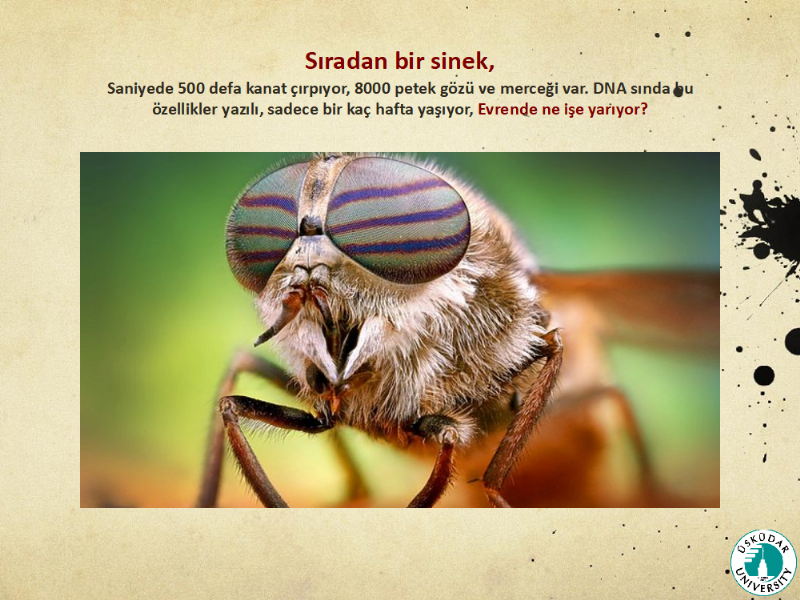
The other is the induction method. The method developed by Aristotle was only the inductive method. As an example of the inductive method, we can show understanding creation and existence by studying a fly.
The other method is called analogy, abduction, or the comparison method. It is based on understanding major premises by considering minor premises. For example, someone came from the center of Şanlıurfa and said, “There was a major accident there, 2 people died!” You may or may not believe them… 10 minutes later, someone else came and said, “There was an accident, 2 people died.” A third person also came and said the same thing… Now you have no doubt that an accident occurred there. When several independent people say this, you have no doubt; an accident has happened.
Thus, it becomes possible to understand a major premise by proceeding from some minor premises. This is called the abduction, analogy, or comparison method. In this way, it is possible to reach the truth, that is, to arrive at what is right and real through reasoning.
Logic-Based Reasoning + Evidence in the Universe + Divine Teachings = The Reality of Creation
Examine the characteristics of an ordinary fly. It flaps its wings 500 times per second, has 8000 compound eyes and lenses. These characteristics are written in its DNA, it lives only a few weeks, what is its purpose in the universe?
Abduction emerged later; modal logic came to the fore in the 1920s. Induction (from specific to general), demonstrative proof by effect, from effect to cause, from smoke to fire is a chain of logic. It is about being able to establish a connection with the cause by starting from the result. In the other case, it is about reaching the result from the cause and establishing a connection with it. The first is the method of drawing a conclusion by connecting from fire to smoke, and the other from smoke to fire.
Reasoning Methods
Numerical Reasoning: Reasoning related to the ability to analyze numerical sequences and relationships.
Logical Reasoning: Reasoning related to the ability to think and analyze based on logic.
Nonverbal Reasoning: Reasoning related to the ability to analyze visual and shape-based information. It expresses relationships of size, color, and form.
Verbal Reasoning: Reasoning related to the ability to analyze and interpret written information.
Another method is modal logic.
This is also called modern logic. It was defined in the years 1925-26. According to modal logic, the method for finding truth is as follows: Let's say you live in Istanbul, and there was an earthquake in 1999. Is there a probable or possible chance of an earthquake now? It's possible but not probable. Because if it were probable, you would need to sleep in the street, set up tents; it would be an immediate danger, but it's possible! For a distant danger, a weak possibility, that is, a very weak danger, you wouldn't think of setting up a tent. When analyzing a matter, the analysis is done by looking at which universe this belongs to. In existence, too, one proceeds according to this modal logic; can we understand existence by reasoning in this way?
First, I need to explain logic-based reasoning so I can explain its logic to you. Today, for intelligence and reasoning tests, there is an analysis system developed using these reasoning methods. It is used in the form of computerized modules. There are attention tests called SPM, COG, or the non-verbal learning test we call NVLT, DAUF long-term attention test, WISC-R and WaisInt…etc. All of these are tests that measure reasoning, intelligence, attention, and decision-making processes including focus, causality, difference, similarity relationships, temporal sequencing, and abstraction. CAS, Tova, Moxo tests are examples of attention tests. These are tests we use in daily practice. They are related to measuring a person's intelligence and reasoning power.
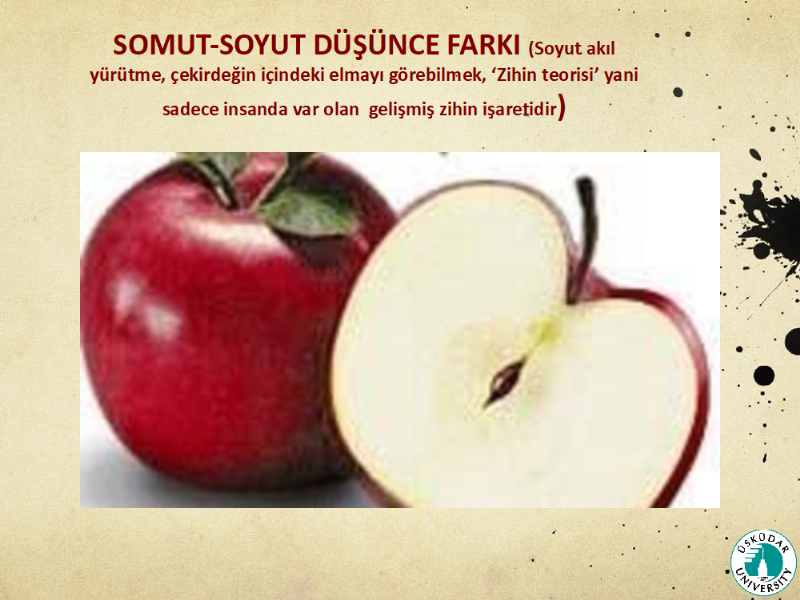
These tests are important in this context. The ability to use this exists in humans. You cannot give an intelligence test to an animal. You cannot give a reasoning test. Animals do not have a theory of mind. Only humans do. Furthermore, humans also have a theory of theory. In the theory of mind, when someone reaches into their pocket, we think they are taking out their keys; when they reach into their pocket while going to their car, you make assumptions about what they will do. This is the theory of mind. For example, autistic people do not have this. An autistic person only believes what they see. Animals do not have this either. An animal also believes what it sees.
There is also the theory of theory, which involves thinking about what the other person is thinking. This is called the theory of theory. All these are features in the human brain; because of these features, humans develop a theory of mind, distinguishing between autistic and non-autistic individuals. Autistic individuals are individuals who have no function other than eating, drinking, and reproduction. This condition makes a person ill, and people unable to produce abstract thought emerge with this disease. This feature is present specifically in humans. Why does this reasoning ability exist in humans but not in other living beings? This is the human ability to understand existence. It is genetically encoded in humans.
Logic is Used in All Sciences
While the application areas of logic were previously only a mental exercise in the philosophy of religion, after the 1930s it began to be applied in natural sciences. Psychology also started using it in the latter part of the twentieth century.
Now, the application area of logic is no longer limited to religion; logic is also seriously used in spiritual experiences and in the science of psychology. It is also applied in conceptual analyses of disciplines such as physics, mathematics, social sciences, and philosophy.
The purpose of logic is to move from the known to the unknown, from the visible to the invisible, from wrong behavior to correct behavior and truth. The purpose of morality is to reach truth and goodness. Logic has served all sciences and developments. The science of logic provides a methodology that can help all sciences in reaching truth while moving from the known to the unknown. Logic occupies a very significant place in the methodology of science. Logic is a method that facilitates human perception and leads to definitive knowledge.
Modern Logic
One must speak of the symbolic logic brought by modernism. If logic cannot be transformed into spoken language, if reasoning is not expressed, it is considered nonexistent.
In classical logic, imagination has been pushed into the background. When conducting schizophrenia research, three realities are mentioned. The first is material reality, the reality we perceive with our five senses. The second is imaginary reality. For example, in the world of imagination, we travel to space, fix the world, do good and beautiful things for people, start wars, make peace. We call these fantasies and then return to the material world. The world of imagination has its own reality; novels are written this way. Literature emerged in this manner. Futurists made predictions about the future based on this. Imagination is important in the advancement of science, as it gives rise to productive and exploratory thought. What Newton did was a journey in the world of imagination. What Archimedes did was the material world's reflection of a journey in the world of imagination. Rationalism and empiricism disregarded the reality in the world of imagination, reducing science solely to matter through experimentation and observation. They relegated theoretical physics, theoretical logic, and theoretical sciences to the background.
Here, in modern logic, theoretical sciences operate alongside positive sciences. Theoretical knowledge, knowledge from the world of imagination, is being attempted to be made expressible. For example, recently, efforts are being made to film the dreams of people dreaming at night.
After material and imaginary reality, the third is dream reality. When a dreamer wakes up, if they don't suddenly realize they've woken up, they continue to live their dream; an observer from outside might think they have lost their mind. The truths in a dream are not the same as the truths in the material world. Both have different psychological dynamics.
In symbolic logic, a journey towards reality is made by operating with different assumptions. In this logic, inferences are made, and their validity is checked. To be testable, symbols such as imagination symbols, existential symbols, angel, devil, opposition, and truth are defined. A mechanism to control these symbols is then created.
Modal Logic
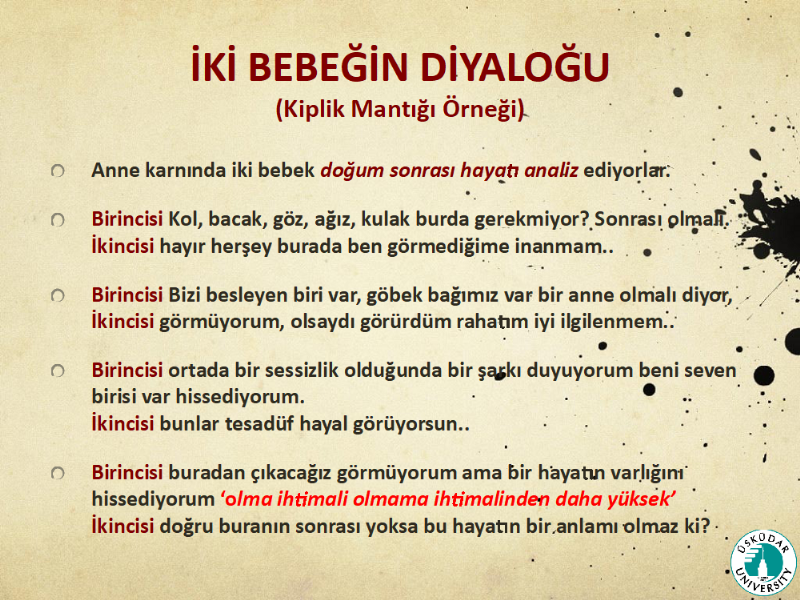
In modal logic, there are four states: the real world, the necessary world (actual world), the possible world, and the probable world. It involves thinking about the truth value of each world and making decisions through reasoning.
For example, we can give a person who is about to pray experiencing doubt about their ablution as an example of modal logic. Someone who doubts their ablution thinks that their prayer is not valid because they are not clean. When modal logic is considered, according to the first state, the real world: “The prayer of one who is not clean is not valid.”
According to the second state, the necessary world: “There is impurity in the intestines. Therefore, you are not clean.” According to the third state, the possible world: “You know you have performed your purification. If you do not remember otherwise, you are clean.”
According to the fourth state, the probable world: “You might be impure, you might not have performed ablution; in that case, your prayer is not valid.”
Here, the truth value of each world is analyzed separately. According to the possible world, if a person perceives themselves as 51 percent clean, they are clean; that is, if they are clean by preponderant opinion, they have performed ablution. The conclusion drawn according to modal logic is this: “You are living in the possible world, therefore you have performed ablution.”
This logic shows the scrupulous person how to act according to the truth value of the probable world.
This method is used by psychiatrists and psychologists in obsession, in correcting cognitive distortions, mental distortions, and perceptual defects.
In modal logic, the truth value of a proposition in a possible world is examined. This is whether what the proposition points to is real, necessary, or possible.
Moral Reasoning
One of the important methods of modern logic is moral reasoning. In the proof method of existential sciences, the definition of moral reasoning is included. According to the first degree of this reasoning, there is consequence-oriented thinking. For example, a child spills a glass of milk and infers whether it is good or bad based on the outcome. They decide based on what is apparent. Since they cannot make the abstract interpretation, “Actually, there was something harmful in the milk, that's why they spilled it,” they remain at the lowest level.
In the second degree of reasoning, intention is taken into account. For example, if someone gets angry with you and you dismiss them as “That person is bad,” a low level of reasoning has been performed. In reasoning according to abstract values, intention is considered, and empathy is shown by putting oneself in another's shoes. Decisions are made with a sense of duty and responsibility. Moral reasoning is performed according to the consciousness of social order, considering questions such as “Does my decision harm others, do I need to endure this difficulty for my future, what is the other party's intention?”
In the third degree, there is higher reasoning. At this stage of reasoning, a person succeeds in being just, showing compassion, alleviating suffering, resisting instincts, being self-sacrificing, enduring hardship for others, enduring hardship for their ideals, and considering the feelings of others. This reasoning is not found in everyone, but only in wise individuals and the ideal human type. Children cannot perceive based on intention. They only make decisions based on what is apparent; as they mature, intention-based decision-making develops.
Moral reasoning occurs within modal logic. In this logic, abstract values and decision-making that considers intention come to the forefront. According to this situation, how should ideal learning be? Ideal learning is the ability to reproduce knowledge. Logic that is based on reproducing knowledge is ideal reasoning. This method is also found in modal logic. This is because other options, differences, and other realities outside of one's own reality are also considered. In modal logic, necessities, possibilities, the difference between fact and perception, perceptual distortions, and prejudices are observed. The underlying reasons for the other party's exaggeration or minimization of an event are understood. In cognitive distortions in psychology, treatment is applied by changing thought habits. While developing the decision-making centers in a person's brain, a reasoning method that reproduces thought is applied. This is a style that questions the existing, rather than just building upon it, and develops thought.
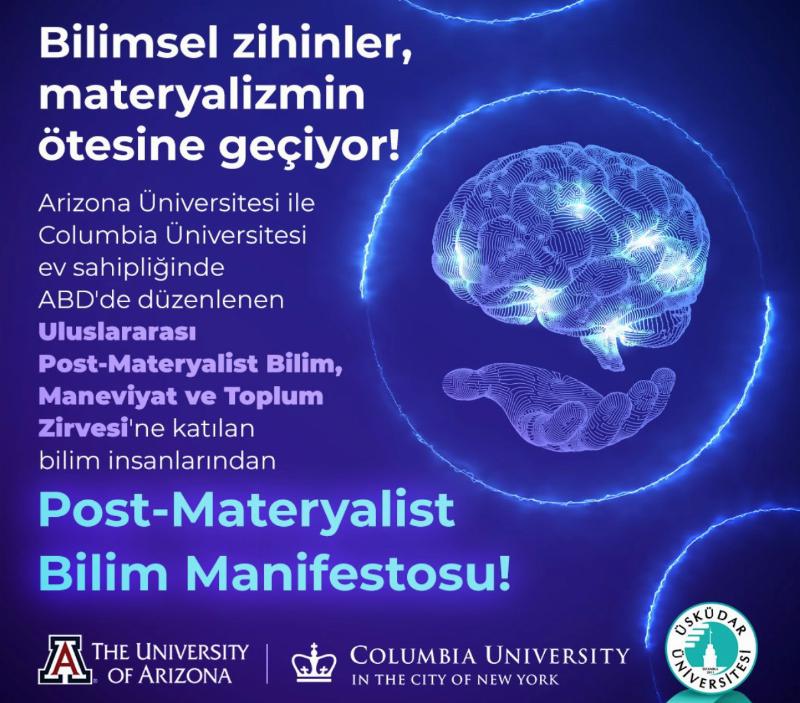
Post-Materialist Science Manifesto
Finally; I would like to state that Neuroscience Brain and Consciousness studies have led us to the collapse of materialism, that rational belief is possible, and that Spinoza's error has been understood. It has now begun to be discussed that Religion and Science are a whole. It has been understood that evolution has an evolution, and that the laws of evolution cannot operate independently of an external reality. An explanation bringing a holistic scientific perspective was announced in 2014 by Dr. Mario Beauregard and his colleagues from Arizona and Columbia Universities.
Prof. Dr. Nevzat Tarhan
Founding Rector of Üsküdar Üniversitesi - Psychiatrist
Zafer Dergisi

