

The United Nations International Narcotics Control Board (INCB) 2020 Report was announced simultaneously with the world by Üsküdar Üniversitesi Vice Rector, Member for the periods 2005-2010 and 2015-2022 and former President of the United Nations (UN) International Narcotics Control Board, Prof. Dr. Sevil Atasoy.
Content
UN International Narcotics Control Board (INCB) 2020 Report Released
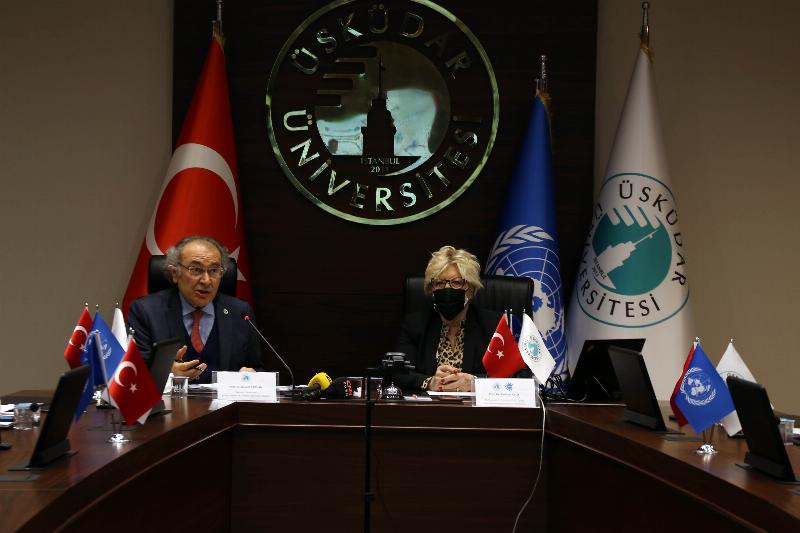
Highlighting Turkey's significant achievements in combating drug supply, Prof. Dr. Sevil Atasoy emphasized that Turkey ranks third globally among countries seizing the most heroin, after Iran and Afghanistan. Prof. Dr. Atasoy noted that during the pandemic, the Balkan route, which originates in Afghanistan and passes through Turkey to Europe, continued to be used. Prof. Dr. Atasoy also stated that illegal shipment methods diversified during the pandemic, with masks, gloves, and disinfectants being used in smuggling.
Speaking at the press conference, which was held in a diluted and simultaneous online format due to the pandemic, Üsküdar Üniversitesi Founding Rector, Psychiatrist Prof. Dr. Nevzat Tarhan, warned, "There is a Great Reset related to Covid." Noting that the world is experiencing a global and major reset, Prof. Dr. Nevzat Tarhan said, "As a society, we must take seriously the pandemic of loneliness and psychiatric illnesses, especially among our youth and the elderly, created by the global pandemic. If we do not implement the Great Reset, we will become the objects of a global disease."
At the press conference held in a diluted and simultaneous online format due to the Covid-19 pandemic at Üsküdar Üniversitesi Central Campus Senate Hall, Üsküdar Üniversitesi Vice Rector, Member for the periods 2005-2010 and 2015-2022 and former President of the United Nations (UN) International Narcotics Control Board, Prof. Dr. Sevil Atasoy, shared the INCB 2020 Report. Üsküdar Üniversitesi Founding Rector, Psychiatrist Prof. Dr. Nevzat Tarhan, also attended the press conference.
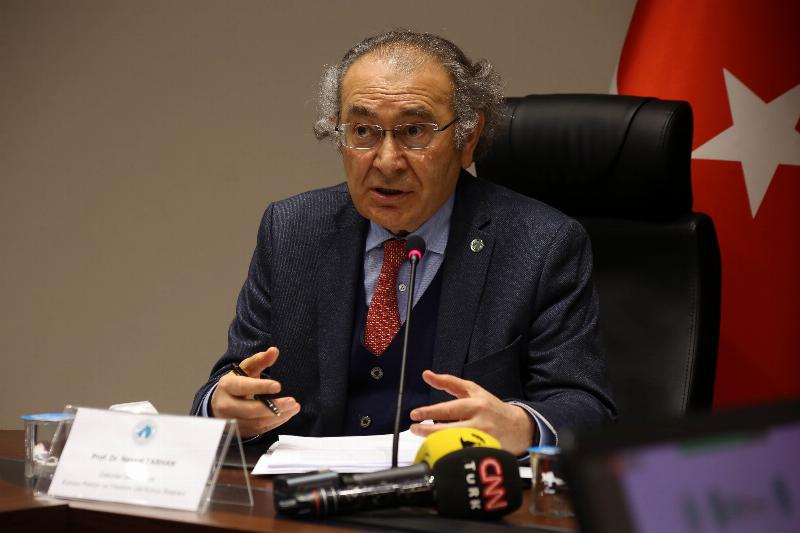
Prof. Dr. Nevzat Tarhan: "Substance use increased in elderly individuals"
Üsküdar Üniversitesi Founding Rector, Psychiatrist Prof. Dr. Nevzat Tarhan, stated in his opening speech that the report's summary drew attention to the issue of elderly individuals with substance addiction, emphasizing, "It is very important that this issue is brought to the forefront seriously. When we look at the relevant statistics, it is indeed observed that the rate of substance use among individuals over 65 has increased globally, and Covid-19 has accelerated this. While the current number of people over 65 in the world is 103 million, this figure will reach 1.5 billion by 2050. This is not just a reality for high-income countries; it is also a reality for middle and low-income countries," he said.
Prof. Dr. Nevzat Tarhan: "Loneliness directs elderly individuals towards substance use"
Prof. Dr. Nevzat Tarhan stated that when investigating why elderly individuals are more inclined to use substances, the most striking reason found is loneliness, adding, "In 2018, a study on loneliness was conducted in the UK. This study found that 27 percent of individuals over 75 suffered from loneliness. Furthermore, people experiencing loneliness are more prone to substance use. Globally, a 'loneliness crisis' is approaching. In 2018, the UK established a Ministry of Loneliness. Last week, Japan also established a ministry. If we, as Turkey, do not want to establish a 'Ministry of Loneliness' within the next 10 years, we need to take precautions now. Studies must be conducted to prevent elderly people from becoming lonely and from feeling the need to use substances," he said.
Prof. Dr. Nevzat Tarhan: "During the pandemic, elderly individuals started using antidepressants"
Stating that scientific research shows global trends, Prof. Dr. Nevzat Tarhan said, "If research were conducted in our country, clues regarding these trends would likely emerge. From our own experience as academics, we observed during the pandemic that elderly individuals started using antidepressants, and compensated Alzheimer's patients became decompensated and unable to perform their own tasks. Unfortunately, Covid-19 is the reality of our day," he said.
Prof. Dr. Nevzat Tarhan: "The world is experiencing a global and major reset"
Warning, "There is a Great Reset related to Covid," Prof. Dr. Nevzat Tarhan continued:
"Covid-19 is currently being called the 'Great Reset.' The world is experiencing a global and major reset. The world and societies must reset themselves. Therefore, policymakers must definitely take the concept of the Great Reset into account. As a society, we must take seriously the pandemic of loneliness and psychiatric illnesses, especially among our youth and the elderly, created by the global pandemic. If we do not implement the Great Reset, we will become the objects of a global disease in such situations. However, we must be the subject, and we must manage the disease, not let the disease manage us. For this, policymakers must be proactive."
Prof. Dr. Nevzat Tarhan: "Elderly individuals can easily access illicit drugs"
Prof. Dr. Nevzat Tarhan drew attention to the need to prioritize programs related to substance addiction in elderly individuals, stating, "In Turkey, our clinical observations show that alcohol use among the elderly goes beyond social drinking. It is even interesting to note that illicit and recreational substances, which are usually seen as problems for young people and used outside legal purposes, are easily obtained and used by elderly individuals due to their intellectual connections. We observe antidepressants and antibiotic medications being used to an addictive extent. Globally, we can say that the pandemic has a higher risk of triggering problems for elderly individuals more than for young people," he warned.
Prof. Dr. Nevzat Tarhan: "Covid-19 affected the drug market"
Stating that protection services weakened during the pandemic, Prof. Dr. Nevzat Tarhan said, "As many countries found it difficult to access medication, the global sale of illicit chemicals increased, leading to a peak. Therefore, Covid-19 not only affected hospitals but also the drug market. We observe the use of cheap chemicals, the active role of dark web areas in this regard, an increase in deaths due to overdose, and the misuse of cannabis outside of medical purposes. Therefore, as Turkey, we are fortunate to have an academic like Sevil Atasoy, who knows our country, on the United Nations International Narcotics Control Board. Prof. Dr. Sevil Atasoy serves as an independent executive on the committee. We have the opportunity to reflect our problems to the United Nations and contribute to the determination of global policies," he said.
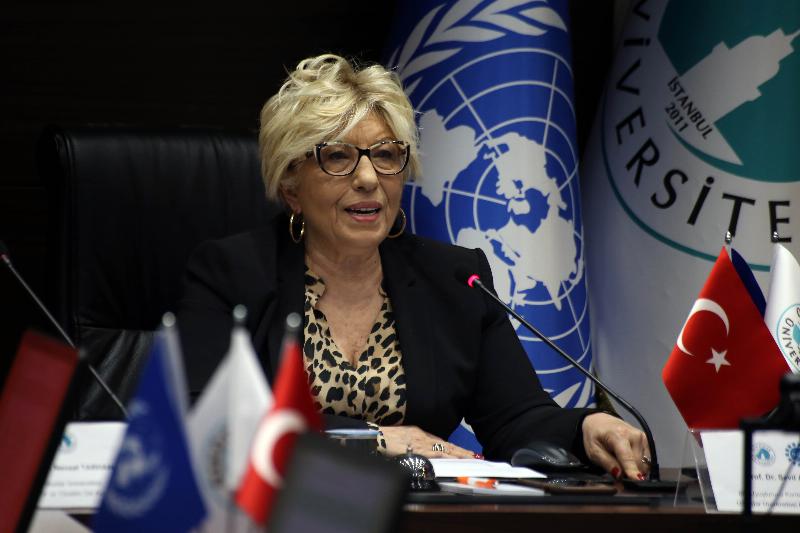
Prof. Dr. Sevil Atasoy shared the 2020 Report
The INCB 2020 Report was simultaneously shared by Üsküdar Üniversitesi Vice Rector, Member for the periods 2005-2010 and 2015-2022 and former President of the United Nations (UN) International Narcotics Control Board, Prof. Dr. Sevil Atasoy, in Vienna, where the Board's secretariat is located, and in major cities of some countries.
Prof. Dr. Sevil Atasoy renominated for the 2022 – 2027 term
Prof. Dr. Sevil Atasoy stated that she has been renominated for the 2022-2027 term for the International Narcotics Control Board (INCB), of which she is currently a member, and said:
"The International Narcotics Control Board, or INCB, established by the 1961 convention, is tasked with monitoring the implementation of conventions, identifying shortcomings, making recommendations, and, when necessary, applying sanctions. The 13 members of the board, of which I am currently a member, are elected for a five-year term by 56 countries that are members of the Economic and Social Council; they are impartial individuals and do not represent their countries. Before my current term of 2017 – 2022, I also served as a Board member between 2005 – 2010. With the approval of our President, I have been renominated by our Ministry of Foreign Affairs for the ECOSOC elections to be held in New York on April 20th for the 2022 – 2027 term. I extend my gratitude to them."
Theme of the 2020 Report: Elderly individuals with substance addiction
At the press conference, which specifically highlighted matters recorded regarding Turkey, Prof. Dr. Sevil Atasoy noted that, as every year, this year's world report also had a theme: "The issue we particularly want to draw governments' attention to is elderly individuals with substance addiction. While 703 million people over 65 lived in the world in 2019, this number is projected to double to 1.5 billion by 2050. One in every six people of the total world population will be over 65 years old. Initially, while the elderly population was a reality for high-income countries, with the development of health services, the same situation now applies to low-income countries. In the last 10 years, the rate of substance use among the elderly population has increased faster than among the young population. It would be incorrect to assume that this rapid increase is solely caused by the "Baby Boomer" generation, born in wealthy countries between 1946 and 1964. Even though substance addiction among elderly individuals has become a global problem, governments are not adequately addressing this issue, and we emphasize the need to develop treatment programs specific to the elderly, both for those who continue substance use because they encountered it in their youth and for those who became addicted in old age due to various reasons," she said.
Prof. Dr. Sevil Atasoy: "Smuggling methods diversified during the pandemic: Masks, gloves, and disinfectants were used"
Prof. Dr. Sevil Atasoy stated that the pandemic also affected smuggling methods, saying, "Although there was a decrease in international legal trade and in the smuggling of some illegal substances, air and sea smuggling continued unabated. While land smuggling was observed, we also witnessed drug smuggling through different transport routes and under the guise of legal trade. Smuggling methods diversified. We witnessed drug smuggling via mail or parcel services, home food delivery services, and even by placing drugs inside masks, gloves, or disinfectants, as if importing or exporting masks or disinfectants. Social media became an important channel for accessing drugs and connecting sellers with buyers. Of course, we detected that a much larger part of the internet beyond what we see, in what we call the dark net or dark web, facilitated both the buying and selling of raw materials for drug manufacturing and addicts' access to substances much more widely," she said.
Prof. Dr. Sevil Atasoy noted that although pandemic restrictions may have reduced the consumption of substances like ecstasy, typically used collectively in nightclubs and parties, drug sales continued on both the open web and dark web markets, on social media, and on encrypted online platforms and forums.
Prof. Dr. Sevil Atasoy: "Our country has significant leadership in the fight against drugs"
Prof. Dr. Sevil Atasoy stated that Turkey uses the PICS operational coordination system in the fight against drugs, saying, "Together with Iran, Bulgaria, the Netherlands, and Interpol, it was revealed that 22,000 liters of anhydride seized in 2017 and 2018 belonged to the same organization. Investigations are ongoing, but our country has significant leadership in this area. As you know, anhydride is, despite everything, the primary chemical for obtaining heroin. Without it, it would not be possible to obtain heroin cheaply through traditional methods. Turkey is one of the few countries that seizes more than 10,000 liters of anhydride annually. The same happened in 2021. We will probably have broken our own record in 2021," she said.
Prof. Dr. Sevil Atasoy: "Turkey, the third country with the most heroin seizures"
Prof. Dr. Sevil Atasoy noted that Turkey ranks third globally among countries seizing the most heroin, after Iran and Afghanistan, adding, "Naturally, it's third because heroin originating from Afghanistan comes to our country via Iran and then passes to Europe. However, it is certain that during the pandemic, the famous Balkan route, originating from Afghanistan and passing through Turkey to Europe, continued to be used, and numerous heroin seizures along the Afghanistan-Iran-Turkey-Balkan countries axis served as proof of this," she said.
Impacts of the Covid-19 pandemic on drug control examined
Prof. Dr. Sevil Atasoy noted that in the 2020 World Report, they examined the impacts of the Covid-19 pandemic on drug control, stating, "As expected, global restrictions imposed due to the pandemic severely affected access to treatment for individuals with mental health issues and substance dependents. According to World Health Organization data, patients in at least 40 countries could not access medication and faced life-threatening situations. Especially the disruptions in the treatment of heroin addicts left them to face the agony of withdrawal, leading them to share syringes with other users and contributing to the spread of HIV," she said.
Prof. Dr. Sevil Atasoy: "Addicts turned to more dangerous drugs during the pandemic"
Prof. Dr. Sevil Atasoy noted that the Covid-19 pandemic also affected illicit drug markets, stating, "In many countries, it disrupted the efforts of security forces and led to changes in smuggling routes and methods. Addicts who could not find their substance of choice or could not afford the increased prices turned to much more dangerous and cheaper chemicals, often produced in local laboratories," she said.
The INCB 2020 Report, on one hand, extensively covered developments and challenges encountered in different regions of the world. The report also included views on the danger of fentanyl, which causes widespread deaths due to overdose; the increasingly widespread use of cannabis (marijuana) for non-medical and non-scientific research purposes, contrary to conventions; the diversification of precursor chemicals used in drug production; and the control of new psychoactive substances appearing on the market every week. The 2020 Report also contained our recommendations to other UN bodies and governments.
Share
Update Date: February 27, 2026
Creation Date: March 25, 2021
Request a Call
Other News
- Social responsibility courses moved to the field
- Erasmus+ Orientation Week completed at Üsküdar
- Prof. Nevzat Tarhan: “Brain secretes ‘dark glue’ in social media lynchers!”
- Prof. Nevzat Tarhan: “Every segment of society should be able to say, ‘This constitution is my constitution!’”
- OHS releases guide for safe operation of industrial robots