

Emphasizing the importance of objectivity in the medical profession, Psychiatrist Prof. Dr. Nevzat Tarhan stated that trust is the most important capital between physician and patient. Emphasizing that it is necessary to establish a relationship that increases trust between the two parties, Prof. Dr. Nevzat Tarhan said, “For a physician to be objective is very important to build trust. An open, transparent, and honest relationship is required for the formation of a basic sense of trust. Therefore, the magical concepts here are objectivity and fairness.” Prof. Dr. Tarhan underlined that a professional should also be independent of their own worldview. Prof. Dr. Nevzat Tarhan stated that healthy cooperation exists where love and trust are together.
Content
Trust is the Most Important Capital Between Physician and Patient
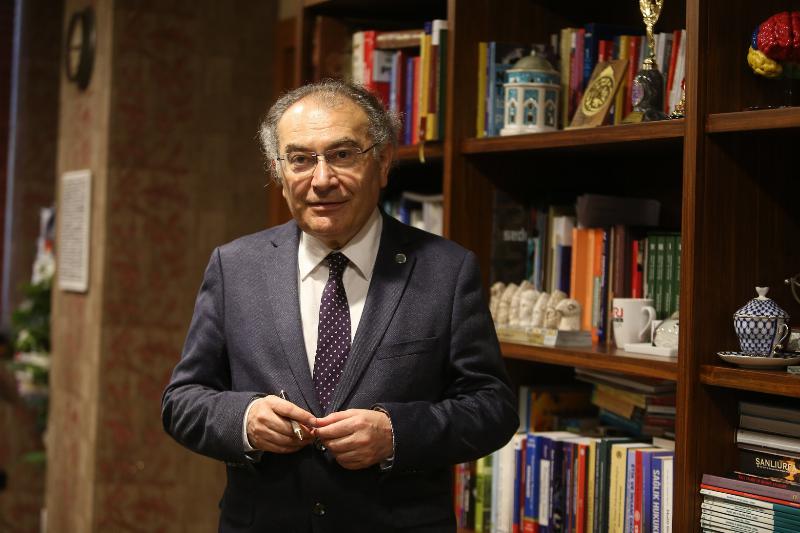
Üsküdar Üniversitesi Founding Rector, Psychiatrist Prof. Dr. Nevzat Tarhan, made an evaluation by pointing out the importance of objectivity in the medical profession.
A trust-based relationship should be established with the patient
Noting that therapeutic cooperation is taught in mental health medicine and clinical psychology training, Prof. Dr. Nevzat Tarhan said, “In this basic relationship, one of the fundamental steps of therapeutic cooperation is trust. In other words, if you cannot establish a trust-based relationship, you cannot establish a telepathic relationship. Therefore, the most important thing is to build trust with the patient or client.”
Trust is the most important power
Noting that knowledge and trust are the two most important capitals in life, Prof. Dr. Nevzat Tarhan stated that the most important condition for doing a profession in the best way is to love that job. Prof. Dr. Nevzat Tarhan said: “These two capitals are also the most important power in leadership, more effective than financial power. A company that operates with financial power manages the company with fear. Fear-based loyalty is short-lived. True loyalty is trust-based loyalty. This exists in corporate loyalty studies. This is also valid for family loyalty and human relations. In loyalty and trust studies, people are asked why they come to work. Individuals with high loyalty scores stated that they came because they loved their workplace. As the second reason, they stated that they came to feel secure about their future, and as the third reason, for the salary they received. Therefore, the most important thing that connects a person to their work, to life, to treatment, and to human relationships is to love what they do. After that comes feeling secure about their future and financial reasons.”
Objectivity is required to build trust
Noting that trust is the most important capital and most valuable currency between a physician or psychologist and a patient or client, Prof. Dr. Nevzat Tarhan said, “Therefore, it is necessary to establish a relationship that increases trust between the two parties. For a physician to be objective is very important to build trust. An open, transparent, and honest relationship is required for the formation of a basic sense of trust. Therefore, the magical concepts here are objectivity and fairness. When looked at in the dictionary, it means impartiality. Objectivity has another meaning. There is also an objective lens in telescopes and microscopes. What does it do? It brings distant objects closer and shows detail. So, in fact, being objective means seeing what no one else sees and being able to make correct decisions. Medicine requires objectivity. Objectivity means being able to see with the eye of reason.”
How to be objective towards the patient?
Noting that every individual can have core values from the past, life scenarios, prejudices, strengths or weaknesses, Tarhan said, “A physician, a therapist, and a patient – all of us have shock experiences, assumptions, and expectations. Within all these, there is a cultural environment everyone lives in, an ecosystem they live in, and prejudices they hold. Given all these, how can a physician or therapist be objective towards a patient or client who consults them?”
Raising awareness of their prejudices is ensured
Noting that there are supervision trainings in clinical psychology to ensure this objectivity, Tarhan said:
“For example, there is a religious psychologist. We give them a transgender case as a patient. We ask how they would approach this person. If this specialist has homophobia, if they have prejudices, it immediately becomes apparent. What does the specialist do here? They become aware of their prejudices, put them aside, and learn to accept this person as a patient. Here, they learn to self-criticize and thus ensure objectivity towards the patient.
Objectivity is taught in clinical communication
Let's say there's also the opposite situation: a very modernist specialist with no religious sensitivity. We give this specialist a case of someone who wears their religiosity like a badge, with a robe and beard. We ask them to analyze that case. If there are prejudices, they emerge one by one. Thus, in therapy, we confront them with prejudice, meaning we teach objectivity. This is called clinical communication. If you can do this in clinical communication, only then do you become a therapist. Otherwise, you are merely a representative of an ideology or a worldview. If you are a professional, you must also be independent of yourself.”
A therapist does not give suggestions, they can offer options
Prof. Dr. Nevzat Tarhan stated that being objective is the principle of impartiality, and that this is a social wisdom formed through centuries of accumulated experience, saying, “The method for learning and teaching objectivity is the Socratic questioning method. In therapy, there are some sequential questions. For example, if a client expresses a thought on a topic, the therapist needs to bring a different perspective to the client and offer options. Guidance is not given with questions and suggestions such as ‘Don’t do this, don’t do it this way, divorce your spouse, live your life’.”
We offer options, the patient makes the decision
Tarhan stated that psychiatry and the profession of a therapist are highly responsible and morally accountable in this sense, saying, “The patient or client will make the final decision. We will offer them options, and they will make the decision. This is actually a general rule.”
Prof. Dr. Nevzat Tarhan stated that this rule is also valid in child education, saying, “A parent should also do this when educating their child so that the child forces and pushes their brain and finds their own truths. Let them be the captain of their own ship. If a parent wants to teach their child to be the captain of their own ship when educating them, they need to teach the child independent thinking and free decision-making. For that, we will offer options. We need to teach in a way that says, ‘If you do this, the cost-benefit analysis will be like this; if you do this, what will you gain and what will you lose?’”
Socratic questioning is important
Tarhan stated that if a person’s thought is dysfunctional or likely to harm that person, the question “Is this thought realistic?” should be asked, adding, “There is a filter of Socrates related to this, called Socratic questioning. One of his students comes to Socrates and says he has news. Socrates tells his student, ‘Wait a minute, I’ll ask a question, and if you pass it, then tell me,’ and asks, ‘Are these things you’re saying true?’ His student says he doesn’t know. Socrates asks, ‘Well, are these things you’re saying correct?’ The student again says he doesn’t know. Socrates asks, ‘Well, are they good and useful?’ and his student again says he doesn’t know. Socrates says, ‘Don’t tell me things whose truth you don’t know, and whose usefulness you don’t know.’ These are filtering and Socratic questioning. For example, you will ask this person, ‘Is this thought real?’ They will immediately say, ‘I heard it from so-and-so.’ They don’t know if it’s real, but they've believed it. Humankind is always inclined to believe things that they like, things that are too good to be true.”
The biggest cause of injustice is a lack of objectivity
Stating that people sometimes approach events with prejudice, he said, “A person does not become aware of their own prejudices. We call this professional thought disorder. A physician or therapist with a professional thought disorder belittles their patient. They think, ‘I am valuable, they are worthless.’ Currently, it is being debated in the American Psychiatric Association whether such a diagnosis should be included in the classification system. Because many examples have started to emerge. For example, there is prejudiced behavior towards Black people. Professional narcissism, like ethnic narcissism, can also be observed. The biggest cause of injustice is a person’s lack of objectivity. Being fair means a person approaches things equitably.”
Formula for healthy cooperation: Love + trust
Emphasizing that there would be no peace where there is no impartiality and objectivity, Prof. Dr. Nevzat Tarhan stated that healthy cooperation exists where love and trust are together.
Prof. Dr. Nevzat Tarhan said, “There is no peace where there is no impartiality, no peace where there is no objectivity. Because everyone has prejudices. If you want peace somewhere, trust is essential. For there to be trust, there must be justice. Love plus trust equals healthy cooperation. Love alone is not enough. If love and trust combine, healthy cooperation occurs, and justice and commitment emerge.”
Without trust, there is no attachment
Noting that there are two meanings in commitment and loyalty, Tarhan said, “One is to be truthful, and the second is loyalty. In other words, truthfulness and commitment are equivalent. Since trust is not formed in someone who is not truthful, open, transparent, or honest, there will be no attachment. Therefore, if we want therapeutic attachment, if a leader wants people to be attached to them, if they want people in their company to be attached to them, an open, transparent, and honest relationship is required. This is a prerequisite for the formation of a basic sense of trust.”