

Depression is the disease of our age. At the same time, the postmodern era triggers attachment problems. So, how is it possible to protect our mental health? What are the effects of spirituality on psychology? We asked all these questions and more to Prof. Dr. Nevzat Tarhan, a scientist who has dedicated half of his life to the science of psychology.
Content
To protect yourself from depression, change yourself instead of changing the world!

Short-term relationships or dependent partnerships... Is being constantly sad called depression? When should one act? We asked all these questions and more to our esteemed professor Prof. Dr. Nevzat Tarhan, the father of psychology with nearly 70 articles. Here are the details...
Prof. Dr. Nevzat Tarhan, who made important statements to Sena Parlar from Aksam.com, stated that the first way to protect oneself from depression is to change one's perspective on life.
If we ask, what are the 3 ways to protect against depression, what would be your answer?
We can summarize the 3 most important ways to protect against depression as follows: First, it's important to know that there are two types of depression: minor depression and major depression. Minor depression can be successfully overcome by an individual's own efforts. One can protect against it, but for major depression to emerge, it definitely requires seeing a specialist. This needs to be understood. The most important aspect of depression is this question of preventive medicine. Since it's a question of preventive medicine, it asks "how should people live?" to prevent them from falling into depression. Here are 3 concise answers, let's call them 'pill answers,' regarding lifestyle.
The first point regarding people's lifestyle is to change your perspective on events. That is, people cannot change events 80% of the time, but they can always change their perspective on events. For this reason, when an event occurs, we hold the event responsible for 80% of the incorrect decisions we make regarding it. In fact, we can change 80% of events by changing our perspective. So, for 80% of the events we experience and encounter, we can change them by changing our perspective. Therefore, when we currently look at an event with automatic biases, there is a first thought, first emotion, and first reaction that comes to mind. If one cannot resolve this, it is important to consider what a 'B' way of thinking or a 'C' way of thinking would be instead. In such situations, one can solve the event or problem experienced. This is also a problem-solving method.
The second is, "Instead of changing the world, change yourself." Especially, there are things a person cannot control, things beyond their power. There are things one has the power to do, and things one does not. For example, if a person entering winter says, "I don't like winter, I hate winter," and succumbs to such a feeling, they will suffer. Because they are imagining and wanting something beyond their power. Some events in life are like this too, such as death or certain severe illnesses. In such situations, they should apply the "accept-manage" method. For events they cannot control, things beyond their power, they should accept and manage. They will accept the events. They will say, "I cannot change this event. I accept it. It is beyond my power. But how can I manage it?" If they can find a solution themselves, they will. If they cannot find a solution, we say to seek help from a good source. It doesn't necessarily have to be an expert immediately; it could be someone with life experience who knows about the matter. We can call this getting help from a good source.
Thirdly, we say to reconsider the meaning you give to life to avoid depression. The search for meaning is very important. Generally, the biggest cause of depressions, especially in this 21st century, are depressions related to the loss of meaning. For example, I once encountered a patient who attempted suicide. When I asked, "Why do you want to commit suicide?" she replied, "I don't have a reason to live." Therefore, always have a reason to live. One thing we will say here is that a person who has a reason to live will find a way to add meaning to their life. In such methods, one can succeed in looking at events from a positive rather than a negative perspective. That is, if a person gives negative meanings to life, they easily fall into depression, but if they give positive, realistic, and positive meanings, that is also their motivation technique. This is a self-motivating, pleasure-seeking technique. Another feature of this search for meaning is that it creates a sense of flow in a person. The sense of flow is like this: A person can even forget to eat. They work for hours. They get so engrossed in a task that they forget everything. This is the sense of flow. The sense of flow is one of the teachings of happiness. Try to experience this feeling in your life. We say, either do the job you love, or love the job you do. For a person to love the job they do, they must not be like other living beings, only concerned with eating, drinking, reproducing, and sheltering. These are the characteristics of other living beings. These are concrete meanings and pleasures, but humans are satisfied with abstract meanings and pleasures. They need to direct their love towards them. Modernism directs love towards these first four things: eating, drinking, sheltering, and reproducing. It is content with these. It only makes people set worldly goals, but in the search for meaning, humans think of higher values. They think of everything, abstract values. That is, not just a person who thinks of themselves, but a person who thinks of the society they live in, a person who thinks of the country they live in, and beyond the country... A person who thinks of the planet they live on, and even a person who thinks universally. A person who can incorporate this into their search for meaning, in such feelings, experiences a deeper pleasure from the work they do because they know its meaning, and can create a life that leaves a mark. Therefore, we can say that those who succeed in living meaningfully are less likely to fall into depression.
What factors can we list among the causes of attachment problems?
Regarding attachment problems, it is important to distinguish between attachment and dependency. These concepts are often confused. Attachment exists in humans, and partially in other living beings as well. For example, all young ones have an attachment to their mother. A chick, for instance, attaches to its mother. In fact, an experiment was done with chicks. One group of chicks, the chicks of a hen, were dyed blue on their necks and backs. Others were marked with red. The chicks were then mixed again with the blue ones. When the chicks gathered again, the blue ones found their own mother, and the red ones found their own mother. How does this happen? This is a scientifically researched topic right now, but it has been found. There are mirror neurons in their brains, between the chicks and their mothers. These mirror nerve cells work like wireless internet and establish a connection. The feeling of attachment in all living beings is biological, neurobiological; it has an equivalent. Later, after this chick grows up, the mother hen pushes it away with her wing and chases them off. Then they try to create their own lives, but a human mother does not do this. She reaches 80 years old, and her child is 60 years old, and she is still questioning what they wear, eat, and drink. This is an exaggeration of the mother's feeling of compassion. It is a misuse. Therefore, what happens to the feeling of attachment, the feeling of dependency here? If a child is not merely attached but dependent on their mother, if they have developed a dependent personality, they ask her everything and do not leave her side. They constantly wander around like her third leg. In such cases, there is dependency, not attachment. That is, regarding attachment: a child's first feeling of attachment is to their mother. This is the person they invest their love in. Secondly, as the child begins to grow, they love their siblings, their toys, their father. They also attach their love investment to them. As they grow older, they attach to their family. They attach to school, as they grow older, they attach to the society they live in, to their country, and as they grow even older, they attach to humanity. As they grow even older, they attach to the Creator. This feeling of attachment is a situation that progresses according to the level of development. The feeling of attachment is, therefore, a feeling that needs to be managed. The feeling of attachment exists in us biologically as a feeling of bonding, but our emotions desire it. Our logic needs to manage it. According to a cost-benefit analysis, it is necessary to manage the feeling of attachment in such a way that, after growing up and getting married, one succeeds in loving their parents from a distance. The most common mistake regarding the inability to manage the feeling of attachment, as I said, is its transformation into dependency. When it turns into dependency, we now see these contexts as clinical cases. In very advanced cases, we even admit them to the hospital. Just as it is difficult for a child to separate from a pacifier, and they cry. There are soft-hearted mothers who breastfeed their child until they are 4-5 years old, but what happens to that child? They later become a child who cannot individualize, whose sense of autonomy has not developed, and who lacks self-confidence. In such situations, they cannot be productive. They cannot discover novelty, cannot be enterprising and assertive. For these to happen, they must feel both a sense of belonging with their family and feel free. That is, they need to learn to balance both. If we teach our child to establish a balance between freedom and belonging, which the child learns by experiencing it, then this attachment will not turn into dependency.
Other attachment disorders include, for example, disorganized attachment. For instance, a mother kisses her child profusely in the morning. In the afternoon, she says, "God curse you, why did I even give birth to you?" There are, for example, borderline mothers. This is disorganized attachment. The child cannot understand whether their mother loves them or not. In such cases, the child becomes constantly anxious in later life. For example, what happens when a child raised this way gets married later? When they fall in love with someone, they cling to the person they are in love with, saying "God curse you!" followed by, "Please don't leave me." These are borderline individuals, this is disorganized attachment. The third is "insecure attachment." What happens in insecure attachment? In relationships with an insecurely attached mother, there is constant doubt. Because there is only trust, love, but not an honest relationship in insecure relationships. Because the spouse loves them, let's say this often happens in husband-wife relationships. They love them but lie a lot. They don't keep their word, they cheat. What happens? Love alone does not provide trust. Love plus honesty equals trust. If there is no open, transparent, honest relationship, love leads to an insecure relationship. People who constantly argue at home but love each other, when they constantly come together, they constantly peck at each other. But they truly love each other. So they say, "We can't be together, we can't be just us, nor can we be without each other." In such situations, trust cannot be formed in these relationships, so love plus trust, healthy love plus honesty, results in a healthy, secure relationship. In such relationships, loyalty emerges in attachment. Because the first meaning of loyalty is devotion, and the second meaning is truthfulness. To be loyal. To show loyalty while being loyal... It is an Arabic word. Its root is 'sıdk', which means truthfulness. 'Sıdk' also comes from the same root. It means truthfulness. Because without truthfulness, loyalty and attachment do not occur. Trust is not formed. This also needs to be known.

Another important factor in attachment is that when we talk about a bond like love, the highest level of attachment is love. Love is not a cause but a result. Because if good lovers cannot establish good cooperation, love evaporates. There is love. Lovers divorce after six months. Why? Because they cannot establish healthy, good cooperation. There is no healthy communication. They divorce, conflict arises. What happens when there is love plus good cooperation? It becomes lifelong love. Because if there is love and good cooperation, if they can talk and communicate. That is, communicating is not just talking, but talking in such love languages. What are love languages? It's not just saying "I love you." It's an act of service, being able to rush to help when needed. It's giving gifts. It's physical touch. It's a smile, a loving gaze. It's a few kind words. As I said, it's a hug, a touch. These are all words of appreciation, praise, and approval in love languages. The thing that most disrupts attachment in relationships is the excessive dose of criticism. A relationship should not be criticism-focused; instead, appreciation, praise, and approval should be the norm, and criticism should be exceptional for healthy attachment. In this context, criticism harms attachment. The topic of attachment is endless.
QUESTION: How should we react to mobbing or violence we experience from our loved ones?
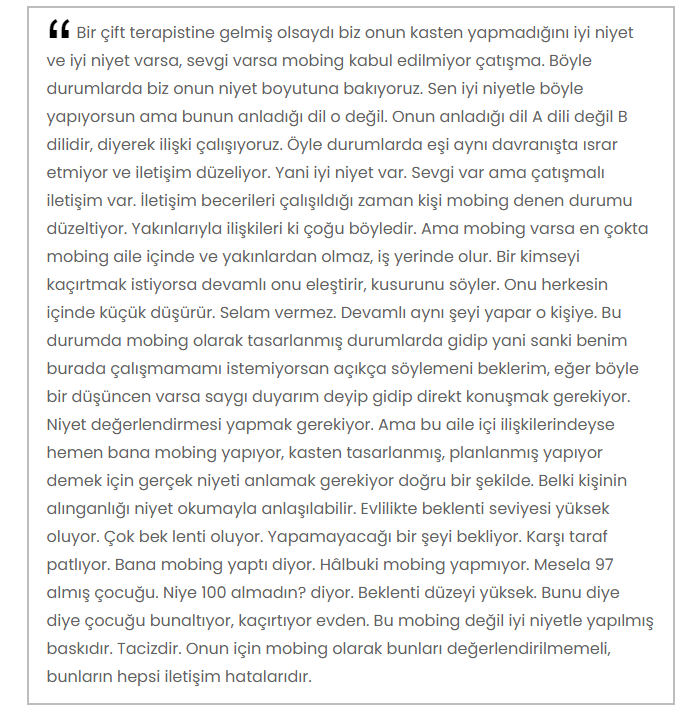
Answer: Of course, when people experience mobbing from their loved ones, some say, "I'm always being mobbed by my spouse." They come to us. You see, they perceive even a normal action of their spouse as mobbing. Let me give an example. It was about obedience. Both are educated, husband and wife, newlyweds, no children. He said, "My wife does not obey me, she constantly objects to me, she constantly contradicts whatever I say." I asked, "Can you give an example?" In the sense of mobbing, psychological harassment. There's an apple example. His wife peels an apple and gives it to him. He says, "Thank you, darling, I don't want it." His wife insists he eat more. She insists again. The woman says, "I won't eat it." She says "I won't eat it" once, then three times. Finally, the man says, "Look, you didn't obey me." In other words, he sees his wife not eating that apple as an act of disobedience. She didn't obey, she objected. This feels like mobbing to him. "My wife doesn't obey me, she harasses me." This is not mobbing. This is entirely related to one's perspective on events. That is, she might eat it for her husband's sake, but she also has the right not to eat it. It's very difficult for a person to eat something they don't want when they are full. The woman might also be uncomfortable eating under pressure in such situations. But it can be said in other ways without shouting at her. But ultimately, this is the man's perspective on the event, but the opposite could also be true. That's why mobbing is important if it's systematic. If psychological harassment is applied systematically, in a planned, designed, and systematic way; but if it happens spontaneously every now and then, it should not be considered mobbing. Systematic, planned, and intentional. There is intent in it. It is done intentionally because it is mobbing. We need to know this. Now, let's say he is really applying mobbing. The thing he applies as mobbing, the person constantly angers his spouse, pushes her buttons. He constantly does something to make her shout. This exists in relationships. This is perceived as mobbing. In reality, this person is simply acting in accordance with their personality. The person doing this is acting according to their character. Since they are acting according to their character, their intention is not actually malicious. Mobbing is knowingly harassing, but it truly poisons the relationship. In such a situation, we do not see what he is doing as a mistake. He does this mobbing continuously, systematically, but without intent. We see this not as mobbing, but merely as conflicted communication. For it to be mobbing, there must be intent. Because this is now a term used in court as well. Therefore, in such situations, we tell the person to note down the events in their relationship with their spouse where they felt their buttons were pushed, or they were angered. After noting them down, you acted this way, you acted that way in that event. If a relationship is built around this negative issue, this problem, the problem will solidify. Beyond that problem, you need to build a good relationship on other topics and try to provide a different perspective on that problem. This often becomes mind-reading. Mind-reading. What we encounter most often in mobbing is that one assumes the other person is doing something they didn't think or intend to do. They don't greet at work. "Look, he's become arrogant, that's why he doesn't say hello," they say. Whereas the man might be distracted, thinking of something else. This is mind-reading. Mind-reading is one of the biggest enemies of a relationship. It is perceived as mobbing. Therefore, in situations we call mobbing, if there is something, for example, Einstein's words to his wife on their tenth wedding anniversary: "If you want to stay married to me, bring me my three meals. Don't object to me. Don't expect friendship and intimacy from me." He says this. Now, some says this stems from Einstein's selfishness. One view is that he did it intentionally to end the marriage. If he did it intentionally, this is mobbing, and it did indeed end the marriage if he did it intentionally. But if he did it otherwise, it's not mobbing.
QUESTION: What are the contributions of spirituality to our mental health?
Before, we viewed psychiatry as a biopsychosocial discipline. We saw it as a biological, psychological, and sociological discipline. However, in recent years, especially after understanding how the human brain works, the healthy functioning of certain nervous systems, particularly the autonomic nervous system, the parasympathetic nervous system, which makes the human brain secrete happiness hormones and ensures the healthy functioning of the nervous system, allows the brain to relax, calm down, and feel that everything is under control, that life is under control. When a person believes in a higher power, a higher mental refuge, or a protective angel according to their belief system, in such a meta-empirical reality, their vagus nervous system works more healthily. The vagus nervous system, the Parasympathetic nervous system. It relaxes. It's the nervous system that says 'relax'. The sympathetic nervous system says 'fight', while the parasympathetic nervous system, the vagus nervous system, works more healthily and says 'relax, calm down'. It says 'the danger has passed'. For the vagus nervous system to be activated, a person's mental state must be good. In fact, there are new treatment methods for this now. For people who cannot manage their vagus nervous system on their own, they implant a vagus nerve stimulator in the neck. Or new devices have been developed. They are attached to the skin, to the ear, and go to the person's brain, activating the vagus nervous system and relaxing the brain. Stimulation of the vagus nervous system. Spirituality stimulates the vagus nervous system. It relaxes it. In people with spirituality, the heart rate decreases, skin temperature decreases, and skin resistance decreases. Skin temperature can be measured. Skin resistance can also be measured. The skin's wetness level can also be measured. Heart rate and breathing rate can also be measured. Muscle tension can be measured. When these five parameters are measured, the vagus nervous system works well in these individuals. And what about people who meditate? There are two types of meditation. One is Buddhist meditation, and the other is Sufi meditation, which we use. Both are meditation. For example, experiments have been conducted with Buddhist meditation. We conducted a similar experiment with Mevlevis. It was published in 2014 as a master's thesis. When certain emotions are captured, there is an anterior cingulate cortex in the person's brain. In the middle of the brain, a region of the cerebral cortex called the ACC (anterior cingulate cortex), which we call the gearbox of the brain. It is called the gearbox of the brain. It performs emotion regulation. That is, the brain region that regulates emotions. In the experiment, the MRI experiment, we found that this region of the brain was working rapidly. So what do these people feel at that moment? What do these people feel when they enter meditation? In Buddhist meditation, in Sufi meditation. When they feel these three things, it is activated; firstly, all their desires are met, secondly, all their needs are satisfied, and thirdly, they are integrated with the universe. Buddhists say integrated with the universe. Sufis also say united with the Creator. That is, they have completely surrendered to the Creator. They feel themselves integrated with the Creator. They feel integrated with Allah. That is, in Sufi meditation, when they feel integrated with Allah, when these people capture the feelings that all their desires are met, all their needs are satisfied, and they are integrated with the universe, integrated with Allah, alpha waves increase in their brains. Alpha waves are the brain's resting wave. At the same time, because that region of the brain is activated, happiness hormones are secreted. The brain literally floods the blood with happiness hormones. Abundantly. This happens in people who can activate that region of the brain. This is related to spirituality, in a way. That's why, when we talk about spirituality, it's no longer an unscientific field. Science has rediscovered spirituality. Spirituality has scientific equivalents. In fact, one of our professors wrote a book about this. A book titled "I Think, Therefore I Am: Descartes' Error" was written. Our professor from Üsküdar Üniversitesi, Prof. Dr. Oğuz Tanrıdağ, also wrote a book titled "I Believe, Therefore I Am." I covered the topic of spirituality in my books, "Psychology of Belief" and "Psychology of Wisdom 1-2." Those interested and curious about the details can access these books.
Share
Update Date: March 01, 2026
Creation Date: September 23, 2022
Request a Call
Other News
- The book that read today's digital threats in 2014: Being a Conscious Family
- Experts warn: 'Instead of memorizing letters, teach pencil grip, scissor use, and coloring'
- School fear and school love both start in the family!
- Family is not merely transforming, it is being battered under a serious assault
- Artificial intelligence opens the door to early diagnosis in autism!