Üsküdar University Political Psychology Application and Research Center (PPM) stepped outside the predominantly Ukrainian perspective on the Russia-Ukraine War and organized a panel featuring academics from the Russian Federation. At the panel, where “The Ukraine Issue from Russia’s Perspective” was discussed, esteemed academics from Moscow State University and Maltepe University shared their views.
Following the opening speech by Prof. Dr. Havva Kök Arslan, Head of the Political Science and International Relations Department at Üsküdar University, and the introduction of the participants by moderator Güler Kalay, Prof. Dr. Arthur Leonavich Demchuk from Moscow State University delivered the first speech on the Russia-Ukraine War, discussing historical and current approaches. Assoc. Prof. Dr. Maksim Vladimirovich Vilikov and Assoc. Prof. Dr. Aleksandr Anatoliyevich Sotnicenkove from Moscow State University, along with Prof. Dr. Hasan Ünal from Maltepe University, provided assessments on the Russia-Ukraine War from a Russian perspective.
Prof. Dr. Havva Kök Arslan stated the reason for organizing the panel with these words: “We are saddened to follow the war that has begun between Russia and Ukraine. In Turkey, news on this topic is learned through Ukraine, from Western media and analyses. However, Russia’s perspective on this issue is very important. We decided to organize this meeting for Turkey to learn Russia’s viewpoint.” she said.
Prof. Dr. Arthur Leonavich Demchuk: “With the start of the war, Russia began to face serious sanctions”
Prof. Dr. Arthur Leonavich Demchuk from Moscow State University began his speech by drawing attention to the importance of the panel organized by Üsküdar University and expressing his gratitude. Demchuk stated: “As Russia, we are going through an extremely sensitive period for the region and Europe. I am grateful for being given the opportunity to speak at such an important organization. There is a special operation launched by the Russian state two months ago. After this operation began, the Russian Federation was subjected to a serious wave of sanctions, especially from Western sources. Not only that, but a 'witch hunt' and defamation campaign against the Russian people and culture was launched, starting particularly in Western countries and spreading to many countries around the world. This is also called Russophobia. In such a conjuncture, the number of scientists capable of making rational, scientifically sound, and logical explanations about the fundamental causes of the Ukraine issue, analyzing it from all angles, and presenting a new approach with an objective perspective is quite small.”
“A concept was established to make people forget that Ukraine was once a part of Russia”
Demchuk, drawing attention to the importance of historical turning points in understanding the escalating Russia-Ukraine tension, stated: “To approach the Ukraine issue from a broad perspective, it needs to be evaluated from a historical standpoint. In 1654, Ukrainian territories voluntarily chose to become a part of Russia, and the situation was similar with Crimea. With the dissolution of the Soviet Union, these entities were not asked which region they wished to live in, and no right to choose was offered. Under the influence of nationalist movements, the process of Ukrainization and becoming a nationalist Ukrainian was presented as a state structure. This concept was implemented through separation and othering, marginalizing other ethnic groups as minorities. In education, a 'New Ukraine' dream dating back 30 years is being created as a delusion. Here, a concept was established to make people forget historical facts and that Ukraine was a part of Russia. With the collapse of the Soviet Union, some regions were granted autonomy as a result of separatist movements, but such a situation did not occur in Ukraine. The Brexit process took place in Europe, and because a country left the EU, the process was handled very sensitively; however, during the dissolution of the Soviet Union, the process was rushed through. We believe there is a serious double standard in this regard.” he concluded.
“Serious work is being carried out on biological weapons in Ukraine”
Demchuk made striking statements regarding the activities of the Ukrainian side, explaining the reasons for Russia's initiation of the military operation. Demchuk said: “Regarding the reasons for the military operation, it is the lack of safety for life and property of ethnically Russian people or those whose mother tongue is Russian, living in the eastern region of Ukraine. Another reason is the Ukrainian president's rhetoric regarding NATO membership. One of the most important reasons is that we learned Ukraine has goals to produce and manufacture nuclear weapons and is carrying out work in this area. Another important point was the news that the Ukrainian armed forces were preparing for a large-scale operation in the Donetsk and Luhansk regions. It has become known to everyone that very serious work is being carried out in Ukraine regarding the manufacturing of biological weapons. The Minsk Agreement is a concept signed twice, and Ukraine has always held back from fulfilling its obligations here. The reason for this needs to be investigated. The West is unscrupulously using all instruments in its struggle with Russia. While doing so, they use international law as a mask. The situation has evolved to such an extent that individual rights and private property are being violated. The West is polarizing the world, dividing it into two poles, good and evil, and portraying Russia as the evil pole. A new world order is being planned, dominated by imbalance, instability, fear, and inter-state distrust.”
Assoc. Prof. Dr. Maksim Vladimirovich Vilikov: “The Soviet Union was not the imperial power of the Russian Empire”
Assoc. Prof. Dr. Maksim Vladimirovich Vilikov from Moscow State University made statements about the historical developments that occurred during the Soviet Union era. Vilikov said: “When examining the Ukraine issue, studying its historical dimension is of great importance. The turning points mostly occurred during the Soviet Union period. In the state structure of the Soviet Union, we see a struggle against all kinds of nationalist approaches at the state level. When we examine history, we see that the vast majority of Soviet Union leaders were Ukrainian. The Soviet Union was never the Russian Empire; it was not an imperial power or an expansion mechanism of the Russian Empire. At that time, people would first state that they were Soviet Union citizens and then that they were Ukrainian. After the societal ruptures, ethnic identity politics began to dominate. With the dissolution of the Soviet Union, a major privatization took place in Ukraine. The Ukrainian elite privatized these investments, which were previously public, leading to a situation that we can describe as the takeover of the state today.”
“We see no short-term exit from the path of crisis”
Assoc. Prof. Dr. Vilikov stated: “The Eurasian Economic Union, established in 2014, was an important initiative for the economic development of the region. Ukraine could have gained significant benefits if it had joined this union. However, with the war, it is technically no longer possible to talk about Ukraine joining the Eurasian Economic Union. At least for the near future, it is not possible to discuss such a thing. This is because we are already talking about a significant wave of sanctions against the Russian Federation for many years. This wave of sanctions does not only produce negative consequences for the Russian Federation or the region. It means a crisis for the entire European Union. We see no short-term exit from the path of crisis. The issue we are facing is not a single issue; these are problems moving in different directions and independently. It is possible to talk about a complex of problems, a combination of them, and unfortunately, I regret to say that their solution is difficult in the short term with the currently implemented policies. What is happening between Ukraine and Russia is not actually a dispute or a war; it is a continuation of the civil war that emerged immediately after the First World War within the Russian Empire.”
Assoc. Prof. Dr. Aleksandır Anatoliyevich Sotnicenko: “The Turkish people will best understand Ukraine and Russia’s confrontation”
Assoc. Prof. Dr. Aleksandır Anatoliyevich Sotnicenko presented the historical events and situations between Ukraine and Russia in his presentation. Sotnicenko said: “The Turkish people will best understand Ukraine and Russia’s confrontation and disagreement. We see significant similarities in the history of Turkey and the Ottoman Empire. During the dissolution of the Ottoman Empire, starting from the 19th century, a problem of nationalism was created from scratch, particularly in the Balkans, with the help of the Western world and Russia. There were major ruptures with separatist movements. The Ottoman Empire went through similar processes in its recent history. The discourse of Ukrainian nationalists is, “Ukraine is the most correct, most honest, most Slavic nation. Russians are the Slavs of the Mongols.” This concept, this idea, also receives significant support in the Western world.”
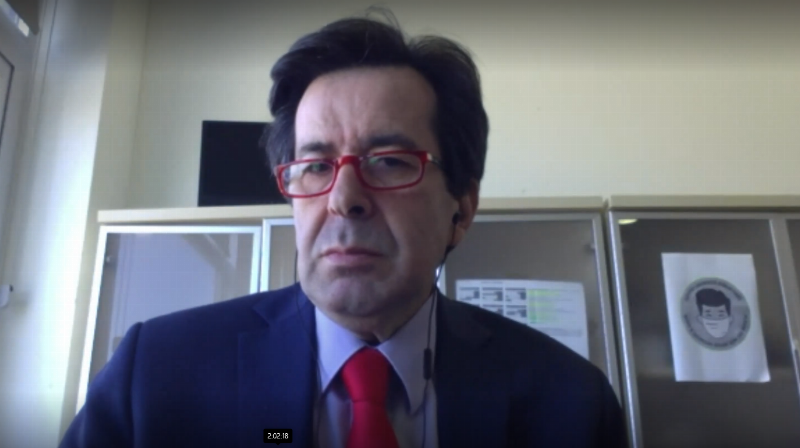
Prof. Dr. Hasan Ünal: “Anti-Russian elements determine foreign policy in Ukraine”
Prof. Dr. Hasan Ünal from Maltepe University stated: “States are sovereign and make their own decisions. However, if a state joining an alliance and acquiring a weapons system poses a threat to other states, those states will act accordingly. Here, Ukraine's desire to join NATO, extreme elements in Ukrainian nationalism, anti-Russian sentiment, etc., even if we put these aside, it is its own decision. But perceiving Ukraine's entry into NATO as a threat to itself is also Russia’s decision. What is important here is for states to utilize balances well and learn to do so, in security matters as in many others. Ukraine has not been able to put forth such a foreign policy. Here, the determination of foreign policy by pro-Russian and anti-Russian elements within Ukrainian nationalism emerges as a very significant problem.”
“The war in Ukraine is progressing on three fronts”
Ünal, stating that the current war in Ukraine is actually being fought on three fronts: “The first combat is the war ongoing in Ukraine between Russian and Ukrainian armed forces. The second is the war waged in media and social media. The third, we can say, is the ongoing war between powers that want to turn the world into multipolarity and those who want to maintain the world as America’s hegemonic unipolar world. Of these three fronts, the Western world has only won the media and social media aspect within itself. There was an information monopoly led by America globally. From Turkey's perspective, we never agreed with America and the Western world on any important issue. Therefore, my interpretation is that by remaining neutral in the Russia-Ukraine war, Turkey is actually pursuing a pro-Russian policy. Russians are not our enemies; our interests align with Russia. Therefore, we should cooperate. But this cooperation does not mean we will exclude the West. We will maintain our relations with the West and remain within NATO, but we will not take Russia as an adversary and participate in sanctions. We will state that we do not find attempts to harm Russia correct. We will also implement policies that are suitable for our national interests. A country of Turkey's size can do this.” he concluded his remarks.

