Wrong tone is the executioner of the right word. So, what is cooperation?
Cooperation means dialogue, not monologue. Monologue is like one-way traffic; it's when a person speaks unilaterally, always themselves. For a person to always be the speaker; to speak from a high register, to have an imperious expression... In a monologue, the speaker is active, and the listener is passive. Therefore, monologue is not considered cooperation. The situation is different in dialogue; when one person says something, the other side thinks about what was said and says something contrary or contributes to what was said. Both sides together multiply the word, cooperating in the manifestation of truth. An active listener, if they also avoid tonal errors, will more easily persuade their companion. Expressing the hardest truth with the kindest tone is an art that requires effort and investment.
Pay attention to the rule of good faith!
The rule of good faith is also a rule that should be taken into account in the gold standard solution in the search for positive meaning and communication in the family. For example, in your spouse's angry, furious, or indifferent attitudes, approach with good faith. First, consider that you might misunderstand your spouse, that they did not do it with the intention to hurt you. Believing in negative scenarios impairs analytical thinking ability, leading a person to wrong judgments. This also harms communication…
Effective communication and relationships occur through states/deeds
Communication has three pillars: verbal transmission, emotional transmission and behavioral transmission… In relationships, verbal transmission covers 5-10% of the matter. Only information can be transmitted with words. Knowing something and presenting its information does not solve the problem. In emotional and behavioral transmission; tone of voice, manner of speech, body language, form of expression, intention come into play. When something known is stated, what is our intention, how much do we live what is said, do we believe what is said? Merely providing information is not 'tebliğ' (conveyance/preaching); true 'tebliğ', communication, is about living the transmitted information. It is not important how well we know and transmit something, but how much we live what we know and transmit is important. Effective communication and relationships occur through states/deeds.
State and situation invalidate what is said…
A person can explain something very well, and it can be emotionally impressive. However, if what is beautifully explained and emotionally impressive is not seen in behavior, if there is no trace of what is narrated in the speaker's state/deeds, it cannot be considered effective for a long time. Nasrettin Hoca visits a friend. Even before reaching the house, he sees his friend through the window from a distance. When he arrives at the house, he knocks on the door. The child who opens the door says, “My father is not home.” Upon this, Hoca says to the child: “Hmm… So your father is not home… Well then, tell your father he left his head in the window.” In Hoca’s story, the state and situation invalidate what is said. What is said does not match the situation and state. Hoca, with his effective humorous language, presents the truth with full clarity.
For a genuine and healthy relationship…
Those who want to establish genuine and healthy relationships should abandon monologue; they should strive not to be self-centered. If a person does not do this, if they act like a commander, they cannot achieve cooperation. If one wants to get productivity from the other side in a relationship, one should not be imperious.
The age is somewhat an age of ego; modernism plays on egoism in the name of individualism. The excessive emphasis on individualism should not be understood as “value for humanity”; individualism, on the contrary, is an effort to abstract man from his values and spiritual values. An individual is one who has no spiritual value or sacredness. At their core, there is no spirituality indicated by death, the desire for eternity, or valuing existence. Whereas man becomes human partly through these truths; for the human being, death, the desire for eternity, and the meaning of things are decisive. The individual is the being who turns their back on these; in the void created by what they turn their back on, egoism and the satisfaction of carnal desires have settled. The individual has supposedly moved past sacred things but this time has sanctified their carnality. ‘I’, carnal desires, have become such fundamental things that the ‘individual’ has, in a sense, become untouchable. God has been expelled from existence, and man has been substituted in His place.
Humanism has such a dimension; it emerged as a religion as a result of the conflict with Christianity. This is the philosophical equivalent of modernism. A humanist (person) is separate from humanism (ideology). Humanism is an approach that sanctifies man, exalts him, sees him as flawless, and evaluates him as if he were the owner of the earth. A humanist, on the other hand, points to man as a value; it is somewhat a reference to man’s nobility as the noblest of creatures. Pointing to man’s meaningful place in existence is different from deifying man. To be humane is understandable, but to be humanistic (in the ideological sense) is problematic. Humanistic humanism is something that sacrifices existence to man; to be humane, on the other hand, is to work for the manifestation of man’s place in existence. It is because man’s ego has been inflated that this era has become so crude. As the poet Necatigil put it, we live in a “very crude era.”
The ‘I’ language and narcissistic attitude in communication negatively affect the course of communication. In a relationship, defending ‘self’ or ‘I’ is problematic. This inevitably leads the other side to defense as well. Thus, relationships emerge where both sides strive to justify themselves. Conversations where the other side is accused break the relationship; the person goes on the defensive. Consequently, a situation arises where both sides defend themselves, justify themselves, and the parties do not try to understand each other. For this reason, one should not say, “What kind of person are you? Why are you doing this?”; one should say, “If you play for yourself and I play for myself, we cannot understand each other.” When acted upon in this way, the other side will stop and think, they will see that there is a fragile heart in front of them. Thus, when a person speaks, they will have spoken to another, not to themselves. A relationship develops between two people. A relationship is a common ground where “I and you” participate; it requires dialogue, not monologue. There can be no relationship without cooperation.
Communication skills
There are many methods in communication skills. The trust-based behavior model is one of them. When this model is evaluated as the gold standard solution in the context of the search for positive meaning and communication in the family, the indispensable aspect of the model is not to use an accusatory and judgmental tone towards the other side.
This is a model that rejects needling the other side, listing their faults, and lying from the outset. This model is essential for a healthy relationship. For a trust-based relationship, one should never lie. Achieving this is not so easy. Chemistry doesn’t lie, does it? Human nature is somewhat prone to lying; lying originates from a person’s childhood.
As is known, children resort to lying at an early age within a defense psychology. Sometimes it is because they are afraid or hesitant, and sometimes it is because they have seen it from people they look up to. It is obvious that they broke the plate, but they say, “No, I didn’t break it.” Upon this, the mother gets angry and finds a solution in slapping. The child learns nothing about not lying from this attitude; they only become afraid because of the mother’s slap. They learn to obey out of fear. Undoubtedly, what the mother should do is not to slap. She should be able to say, “Look, my child, it’s clear you broke the plate. Okay, this is a regrettable thing, but you did something worse, you said something untrue, you lied.”
The most expensive thing in the world is trust. Lies should be crossed out, and truth should be underlined.
When acted upon in this way, the child learns two things: that they are loved by their mother and that they must speak the truth no matter what… In this way of acting, lies are crossed out while the truth is underlined. The trust-based relationship model should be founded step by step during childhood in this manner. If a child believes in the virtue of telling the truth under all circumstances, they will also act truthfully in later periods of their life. Someone who lives an “open, transparent, honest, and accountable” life not only becomes happier more easily but also gains trust, the most expensive thing in the world.
Sometimes, a person is seen to be particularly defended. When asked, “Why are you defending this man so much?”, the answer is, “Because he inspires trust in me.” People can stand behind some individuals and entrust many things to them simply because they trust them. For example, a patient surrenders themselves to the doctor without question because they trust them.
Lies open the door to evils…
When one witnesses one or two lies from the other party in a relationship, can that person be trusted after this testimony? No, they cannot be trusted because a single lie destroys trust. Trust is like a wary dove; a single spoken lie becomes a stone that scares the dove away. It is said that all evils are locked in a room. The key that opens the door closed over evils is a lie.
When lying begins, all evils start to spill out. Even though lying harbors such danger, it has become much more widespread today. Thanks to communication technologies, it has permeated every aspect of life and all dimensions of relationships. Lying has become so normalized and accepted that being honest has become a virtue in itself. While honesty should be fundamental and not surprising, it is treated like a virtue. Today, a man acting as he should, doing what is normal; even not stealing or swindling is surprising. “Oh, that man is very honest!” is said. Economic models are collapsing because those who implement the models are not honest. In environments where honesty is not universally accepted, evils also spread rapidly.
The ground where cooperation flourishes is trust…
In this situation where individualism is increasing day by day with modernism, occupying all areas of life, and disrupting relationships and communication, a trust-based relationship model is important for beautiful cooperation, genuine and healthy relationships. With the sensitivity of abandoning monologue and striving not to be self-centered in relationships, we should adopt the trust-based relationship model as the gold standard solution in the context of the search for positive meaning and communication in the family. It should not be forgotten that the ground where cooperation flourishes is trust.
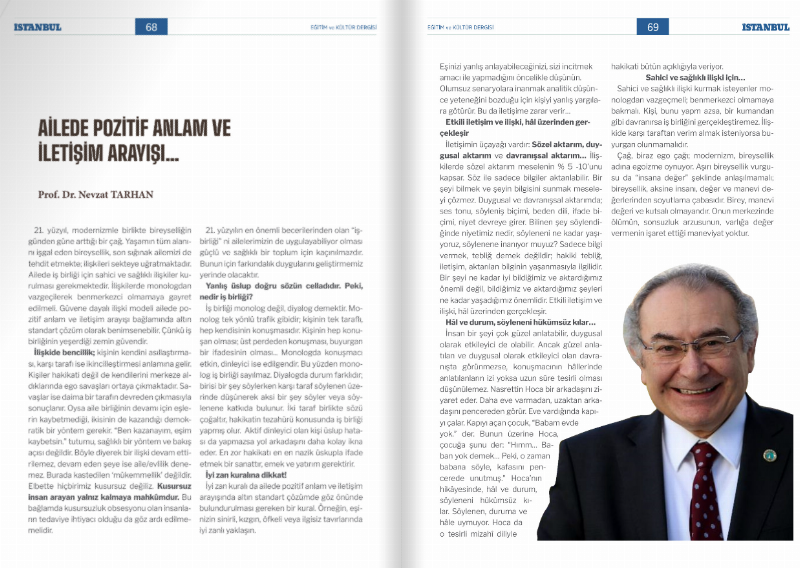
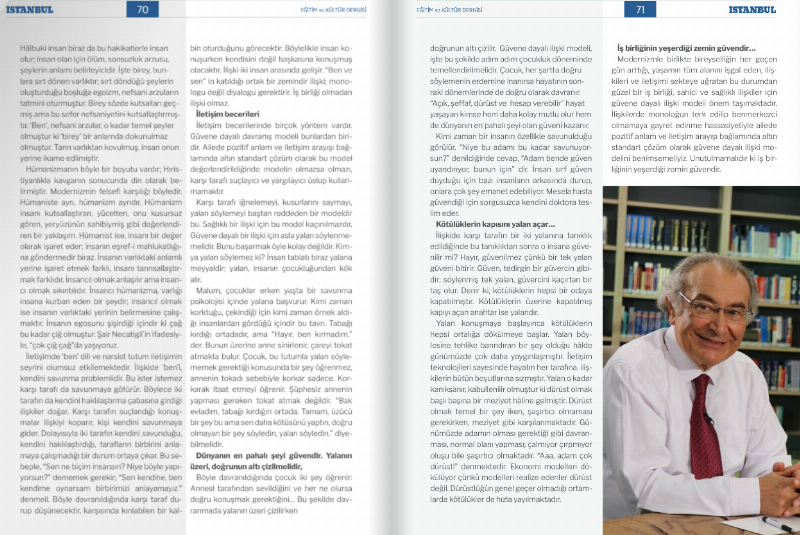
Prof. Dr. Nevzat Tarhan
Founding Rector of Üsküdar Üniversitesi - Psychiatrist
Istanbul Education and Culture Magazine January - April 2023 Issue 5

