

Psychiatrist Prof. Dr. Nevzat Tarhan, stating that love is not the cause but the result of marriage, said, “If there is love and good cooperation, it equals lifelong love. If there is no good cooperation, there is no love. Therefore, the magic word in marriage is not love, nor is it trust, but cooperation.” Tarhan, drawing attention to the importance of the golden mean in marriage, stated, “In a marriage without a golden mean, there is domination, pressure, and egocentrism, but at the golden mean, both sides make sacrifices, and both sides win. If one approaches marriage with a win-win approach, romantic love transforms into mature love.”
Content
The golden mean in marriage matures romantic love…
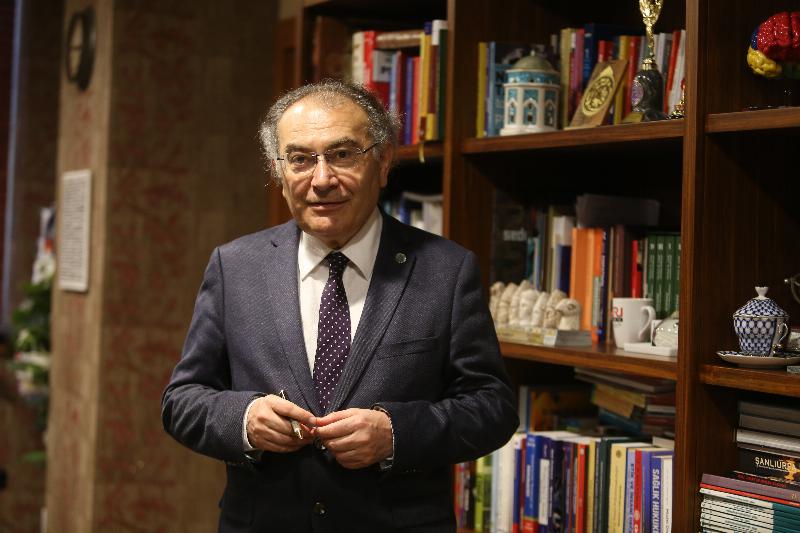
Üsküdar Üniversitesi Founding Rector, Psychiatrist Prof. Dr. Nevzat Tarhan, made evaluations on effective communication and happiness between couples in marriage on the 'Evlilik Okulu' (Marriage School) program aired on Akra FM.
First stage: the romantic period…
Prof. Dr. Nevzat Tarhan stated that there are three stages in marriages, and the first period is romance. Prof. Dr. Nevzat Tarhan said, “During this period, both parties are in love with each other. Especially during the engagement and pre-marriage period. Couples spend time together, look into each other's eyes, and wonderfully comfort each other. They constantly think about each other.”
Couples' investment in each other decreases
Prof. Dr. Nevzat Tarhan stated that these feelings can change after a while of marriage, saying, “The man devotes himself to his work. The woman, when children are born, devotes herself to her children. Their investment in each other decreases. Love does not decrease, but interest does. Investment decreases. When investment decreases, the marriage begins to cool down. Marriage is like a fire on a grill. If you tinker with the fire too much, it burns; if you don't pay attention, it cools down and goes out. Marriage also starts to cool down because you are not paying attention to it and not investing.”
Ego wars can occur in the second stage
Prof. Dr. Nevzat Tarhan noted that when cooling occurs in marriages, the second period of marriage begins, saying, “In the second stage, power struggles and ego wars begin. Complaints like 'You don't love me. You don't make time for me anymore' can arise. In such situations, the other party thinks, 'My spouse is jealous of my interest in my work.'”
Marriage is seen as a guarantee
Prof. Dr. Nevzat Tarhan stated that some men see marriage as a guarantee, saying, “There is a thought in men that after marriage, they see it as if they have acquired the title deed to their spouse. They no longer make emotional investments in their spouse. They emotionally consider their spouse as guaranteed. Women and men no longer marry to avoid such situations. If there are children, they are given to care homes. Children's care homes and women's shelters have tremendously increased. Women's shelters are not something to boast about. Here, women are the most victimized. Women-men wars, power struggles begin. Since the man brings bread to the home, psychological superiority usually lies with the man. When this happens, the man uses it to oppress the woman.”
Balance is achieved when women work
Prof. Dr. Nevzat Tarhan pointed out that a woman having a profession and economic power restrains the man, saying, “In such situations, every responsibility in the home will be shared fairly. The woman will not always be the sacrificing party. If the woman is not working, she either internalizes it or becomes jealous. She constantly pursues her spouse to win him over. This pushes him further away. Her spouse runs away, saying 'my spouse is slipping away,' and tries to win him back, saying; 'No one should love him. My spouse should only belong to me.'”
There is comparison in jealousy…
Prof. Dr. Nevzat Tarhan stated that the feeling of jealousy is one of humanity's greatest weaknesses, saying, “Envy and ambition are what cause humanity to lose itself. They are the first qualities of Satan. Satan's greatest characteristic is his jealousy of Prophet Adam. The reason for being expelled from Paradise is jealousy. Jealousy is humanity's greatest weakness. Jealousy is also the feeling of envy. Admiration is different. Admiration is beautiful. One says, 'He has it, I wish I had it too.' A person sets a goal for themselves. They do not compare themselves with others but compare themselves with the goal. A jealous person compares themselves with others.”
Don't compare your child with others!
Prof. Dr. Nevzat Tarhan stated that many mothers and fathers fall into this trap, saying, “They tell their child, 'Look how good that child is, you be like that too.' They compare him. Because of that comparison, the child's self-confidence drops. One of the reasons for decreased self-confidence is using comparison in education. However, pedagogically it is recommended not to raise your child by comparing them with others and not to diminish their self-confidence. Set a goal for them so they can compare themselves with it. Like, 'I achieved this. I didn't go for that.' Let them compare themselves with that goal.”
One needs to discipline the ego/self
Prof. Dr. Nevzat Tarhan also offered advice to those who want their spouses to be interested in their home and themselves: “One should focus on the thought of 'How do I make my spouse love me?' Jealous people focus on the thought of 'How do I force my spouse to stay home?' Jealousy exists in all of us to some extent. Anyone who says they are not jealous is lying. If we see an excess of something we value greatly in someone else, it awakens a negative feeling within us. This is normal. Our ego/self also awakens. But if a person has educated themselves, their heart says, 'Well, this is how it is, but this person also has good sides.' Then they immediately do a quick analysis. They control their ego/self. They listen to what their heart says. The hearts of such people are sparkling clean. If this person disciplines their ego/self… If they haven't disciplined it, what does the ego/self do? The ego/self is selfish. It immediately says, 'Let it be mine, only mine.'”
Balances with the spouse's family must be observed…
For example, people who are jealous of their spouses even with their mothers say, 'My spouse shouldn't love his/her mother. He/she should only love me.' They get uncomfortable going to her during holidays. They get uncomfortable with him/her talking to his/her mother on the phone. They get uncomfortable when his/her face smiles at the mention of his/her mother. This child was also raised by his/her mother. One cannot abandon their mother and father… A person needs to establish a balance with their family. They need to be able to say no to their spouse. Couples need to use the language of love. People who use the language of love generally win in the second period of marriage.”
Love is not the cause, but the result of marriage
Prof. Dr. Nevzat Tarhan stated that the third period of marriage is the period of commitment, saying, “Some people use the trial and error method here. Lifelong love emerges then. For lifelong love, this is what is needed: It is said, 'Love is the cause of marriage,' no. Love is not the cause, but the result of marriage. If there is good cooperation, if there is love and good cooperation, it equals lifelong love. If there is no good cooperation, there is no love. Therefore, the magic word in marriage is not love, nor is it trust, but cooperation. Love plus cooperation equals trust. When trust is formed, lifelong love begins. That is why we call marriage a zone of trust. For trust to be formed, love and cooperation must be together. When such families approach us, we work on relationship management.”
Prof. Dr. Nevzat Tarhan stated that the trust area in the brain of a jealous person is disrupted, saying, “When the area related to the feeling of trust is disrupted, jealousy paranoia begins. They recover with clinical treatment. At the end of such jealousy paranoia, the person says, 'You are either mine or in the ground.' These are actually clinical cases. These individuals need serious intensive clinical education. Rehabilitation training is needed. People with a high potential to harm their spouse should be taken for 1 to 3 months of clinical treatment at a rehabilitation center.”
The language of love needs to be used
Prof. Dr. Nevzat Tarhan highlighted the importance of using the language of love, especially in solving problems related to jealousy, saying, “For example, what are the languages of love? Giving gifts is a language of love. Words of appreciation, praise, and affirmation are languages of love. Sacrifice is a language of love. It exists in Shakespeare's Hamlet. They ask, 'Does my spouse love me?' In the work written in the Middle Ages, it says, 'Look at the sacrifices your spouse makes for you. If you want to understand if he/she loves you.' If he/she makes sacrifices, it means he/she loves you. If he/she sacrifices his/her sleep, comfort, and rest, he/she loves you. For example, another language of love is acts of service. Taking care of someone when they are sick, noticing a need and immediately attending to it.”
Physical touch is also one of the languages of love
Prof. Dr. Nevzat Tarhan noted that physical touch is also a language of love, saying, “A woman whose spouse only touches her for sex thinks she is not loved by her spouse. However, while women have the highest sex hormones in their brains, men are sexually aroused visually, women are aroused tactilely. That's why smart men use touching their spouse as a language of love. In such situations, the woman easily understands that she is loved. Men need to learn the languages of love. A person might know a few languages, but because they don't know the language of love, their emotional intelligence is in the dumps. Einstein, for example, is like that. He is a genius. His intelligence is above 160. But in the tenth year of his marriage, he told his wife, 'If you want to continue this marriage with me, you will do everything I ask. Bring my three meals to my room. Don't complain about me.' He wrote this down item by item. His wife left him. He wanted to enslave his wife. After that, he never married again. This is an example of low emotional intelligence.”
Characteristics of happy spouses…
Tarhan, noting that they work on mental flexibility, also known as “Cognitive Flexibility,” to prevent power and personality conflicts between spouses in marriage, said, “A person should think, 'What language does my spouse understand?' Someone who thinks their spouse doesn't love them greatly needs their spouse's words of appreciation, praise, and affirmation. There is research conducted by the University of Nebraska in the USA. They researched happy spouses and identified these common characteristics. Firstly, spending time together, secondly, an abundance of words of appreciation, praise, and affirmation. What do these characteristics show us? This characteristic has also started to weaken in our culture currently. Spending time together is decreasing, and secondly, words of appreciation, affirmation, and praise create positive effects on the other party. One says, 'My spouse has this side, but they also have such good sides, let me see those too.' If one sees that positive side, then love increases. The way to increase love is to be able to see the positive aspects of your spouse. If a relationship always sees only the negative aspects, love slowly fades there. In other words, the misuse of reason extinguishes love.”
5S is important in marriage
Prof. Dr. Nevzat Tarhan stated that another magic word in marriage is patience, saying, “In marriage, love and respect are not enough; there is one more thing: patience. Along with patience, there is loyalty and sincerity, there are five 'S's in marriage: Sevgi (Love), Saygı (Respect), Sabır (Patience), Samimiyet (Sincerity), and Sadakat (Loyalty). Patience is very important here.”
Rationalism will be added to romanticism
Prof. Dr. Nevzat Tarhan noted that rationalism should be added to romanticism, saying, “In mature love, for the sake of the marriage's well-being, there is resilience, patience, and tolerance towards a spouse's mistakes. One must say, 'This action of yours is not right, but for the good of the marriage, I tolerate it, but I do not approve.' Rationalism will be added to romanticism. If rationalism is added to romanticism, it turns into mature love. One performs a cost-benefit analysis, makes correct decisions, thinks about the future of the 'ship' (marriage), but also doesn't let themselves be suppressed. This situation also provides love justice at home. What happens in such situations? Love transforms into mature love. After a while, mature love already becomes automatic.”
Good intention and beautiful effort…
Prof. Dr. Nevzat Tarhan said, “If a person says, 'I love my spouse for the sake of Allah,' they move towards mature love, but if they love their spouse for worldly reasons, it is very difficult for a person to achieve mature love. Because sacrifice is required, and only if one knows that they will see the reward for these difficulties in divine presence can one be patient. Otherwise, being patient in some things is very difficult. Allah gives opportunities to those who turn their hearts to Him. The Hadith Qudsi says, 'If you have good intention and beautiful effort, I am your completer.' Good intention alone is not enough, beautiful effort is also required. The phrase 'beautiful effort' is also very meaningful. Beautiful effort, not bad effort. Not causing agitation or tension. Effort that can approach things in a solution-oriented way, not problem-oriented, is beautiful effort. To be able to do things without breaking or destroying, to live balanced and just love without breaking or destroying, if cooperation is established, it will be a win-win system.”
In the sacrifice of both sides, both win
Prof. Dr. Nevzat Tarhan, drawing attention to the concept of the golden mean in marriage, said, “One takes a step, the other takes a step, and they meet in the middle. In a marriage without a golden mean, there is domination, pressure, and egocentrism, but at the golden mean, both sides make sacrifices, and both sides win. If one approaches marriage with a win-win approach, romantic love transforms into mature love. In such situations, a phenomenon we call the Michelangelo phenomenon occurs in the brains of both parties. Michelangelo, one of the Renaissance sculptors, made the giant 15-meter David statue. In the end, it was so beautiful that everyone admired the statue, and the man's ego swelled, and finally, he took the hammer in his hand and told the statue to 'come to life.' When the statue didn't come to life, he threw it. That's why the statue's finger is broken. There is such a truth behind such a perfect work. Why is it called the Michelangelo phenomenon? He is a master sculptor; the brains of both parties change like a sculpture. His personality exists like a sculpture in the other's brain, immediately reading what is on his/her mind. For example, it also exists between a mother and child. Even if no one else can understand, the mother understands the child's need. Because it becomes a telepathic relationship. She understands thirst and immediately offers water. It happens like this with spouses too. Brains start to talk; there are mirror neurons in the brain. In people with intense love, if there are strong loves, the brains of two people with strong love communicate like a wireless internet. There are not only motor mirror neurons, but also emotional mirror neurons. In those emotional mirror neurons, the other party reads their emotional side and feels loved. One says, 'I love this, but I couldn't understand why.' One says, 'I don't know the reason, but I love it.' Because there are emotional mirror neurons. In matchmaking programs, both parties say they have a connection, that is the mirror neuron.”
Share
Update Date: March 01, 2026
Creation Date: October 11, 2022