

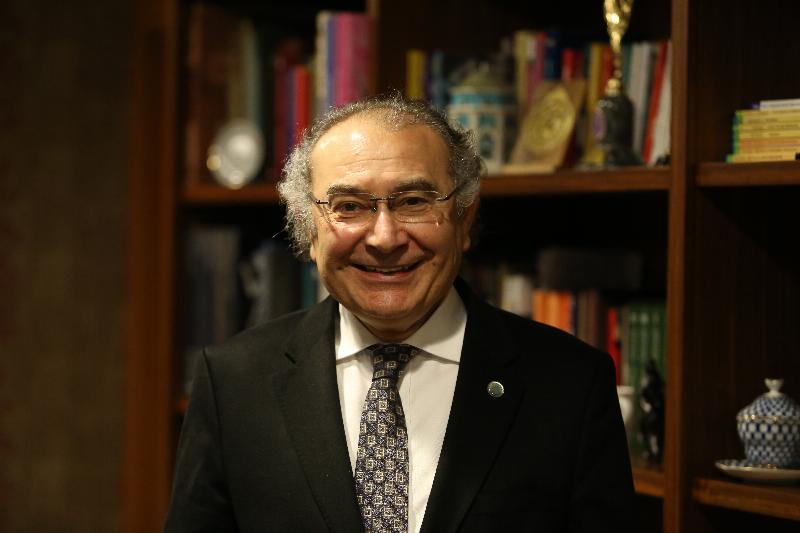
In the second of our City and Culture Conversations, we are with scientist and Üsküdar Üniversitesi Founding Rector Prof. Dr. Nevzat Tarhan, one of our country's distinguished personalities. It was an enjoyable and lengthy conversation from which we will benefit, so I will start with the questions immediately;
Content
Tarhan: 'There is a Tremendous Balance and Measure in the Universe'
1. “Love is all there is in the universe.” Says Fuzuli, but today we see that it is not love itself, but the concept of “love” that makes people astonished. What do you think are the reasons for this, and how can we overcome it?
The feeling of love is the pinnacle of the feeling of affection and means selfless love. In Arabic, it is said that love comes from the root of ivy. We can talk about a meaning like a person thinks of the person they love so much, becomes so attached to them, that they almost die with them. However, just as modernism changed many things, it also changed the concept of love. We can talk about 3 dimensions of love. The first is eroticism, which animals also have. The second is romanticism. The third is the higher emotions we call spiritualism. Now, today, modernism has reduced love only to eroticism. This is a male perspective. We can say that there is a patriarchal modernism currently. When we say love, sexuality is understood. Yet, romanticism is greater and more important than sexuality; it binds people together. When we understand only eroticism as love, those one-night stands emerge. What happens in these one-night relationships? The man forgets and leaves, the woman suffers, waiting for a phone call. Why? Because women elevate romanticism more. The male brain elevates eroticism more. People fall in love, but then you see them break up after six months. When asked, "Why did you break up?" they answer, "My love ended." However, for that feeling to turn into lifelong love, it requires: love + cooperation = lifelong love. If people cannot cooperate, they cannot truly love. Therefore, the key concept in relationships is cooperation. If there is cooperation, love lives on and continues for a lifetime. For this reason, love is a result, not a cause, in relationships. But modernism sees love as a cause. Selfishness was added to love and affection, and this understanding became widespread as a culture. In selfish love, there is a love for the other person's benefit, not a love for them as they are. When that benefit, their physical appearance, or their wealth is lost, you suddenly grow cold towards them. Because you do not love their personality and identity as they are. For this reason, the essence of love has been emptied today.
Also, what young people understand by marriage is very important. They need to read and learn about this topic. Marriage is a matter of culture. If there is no marriage culture, and if the two parties cannot sit down and develop problem-solving methods, marriages will not last. Furthermore, there is no vertical relationship in marriage, there is a horizontal relationship. Proponents of vertical relationships cannot sustain a marriage. If a person sees their spouse as a slave, if they think of their spouse as a being who must obey them, this means a master-slave relationship. Such marriages do not work. Especially in this period, with the winds of freedom brought by modernism, no one -rightly so- wants to be a slave. For this reason, in such situations, a consciousness of living together needs to be formed. In my book "Son Sığınak Aile" (The Last Refuge: Family), I mentioned some articles within the scope of the Marriage Intent Agreement. The aim here is to emphasize a relationship based on love, respect, and trust, stating, "We are two separate individuals, yet parts of a whole. We will not forget the balance between our freedoms and responsibilities." Finally, I must tell young people/individuals who are afraid of marriage this: if there is sincerity and both parties agree, they should not be afraid of marriage. They will come to an understanding in some way.
2. What should we do to emerge sound and ourselves from the chaos, depression, and speed within the city noise?
Here, we need to think on both an individual and a social/community basis. Now, the saying "big fish eats little fish" is seriously like a motto for "Life is a struggle." Actually, when we say life is a struggle, cooperation is the principle in life, and struggle is the exception. In fact, if you look at the universe, there is not struggle but complementarity. Look, not even cooperation, but complementarity. As you know, in past years, there was a bird flu, and all chickens were culled. After that, ticks increased, and various diseases emerged. The balance is disturbed. Therefore, we can say that there is a tremendous balance and measure in the universe. In this measure and balance, we need to return to ourselves and our essence and use reason correctly, which is the greatest value for humans. We need to change/correct our philosophy of life. Unless we change our philosophy of life, humanity will continue to suffer. The price of this includes social problems, divorces, unhappiness, crime, and violence. To give an example: in the late period of Rome, everyone tried to undermine each other, they devoured each other, epidemic diseases broke out, and Rome, while being the sole superpower, collapsed. Therefore, we also need to keep our own areas and values clean and protect them. For example, we need to maintain strong neighborly relations. Random acts of kindness projects were launched in California. A person goes to a nursing home and helps people they don't know at all. They work there for a while and report what they have done. Another person goes and cleans an area and reports what they have done. Then they give that person a score. Actually, this is a different form of our "sadaka taşı" (charity stone) tradition. We need to rebuild those values we have abandoned.
For this reason, we can say that development does not mean only physical development. With the Republic, we gained our geographical independence, and we owe gratitude to those who contributed. But geographical independence alone is not enough. Economic independence, military independence are needed, but in the long term, cultural independence is also needed. We have not yet achieved our cultural independence. Great steps have been taken for military independence and economic independence, but we have not achieved our cultural independence. If there is no cultural independence - yes, let's adopt the universal beauties brought by civilization, but let's be ourselves - if we cannot do this, then neither family, nor neighborhood, nor city will remain. And we will always be dealing with people who are crime machines.
3.We encounter different interpretations from various scientists regarding the pandemic process we are experiencing, which generally creates confusion in society. What would be your suggestions to resolve this confusion?
The reason for this confusion lies in scientific technical discussions, which are actually detailed discussions. People with a certain level of knowledge first discuss these detailed matters among themselves and finally explain them to people with basic minimum standards. This is actually how the system should work. However, we see that it is not so here. For example, councils used to be held in hospitals regarding the treatment of a disease. They would sit for hours discussing whether to operate on this person, give medication, do this, or do that, and eventually reach a consensus. If someone unfamiliar with the field listened to those discussions, they would give up on having surgery. Because things are discussed there that… Therefore, discussing such technical issues on television and going into detail causes confusion in people. For this reason, it is sufficient for individuals to rely on official statements. The general rules have already been given: cleanliness, mask, distance.
In fact, these rules are not a new discovery. There is Şerafettin Sabuncuoğlu, a famous physician from Amasya, who lived in the 1300s during the reign of Fatih. He wrote a book, which has 3 volumes in the world. In it, he says: “During plague/epidemic times; eat well, sleep well, greet from a distance.” Ibn-i Sina, for example, would wash his hands with vinegar, so these rules are universal rules. Applying these rules will protect us. Therefore, the job of scientists here is to find vaccines and treat patients. For example, public health specialists should research what needs to be done to prevent the spread of the epidemic; this is not the job of an infectious disease specialist. There are epidemic specialists, public health specialists; they should be the ones speaking. They are more decisive on this matter. Not everyone should assume the role of an expert. Everyone is trying to be like a virology expert. It is impossible to know that much, and when this happens, anxiety increases, society listens to those people, and naturally gets confused. Let's not try to be experts ourselves. For example, a person who is an expert in medicine does not have authority in engineering. For this reason, it is necessary to respect expertise here. Let's look at the general measures, comply with them, and then continue our lives. It is in our favor to comply with officially made statements rather than randomly spoken ones.
4. While the concept of ‘emotion reading’ is very important during children's development periods, the difficult process we are experiencing today; the necessity of masks and distance, causes children to grow up without seeing or feeling smiles, facial expressions, and touch. What kind of effects will this situation leave on society in the future, and what should be done to prevent negative effects?
Currently, because we are wearing masks, face reading and emotional literacy are naturally somewhat negatively affected. But people have gotten used to it; they can read emotions from the eyes. At first, it might not be practical, but after a while, communication can be established through people's tone of voice, emphasis, and speech. In this process, especially concerning children; emotional development is very important. The most beautiful development for children is being in social environments. Currently, the only things affecting them are tablets, mobile phones, computers, and televisions. These are the biggest areas of influence for children. However, what develops children is play. A child's most serious business is play, playing with their friends. A child needs to socialize because a child who does not socialize remains individual and isolated. As they become isolated, autistic children emerge, and cases of delayed speech appear. During the pandemic, cases of delayed speech increased significantly, for example. Why? Because a child who constantly has a phone in hand and is constantly in front of a screen does not feel the necessity to speak, thus cannot develop word production skills. For this reason – especially during this period – parents should spend more time with their child. If this is done, problems can be compensated for.
On the other hand, this process is a necessity, and in such situations, we need to focus on the gains rather than the dangers. For example, during this process, you spend more time with your family, and this contributes to psychological maturation, leading to an increase in many psychological maturation values such as appreciating what you have, treating other people better, and reducing selfishness. Therefore, every crisis has a dimension of gain. People should focus on that. For instance, individuals found more opportunities to spend time on themselves during this period. Nightlife and entertainment might have been restricted, but individuals gained more time for self-development.
5.To conclude on a hopeful note, I would like to end my questions with this: Drawing from Dostoevsky's book title "Beauty Will Save the World," what beauties will save the world? What can we do as individuals to embrace a life where we make others happy and are happy ourselves?
Now, when we consider what would open the door if we filled a room with evils and another room with good deeds. If we filled a room with evils, pride, selfishness, and looking down on other people would open its door. If we filled a room with good deeds, humility would open its door, as would cooperation. Therefore, the greatest beauties are social beauties. Social beauty involves empathy, being understanding towards the other side; the people we call understanding are actually empathetic people, so empathy opens the door to beauties. It is necessary to accept every human being as unique and show respect to everyone.
Good and evil have always existed in the universe, in the form of a sinusoidal curve; sometimes evils increase, sometimes good deeds. When the bad consequences of evil are seen, the value of good deeds is understood, and then good deeds begin to multiply. Currently, I believe evils have hit rock bottom in the world. The pandemic will bring this realization to people. Behaviors such as greed, insatiability, selfishness, and thinking only of one's own interest are decreasing in people.
Another element of happiness is the environment we live in. Let me give an example about environmentalism; mathematical modeling is being done on bees: what would happen if bees disappeared from the world? 50 years after bees disappear, the world completely turns into a desert. Because when bees disappear, pollination gradually ceases, plants and animals disappear. This takes 50 years with this mathematical modeling. When looking at what happens when humans disappear with the same modeling; the world becomes more beautiful, greener, more livable. Therefore, it is necessary to know this, pay attention, and live consciously. That's why environmental awareness is important. Look at the cities in Europe, in old cities/traditional cities, there are no trees, they are completely dry. The environment was later reforested. It's not like that in the Ottoman Empire; in the Ottoman Empire, greenery and cemeteries were always together within the city. This means there was respect for greenery. But under the guise of rapid modernization, we have destroyed/are destroying all the greenery in the city. We have started to spoil what the West noticed and corrected. There should not be a culture of concretization; we must definitely create a culture that is at peace with nature. When a person is intertwined with nature, they learn respect for nature. A person who learns respect for nature also learns respect for others. Therefore, environmental awareness must be maintained. Environmental awareness and the consciousness of cooperation, these two are quite important. City managers should invest in initiatives that increase sharing and environmental awareness; then cities will be more livable and people will be happier.
To read the first part of the interview: https://uskudar.edu.tr/tr/icerik/6031/tarhan-kulturlu-insanlar-cogunluktaysa-orada-mutluluk-huzur-ve-duzen-olur
Source: Şehir ve Kültür Magazine/ Zeynep Betül Kavak
ISSUE: 77 December 2020
Share
Update Date: February 27, 2026
Creation Date: December 24, 2020
Request a Call
Other News
- Social responsibility courses moved to the field
- Erasmus+ Orientation Week completed at Üsküdar
- Prof. Nevzat Tarhan: “Brain secretes ‘dark glue’ in social media lynchers!”
- Prof. Nevzat Tarhan: “Every segment of society should be able to say, ‘This constitution is my constitution!’”
- OHS releases guide for safe operation of industrial robots