

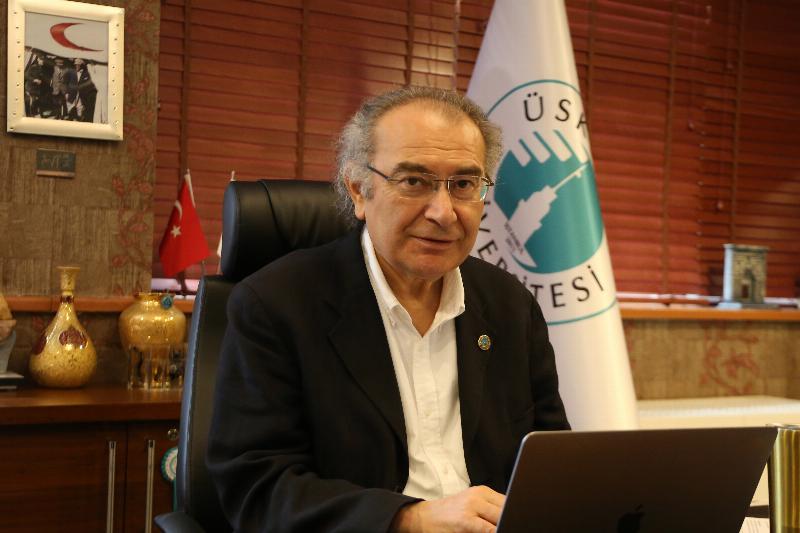
Üsküdar Üniversitesi Founding Rector Prof. Dr. Nevzat Tarhan, attended the "Super Vision" program organized by the Institute of Positive Psychology. Making evaluations on the topic of "Positive Psychology Applications in Psychotherapy," Prof. Dr. Tarhan said, "The scientific standards of positive psychology must now be determined. Furthermore, mental health professionals also need to know positive psychology."
Content
Tarhan: "Mental Health Professionals Need to Know Positive Psychology"
"We Discovered Other Processes in Psychotherapy"
Prof. Dr. Nevzat Tarhan stated that thirty to forty percent of genes are in personality structure, and sixty to seventy percent are epigenetic changes we make in genes, adding: "Before, when psychotherapy was mentioned, there were various psychoanalytic, cognitive theories. According to these, there was an influence on a person's thought processes. But now, in psychotherapy, we have discovered other processes. Every psychotherapy attempt made without knowing neuroplasticity is a neuroplasticity intervention. When we do therapy, we change the network in a person's brain. This involves automatic thoughts, automatic behaviors, and automatic emotions. These are situations known as habits. If they are repeated, they become a habit after a while, and if they last longer, they become personality. Here, it is necessary to answer whether genes are destiny. It is known that genes are not destiny, there is also epigenetics, and they play a thirty to forty percent role in personality structure. Sixty to seventy percent are placebo and nocebo effects, which are the epigenetic changes we make in genes."
Seligman's Theoretical Thesis 'PERMA'
Tarhan stated that the principles of hope, balance, and value are not emphasized in other therapies: "There are four basic principles in positive psychotherapy: hope, balance, value, and PERMA. The principle of hope is the most important principle. In other therapies, they do not care about a person's principles of hope, balance, and values. They say that emotion and thought arise in behavior. The principle of hope and balance is already absent, and the principle of values is completely absent. Seligman's PERMA model forms the theoretical basis. This model includes being able to immerse oneself in a subject, being able to form relationships, pursuing meaning, and being able to taste the success of one's work. Seligman accepts this as a theoretical thesis."
"Mental Health Professionals Need to Know Positive Psychology"
Prof. Dr. Tarhan said that when Seligman defined positive psychology, he talked about authentic happiness; "What he meant by authentic happiness is for a person to be happy in all circumstances, and we need to teach this to individuals. Happiness dependent on external causes is not happiness; it is happiness dependent on internal causes. Seligman takes the wisdom of the East and the teachings of Rumi and presents them to us as positive psychology. Now, the scientific standards of positive psychology must be determined. Furthermore, mental health professionals also need to know positive psychology."
"Positive Psychology is Not Pollyannaism"
Prof. Dr. Tarhan emphasized that positive psychology is not Pollyannaism but about raising a person above zero. Tarhan said: "When psychology was mentioned, it was always seen as a field dealing with pathology, understood as bringing a person to normal if they had depression, or to normal if they had a psychotic disorder, that is, bringing a negative to zero. When positive psychology is mentioned, I encounter this; it is generally understood as Pollyannaism, whereas positive psychology is not Pollyannaism. There is a neglected aspect of psychology that brings negative to zero, which is to raise a person above zero. To empower the person, to make its physical definition, to make its methodology has been delayed, neglected, and humanistic psychology has tried to fill this gap."
Share
Update Date: February 26, 2026
Creation Date: October 12, 2020
Request a Call
Other News
- Social responsibility courses moved to the field
- Erasmus+ Orientation Week completed at Üsküdar
- Prof. Nevzat Tarhan: “Brain secretes ‘dark glue’ in social media lynchers!”
- Prof. Nevzat Tarhan: “Every segment of society should be able to say, ‘This constitution is my constitution!’”
- OHS releases guide for safe operation of industrial robots