

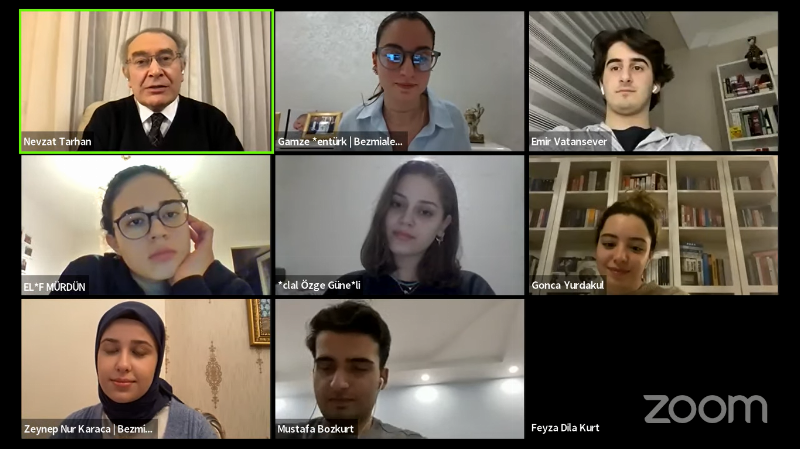
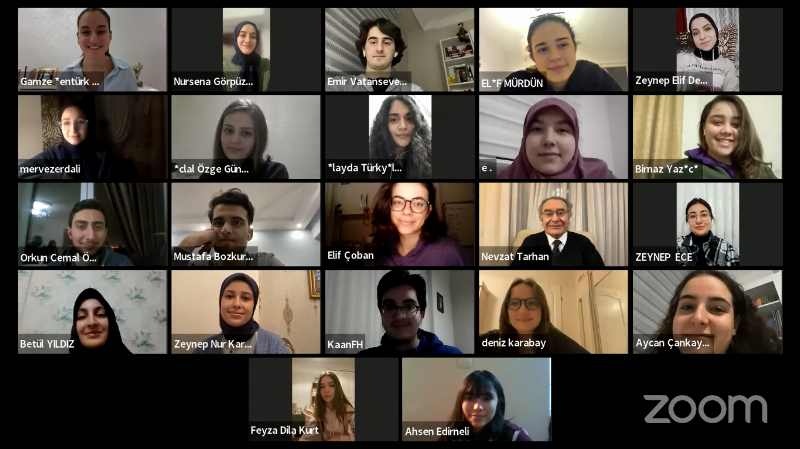
Founder Rector of Üsküdar Üniversitesi, Psychiatrist Prof. Dr. Nevzat Tarhan, was the guest of the program organized by Bezmialem Vakıf University Medical Students' Association. In the program held via Zoom, Tarhan, making evaluations on the topic of 'Neuropsychiatry: Interesting Clinical Cases with Research,' drew attention to the importance of preventive mental health. Stating that medicine begins when the patient walks through the door, Tarhan said, “In preventive mental health services, physicians must first focus on preventing people from getting sick.”
Content
Tarhan Meets Medical Students: 'We Need to Be Preventive Physicians, Not Just Curative Physicians'
“Whoever Follows the Literature Follows Innovation”
Tarhan, who met medical students in the online program, emphasized the continuous pursuit of innovation and the absolute necessity of knowing a second language. Tarhan said; “Our profession is a responsible one. If a method for treating a patient emerges in the world and enters the literature, you constantly need to follow innovation. If you stick with the knowledge you gained after graduation, previously the half-life of knowledge was thirty to forty years. Now it has dropped to two or three years. In such a period, you quickly become outdated. Therefore, you must constantly follow innovation. When you do so, you catch new things. They call it the point where luck intersects with intelligence and opportunity. The right position should be taken. For example, a cat waits for a mouse for three hours. It sits and waits for its prey. When it comes, it catches it. In fact, speaking of cats and mice, a story came to mind. One cat was waiting to catch a mouse, but the mouse stubbornly wouldn't come out and wouldn't get caught. A dog's bark was heard from outside, and the mouse came out, thinking the cat had fled. When it came out, the cat caught the mouse. The mouse, being an animation, said, “I heard a dog's bark, why didn't you run away?” The cat replied, “This is the benefit of knowing two languages.” It turned out the cat was barking. That's why you absolutely need to know a second language. Whoever follows the literature follows innovation. If you have a goal, you work, learn, and somehow succeed,” he stated.
“Medicine Begins When the Patient Walks Through the Door”
Tarhan, stating that it is very important to make the patient feel that you are trying to understand them; “Personalized treatment, for example, is personalized. By taking brain images, especially in neuropsychiatric diseases, it is so, but a significant portion of many internal diseases, rest assured, are managed by the brain. Previously, when asked what the essential cause was, they used to say essential. Now, most of those essentials are slowly being understood. The gallbladder has a counterpart in the brain, our stomach has a counterpart in the brain. When the program in the brain is disrupted, the stomach works chaotically even though the organ is sound, but if the program in the brain is disrupted, what happens now is that they tell the patient to go to psychiatry without correcting the brain's program. They often don't come saying 'I'm not crazy.' But knowledgeable physicians do this because there is a brain-body duality. We are currently moving towards the totality of sciences. Every science is not a standalone discipline within itself. That's why, whichever branch you choose, orthopedic surgeons, for example, have something; those who want to be orthopedic surgeons should pay attention to this. For instance, patients used to lie in large wards, and the professor would do rounds with assistants. They would expose the leg, explain, and leave. Then the patient next to them would ask, 'What did they say?' And the reply would be, 'Honestly, I understood nothing, they just talked to Mr. Leg and left.' In other words, the patient is not Mr. Organ, not Mr. Leg. Therefore, they are a human first. You will greet them, show goodwill, and make them feel that you are trying to understand them. Medicine begins when the patient walks through the door. It's important to welcome them, smile, and make them feel that you are trying to understand them. These things are not written in books, nor are they mentioned anywhere. I learned them through years of experience and I am conveying them to you; these are very important,” he said.
“It is Necessary to Treat Wherever the Brain is Damaged”
Prof. Dr. Nevzat Tarhan, speaking about evaluating the localization of the disease in which region of the brain and then treating accordingly; “In fact, a region of a person's brain works independently of the brain's integrity, producing faulty thoughts and faulty commands. In fact, OCD and schizophrenia are brain diseases. Diseases called mental illnesses are brain diseases. Brain function is impaired, but there is a mind, a consciousness, above our brain. They are separate, but once it becomes a disease, this depression is a decrease in serotonin in the brain. We evaluate the localization of which region it is in and treat accordingly. When a person's leg is broken, the entire body is not put in a cast; only the broken limb is cast. Similarly, in the brain, it is necessary to treat wherever it is damaged; treating the entire brain happens in very severe cases. That's why we are trying to do these things. This method has now become a model and is widely used worldwide. In OCD, we say that this network of the brain is damaged, and in addiction, addicts are now referred to more as having 'reward deficiency syndrome' rather than just 'addiction.' That is, this person's brain is not satisfied with rewards; beyond expected rewards, unexpected rewards now satisfy them, surprises satisfy them. Substances activate those centers in the brain, areas related to unexpected rewards. Such pleasures are tremendously more enjoyable. Expected rewards are already guaranteed, and no one derives pleasure from them. Surprises give people more pleasure. That's why movies and such are more effective,” he stated.
“Where There is Freedom, There is Entrepreneurship”
Tarhan, emphasizing that we should be the subject, not the object, of the digital world in the Metaverse; “Where there is no R&D, there is no innovation, no entrepreneurship. Entrepreneurship is a mindset. Silicon Valley is also a mindset. Silicon Valley is not a valley in San Francisco; it is a valley in minds. Where there is freedom, there is entrepreneurship. Where there is no freedom, there is no entrepreneurship. In cultures where obedience is glorified, freedom is absent, so fear dominates, and people cannot engage in entrepreneurship. Therefore, it must be in an environment of freedom; this happens in free countries. Discovery occurs in secure societies. Let's not fear the Metaverse, but in the Metaverse, let us be the subjects of the digital world, not its objects. Let's teach software; a few super young people, a few super computers, will do super things. Young friends, I told you to learn software first and foremost. Become software developers and combine software development with medicine; I tell you, no one can stop you. They are highly sought-after personnel right now; we cannot understand software developers, and software developers cannot understand us. Right now, we sat down and formed a team: software developers, geneticists, orthopedic surgeons, physicians are currently working together. The university's initial theme is like that. It combined the fields of engineering, health, and behavioral sciences. The human brain also has a characteristic: if it limits itself to something, it cannot progress beyond it. Let's not limit ourselves; therefore, let's think outside the box. Let's think in such a convention-breaking way. There is no discovery without mental rebellion. Therefore, you must think about what else is beyond these methods, sit and dream, challenge your brain, and rest assured, inspiration will come then. We can say all of these are other pieces of information that will be useful to you,” he stated.
“Every Patient is a Separate Case, Valuable”
Prof. Dr. Nevzat Tarhan spoke about the responsibility of treating every patient. Tarhan said; “The biggest lesson I learned from my patients is that in the patient-physician relationship, patients, as injured individuals, possess a set of knowledge, and they need that set of knowledge. I approached by thinking, 'What would I do if this were my sister, my mother, my father, a close relative?' When I approached in this way, I felt that the patient understood me much better because we have micro-expressions on our faces. These are reflected in our micro-expressions. I believe that their coming to us for help, their need for our knowledge, constitutes a responsibility for us to do good for them. We take their health security. We, in a sense, take their power of attorney for treatment. When we take their power of attorney, we have a responsibility to research what is right on their behalf. The common thing I've learned from all my patients is that I see the truth in the saying 'there is no disease, only the patient.' The saying 'there is no disease, only the patient' is absolutely true. So much so that the biggest lesson we can learn from patients is that every patient is a separate case, every patient is valuable. Our time may be limited; I also worked in a public hospital for a long time, but when a patient feels valued, a smile, a few kind words, a warm touch create a positive interaction with the other person. If you act positively towards patients, you receive a positive response; if you act negatively, you receive a negative response. Therefore, we may not be able to treat every patient, but we can do our best for every patient. Therefore, treating every patient is a responsibility because treatment is not something we can control. Of course, there is something we can control: explaining, presenting, and applying the knowledge we have to the patient. That's why we learn something new from every patient, and that's why I see every patient as a separate case,” he stated.
“We Need to Be Preventive Physicians, Not Just Curative Physicians”
Tarhan, particularly emphasizing that in preventive mental health services, physicians must first focus on preventing people from getting sick; “Psychiatry: It is the intersection of Medicine, Sociology, Psychology, and Philosophy. Therefore, it is referred to as a social scientist, a psychologist, child health and diseases, mental health and diseases. Education says you are also responsible for people's health. It doesn't just say disease specialist. It says child health and diseases specialist, mental health and diseases. Beyond these, all are disease specialists. For example, it says heart disease specialist, but child health and diseases medicine is different. Therefore, the most important thing is preventive health medicine. Curative medicine is difficult and costly. Therefore, even though I am a psychiatrist as a physician, most of my books are on positive psychology. Positive psychology books are a kind of preventive mental health books, books about family. I focused on these. Writing a disease book is very easy; I could write one immediately if I wanted to. I only wrote 'Addiction' in 2013 because the world was heading towards an addiction pandemic. Other than that, I always wrote books on preventive mental health. In preventive mental health services, as physicians, we must first focus on preventing people from getting sick. We need to be preventive physicians, not just curative physicians. There is primary prevention, which is about healthy individuals not getting sick. There is secondary prevention, which is about identifying risk groups, what we call preventive medicine, and achieving early diagnosis. There is tertiary prevention, which is about providing assistance to prevent the recurrence of a disease after it has occurred. Every physician needs to perform and know these three types of prevention. Primary, secondary, and tertiary prevention are perhaps even more important than curative medicine,” he said.
Share
Update Date: February 28, 2026
Creation Date: January 31, 2022
Request a Call
Other News
- Prof. Nevzat Tarhan: “Those with a mental filter are not afraid of the digital”
- Artificial intelligence doesn't eliminate the translator, it transforms their expertise!
- Social responsibility courses moved to the field
- Erasmus+ Orientation Week completed at Üsküdar
- Prof. Nevzat Tarhan: “Brain secretes ‘dark glue’ in social media lynchers!”