

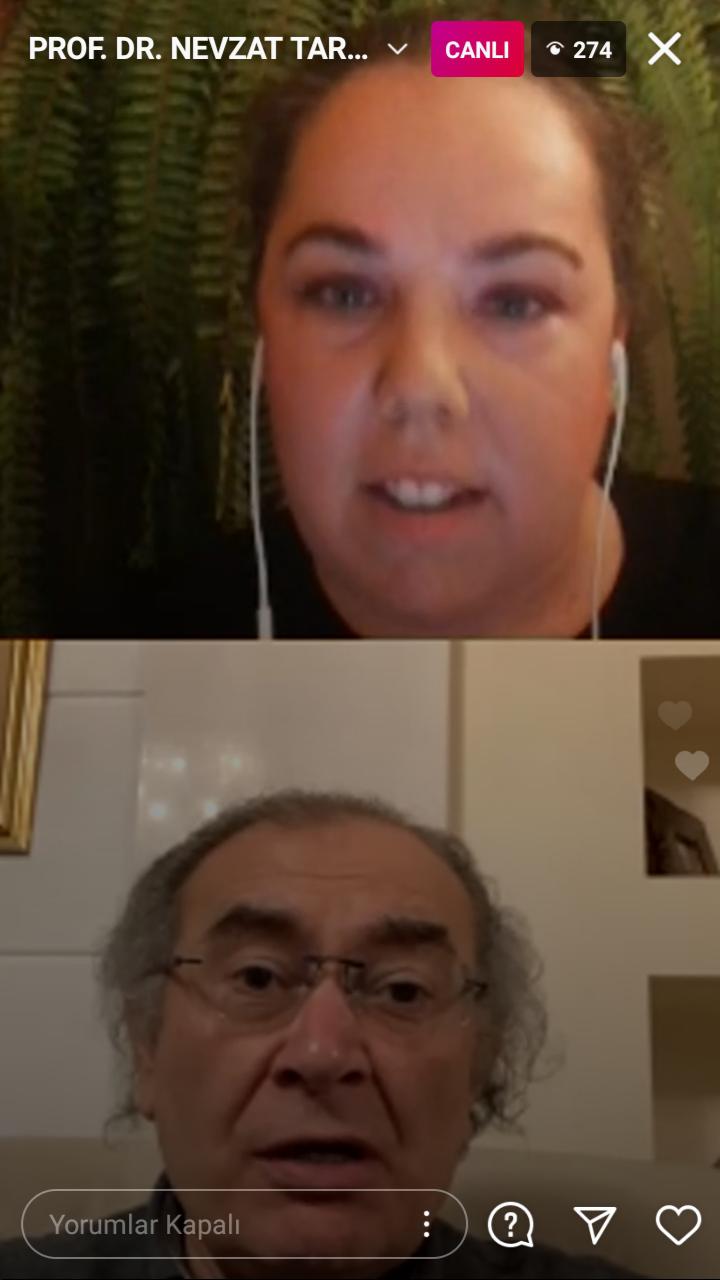
As the guest of the ‘Innovations in Health’ platform's Instagram live broadcast, Üsküdar Üniversitesi Founding Rector Prof. Dr. Nevzat Tarhan made important evaluations regarding the psychological effects of the pandemic on society, under the title “How does the pandemic affect our psychology?”
Content
Tarhan: 'Excessive Fear Negatively Affects the Immune System'
“It seems we will experience a psychological pandemic if precautions are not taken.”
In the broadcast moderated by Ayşe Engez, Tarhan stated that if precautions are not taken, a psychological pandemic will be experienced, saying: “It is too early to say we are currently experiencing a psychological pandemic, but there are preliminary signs. It seems we will experience it if precautions are not taken. The World Health Organization's spokesperson also warned about a pandemic of psychological illnesses. That risk currently exists worldwide. While it was initially thought that it would last 3-4 months and subside in the summer, second and third peaks were experienced. Following this, people suffered significant losses. Social, economic, psychological losses... There is uncertainty about the future, and concerns about whether the vaccine will yield results. All of these factors create high anxiety in people.”
“More than 50% of society reported high fears related to the pandemic.”
Stating that society has fears regarding the pandemic, Tarhan said; “We have a research group, and they conducted a study. In a study conducted with 6,318 people in April during the pandemic, more than 50% of society, between 40% and 70%, reported high levels of fear, anxiety, concerns about processes, and fears related to the pandemic. We are currently planning to repeat this in December. If anxiety is short-term, the body can tolerate it, but if it lasts for a long time and losses start to become permanent in some cases, people begin to feel panic, like a loss of control. The feeling of panic occurs when anxiety is coupled with a feeling of loss of control, meaning the person feels like they are losing control over their own life and mental health. People experience serious fears such as “I will get sick,” “I will lose my mind,” “my heart will stop,” “I will end up in intensive care.”
“Individuals with high values, beliefs, and ideals do not panic and can remain more composed.”
Referring to fear and anxiety during the pandemic, Tarhan also made important statements on how we can manage them. Tarhan said; “Here, we will listen to experts, dedicate 15 minutes to half an hour a day to this topic, and then return to our routine tasks. If a person spends 50 out of 60 minutes thinking about the pandemic, there is no chance they won't get stressed. Therefore, all precautions must be taken, and the rules of science must be followed. There are things beyond human control. In such situations, if a person has high values, high ideals, and beliefs, they do not panic and can remain more composed.” he stated.
“Excessive fear negatively affects the immune system.”
Stating that excessive fear makes life unbearable, Tarhan also touched upon the effects of fear and stress on the immune system. Tarhan said, “Excessive fear makes our lives more unbearable. Additionally, fear has the following effect: It suppresses the immune system. Stress hormones suppress our immune cells. Because it focuses on danger, the body stops growth during stress and directs all its energy towards the threat. Pupils dilate, it triggers a fight-or-flight response, shoulder, neck, and back muscles tense, gastrointestinal spasms occur, digestion slows, all energy resources are pumped into the bloodstream, blood sugar rises. If this lasts a few hours, the body compensates, but if it continues for days, the immune system collapses, and other diseases begin. If a person can achieve ‘Psychological well-being,’ which is a friend to our immune system, they will take precautions, prepare themselves against the negative, and aim for the positive to continue their life.” he concluded.
Share
Update Date: February 27, 2026
Creation Date: December 10, 2020
Request a Call
Other News
- Prof. Nevzat Tarhan: “Every segment of society should be able to say, ‘This constitution is my constitution!’”
- OHS Releases Guide for Safe Operation of Industrial Robots
- Prof. Nevzat Tarhan: “Social media is digital fast food”
- 2026-2027 Academic Year orientations completed
- Asst. Prof. İdil Arasan Doğan explained the importance of early intervention in living with dementia