

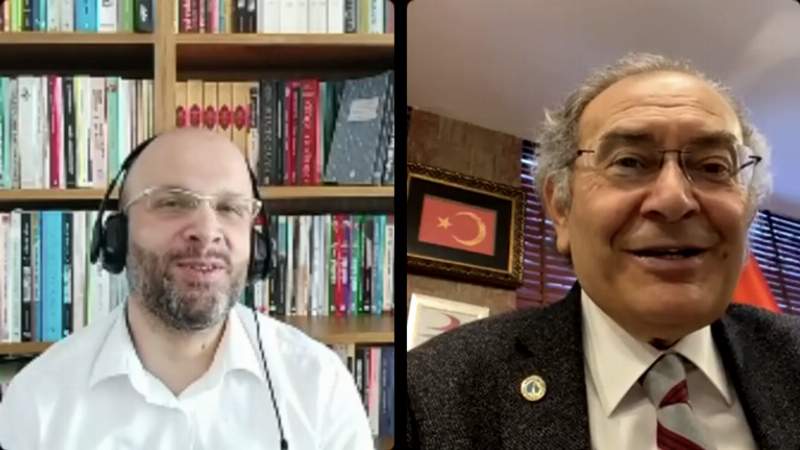
Üsküdar Üniversitesi Founding Rector, Psychiatrist Prof. Dr. Nevzat Tarhan, was the guest of an Instagram live broadcast organized by Tenzile Erdoğan Imam Hatip High School. Making evaluations on the topic of “New Truths in Education and 21st Century Skills,” Tarhan stated that all actors must work in harmony to ensure success in education. Tarhan said; “Education is an ecosystem. School alone is not enough, and the family must also be involved in education. In education, the child is at the center, and the family is also a part of education. The actors in education are; the child, teacher, school, and family. Systems where the family is not integrated into the education system cannot be successful.”
Content
Tarhan: “Education Systems Where the Family is Not Integrated Cannot Be Successful”
“We Must Be Examples Leading Generations”
In the program moderated by Mehmet Polat, the Director of Tenzile Erdoğan Anatolian Imam Hatip High School, Prof. Dr. Nevzat Tarhan stated that it is necessary to capture the contemporary in method while preserving the essence according to the spirit of the times. Tarhan stated that being stuck in the past leads to anachronism; “If a person gets stuck in the past, they miss the era mentally and cannot give new answers to old questions. We need to give new answers to old questions, not old answers. If we cannot give new answers, generations cannot understand us and will turn to other examples. For future generations, it is necessary to realize the synthesis of religion and science in education as soon as possible. The new generation questions not how to perform prayer, but why to perform it. Ilm-i Kalam (Islamic Scholastic Theology) lessons should be taught at high school level. As someone educated in natural sciences, I argue that the belief in Tawhid (monotheism) is the most rational belief. We can easily defend the belief in Tawhid as a rational belief. Because currently, quantum science and neuroscience have been discovered. All these confirm the thesis that an external intelligence is needed in the universe.”
“Synthesis of Religion and Science Should Be Made in Education”
Tarhan stated that children should be encouraged to ask questions; “Parents prevent children from asking questions at home with the mentality of ‘water to the elder, silence to the younger.’ When children don't ask questions, thought doesn't progress. The West produces, we imitate. Investment should be made in R&D to produce long-term policies. To conduct R&D, there is a need for questioning, researching young people. The one-sided perspective in education causes confusion. In high schools, the biology teacher calls the formation of the universe a coincidence, while the religious education teacher calls it God. For this reason, children get confused. We have not yet achieved the synthesis of religion and science in education. Instead of the phrase ‘values education,’ ‘values-infused education’ is more appropriate. Within physics, mathematics, all subjects; with the perspective of ‘This is God’s art of creating the universe, His knowledge,’ children learn physics and chemistry and also learn God’s art. In America, within the scope of academic freedom, the creation thesis is taught as a course under the title of intelligent design,” he said.
“Teachers Should Be Visionary Like Akshamsaddin”
Tarhan emphasized that the reason for the conquest of Istanbul opening and closing an era was due to the ability to enter castles; “With the invention of the mortar and cannon, Fatih Sultan Mehmet managed to demolish the castle and thus conquered Istanbul. Mortar and cannon were the superpowers of that era. Fatih became Fatih because he was able to achieve this. If you say we need to raise children like Fatih, then super young people and supercomputers need to come together. Then super works will emerge. Akshamsaddin, who was one of Fatih's biggest supporters while everyone was opposing him, was a scholar with a very broad vision. As teachers, we need to question whether we can be like Akshamsaddin today,” he said.
“Knowledge Infused with Emotion is Unforgettable”
Prof. Dr. Nevzat Tarhan stated that for a child to be successful in class, they must love the subject, and if a student loves the subject, they study it more and succeed. Tarhan said; “For a child to love the subject, they must love the teacher, and for them to love the teacher, the teacher must love the student. When the teacher goes to school, they will focus on their work and strive to raise these children better. For leadership to be present in the teacher, the teacher must infuse information with emotion. When information is not infused with emotion, it does not turn into belief. When it doesn't turn into belief, it doesn't turn into a habit and doesn't become part of one's personality. Dry information is easily forgotten, but when you add emotion to information, the brain stores it in chemical memory; otherwise, it is forgotten in temporary memory.”
“Family Must Be Part of Education”
Tarhan stated that education is an ecosystem and emphasized that the family must also be involved in education. Tarhan said; “In education, the child is at the center, and the family is also part of education. The actors in education are the child, teacher, school, and family. Systems where the family is not integrated into the education system cannot be successful. If the family gives one message and the school gives another, the child gets confused. Especially during the primary education period, teaching is very important. Educators in that period are those who sow seeds in the souls of children. They should also know the children's strengths and weaknesses by conducting talent management. If a shepherd is good at managing his flock, he will understand a sick sheep at a glance and have it treated. If he is an indifferent shepherd, the animal dies unnoticed, and even infects other animals. These are subtle touches in education.”
“Our Examination Systems Do Not Conform to New Truths”
Tarhan stated that emotivism, one of the 21st-century skills, means taking emotions into account; “Social and emotional skills need to be taken into account. Humans are not mechanical beings but social, relational beings. People need to be able to manage their emotions. Today, the education system worldwide is experience-oriented. Education does not happen by gathering people in a classroom and teaching theoretical information. We have an exam-oriented education system, where a child's entire life is determined by a single exam. In an exam-oriented system, students are overwhelmed with theory. Many intelligent children are wasted in this system because they have different skills. However, the current examination system does not conform to new truths,” he said.
“Avoiding Teamwork Hinders Success”
Tarhan stated that another important skill in 21st-century skills is teamwork; “In leader-centric, single-person-focused systems, even if one is a genius, they cannot be successful if they do not work in a team. True leadership is team leadership; being in front of the team is not being a boss. A boss is different, a leader is different. A boss gives orders, is demanding, but a leader is on the field. It's the same in business life; you cannot become the master of a job without being its laborer. But the current generation wants their comfortable desires to be fulfilled easily and immediately. We need to set a good example for them. Our generations matured through hardship, while the current generation is maturing in abundance, which is why they adapt late to many things. This pandemic showed them that the world is not as easy as it seems on television. During this process, people were deprived of many freedoms, and saw that death was very close. In this period, despite so much success, health systems became helpless against a virus; nature seems to be taking revenge on us. And we don't know if a new virus will emerge in the upcoming period,” he stated.
News: Esmanur Tuna
Share
Update Date: February 27, 2026
Creation Date: May 31, 2021
Request a Call
Other News
- The book that read today's digital threats in 2014: Being a Conscious Family
- Experts warn: 'Instead of memorizing letters, teach pencil grip, scissor use, and coloring'
- School fear and school love both start in the family!
- Family is not merely transforming, it is being battered under a serious assault
- Artificial intelligence opens the door to early diagnosis in autism!