

The "Süleyman Çelebi and Mevlid" program was organized in cooperation with the T.R. Ministry of Culture and Tourism, Üsküdar Üniversitesi Institute of Sufi Studies, Kerim Foundation, and Turkish Women's Culture Association. In the first part of the program held at the Nermin Tarhan Conference Hall, a Panel was held, chaired by Prof. Dr. Emine Yeniterzi, with the participation of Prof. Dr. Dursun Ali Tökel, Prof. Dr. Barış Erdoğan, and Xanthi Mufti Mustafa Trampa, discussing Süleyman Çelebi and Mevlid from various perspectives. In the second part, the Nisa Turkish Music Ensemble performed a concert featuring the Burdur Cumhur Women's Mevlid, with Nebahat Konu as its art director.
Content
"Süleyman Çelebi and Mevlid" Panel and Concert Program Held
The program was opened by Prof. Dr. Elif Erhan, Director of the Institute of Sufi Studies. Prof. Dr. Erhan stated that “2022 was declared by UNESCO as the year to commemorate Süleyman Çelebi on the occasion of the 600th anniversary of his passing. At the beginning of the year, Prof. Dr. Emine Yeniterzi, an expert on Naat-ı Şerîfler (Prophetic eulogies) from the Institute of Sufi Studies, was invited by the UNESCO Turkey Committee to the organized meetings, and the issue is being closely followed on behalf of our University.”
Mevlid and the tradition formed around it, as an important indicator of the Turkish-Islamic civilization's love and reverence for Prophet Muhammad (PBUH), were interestingly discussed from the perspectives of different disciplines in the panel organized within the program. During the program, the Nisa Turkish Music Ensemble gave a special concert aimed at keeping alive the traditional Burdur Cumhur Women's Mevlid, which was introduced to the Turkish music repertoire by the late Ahmet Hatipoğlu.
Prof. Dr. Dursun Ali Tökel: “Reciting Mevlid is not merely a ceremony”
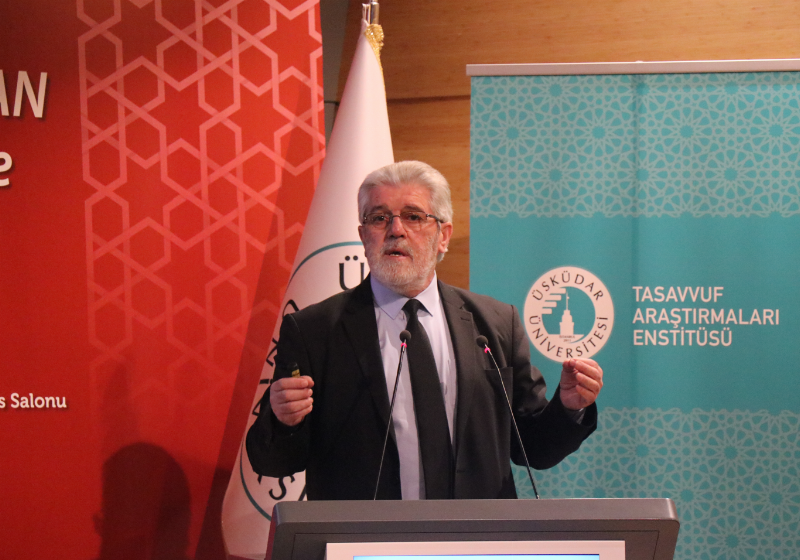
The first part of the program began with a panel, where Prof. Dr. Dursun Ali Tökel, a faculty member at the Faculty of Letters, Istanbul Fatih Sultan Mehmet Vakıf University, delivered a presentation titled "Mevlid-i Şerîf as a Self-Builder in the Mirror of Existence." Tökel made evaluations about the role and importance of Mevlid in our culture; "My title might sound a bit fantastic and philosophical to you, but we will actually talk about a very simple 'self-building in the mirror of existence.' What I mean by the mirror of existence here is what role Mevlid has assumed as a Muslim Turk, and I will share my humble opinions. A minaret is a common symbol of Islam, but every culture has interpreted it in its own way. If we have our own interpretation of a minaret, we also have our own interpretation of Islam. This interpretation is definitely unique to us in visual, auditory, literature, food, and human relations. We are trying to explain what this uniqueness is. Our ancestors built palaces for birds in our mosques; other countries did not do such a thing – this is our interpretation. They considered birds not only in mosques but also in fountains and inns. What is this? These are our self-indicators, our concretizations, that we put in the existence of Islam to build our selfhood. Cahit Zarifoğlu has a very nice article where he says; 'If we have the Prophet as the central figure in our minds, we become better Muslims.' Let Prophet Muhammad be the center. Reciting Mevlid is not merely a ceremony. Religion is not just about worship; religion is a whole. For centuries, Mevlid has been one of the primary sources for Turkish names; all these names originate from Mevlid. The source of approximately 70 names is Mevlid. If we reduce religion solely to worship, this would be an incomplete interpretation. Mevlid performed many functions. When these go, existence does not tolerate a vacuum; it fills its place with other things. Mevlid, Vesîletü’n-Necât, is the Turks' interpretation of Prophet Muhammad." he said.
“Mevlid is a text woven with hadith sharifs and holy verses”
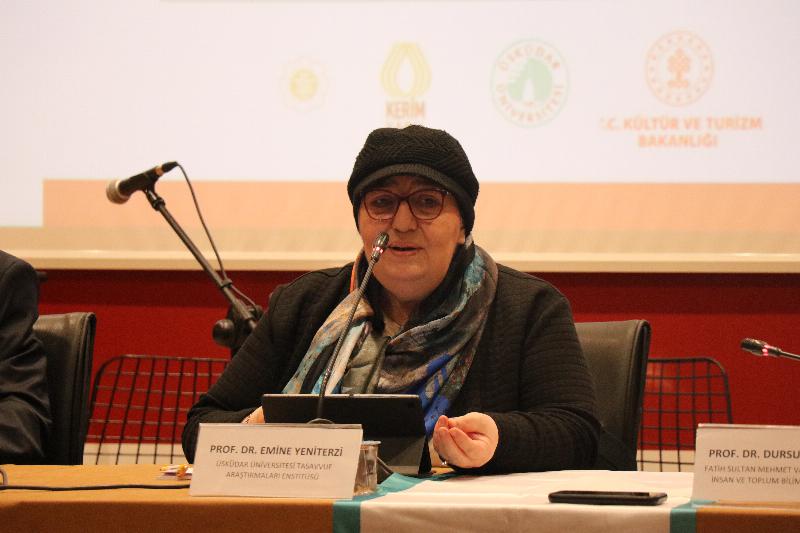
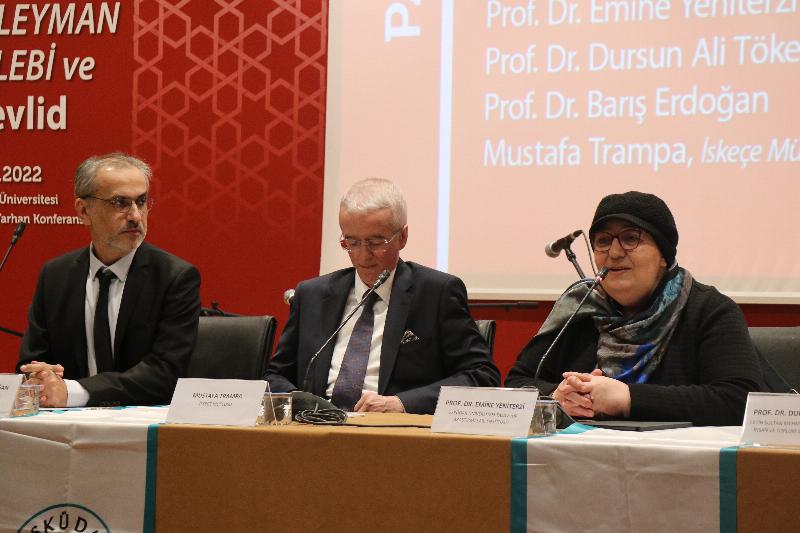
The second speaker, Prof. Dr. Emine Yeniterzi, Vice Director of the Üsküdar Üniversitesi Institute of Sufi Studies and Head of the Department of Sufi Culture and Literature, gave a speech titled "The Hadith Foundations of Vesîletü’n-Necât." Yeniterzi, interpreting the hadith sharifs mentioned in Mevlid from a literary perspective, stated that Mevlid is a text woven with hadith sharifs and holy verses. Yeniterzi said; "Süleyman Çelebi's Mevlid is a work founded on monotheism, prophethood, and morality. It narrates our love for Prophet Muhammad (PBUH), his life including his birth, and his miracles. Therefore, it is natural for this work, imbued with Prophet Muhammad, to contain many hadith sharifs. Research by academics working in the field of Hadith has indicated that there are approximately 45 hadith sharifs. These are direct quotes from hadiths. On the other hand, Süleyman Çelebi's Mevlid, like the invisible roots of a tree, is fundamentally full of immense associations and connotations. When we, as literary scholars, look at this work, we can see one or more hadith sharifs in every couplet. When we identify these chains of association, it becomes possible to determine what Süleyman Çelebi wanted to tell us, which thoughts he is conveying, and from what level of knowledge he approaches the subject. When Mevlid-i Şerif is examined in this light, it becomes clear that hadiths are fully integrated into the fabric of the work, and it is a text woven with hadith sharifs and holy verses.
When we ask why Süleyman Çelebi's Mevlid has been so loved by the people for centuries, the reasons are; that it conveys the love for Prophet Muhammad (PBUH) in every couplet in a very simple, clear, and understandable language. 613 years have passed, and we still understand it easily. And it has expressed this love with a very sincere expression. There is no concern for artistic creation at all. By placing a tremendous culture of verses and hadiths into the text through associations, Mevlid, with its solid foundations, has created a lasting impression on its readers." he stated.
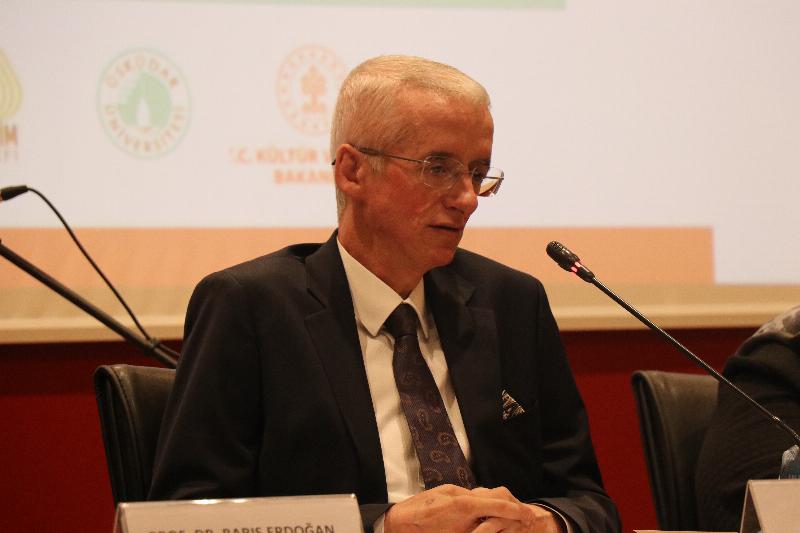
Mustafa Trampa: “In the Balkans, 'Mevlid' means Islam, and 'Islam' means Mevlid”
Mr. Mustafa Trampa, the Mufti of Xanthi, who participated in the program from Xanthi, conveyed greetings from Western Thrace, Xanthi, before moving on to his presentation titled "Mevlid Tradition in Western Thrace." In his presentation, Trampa emphasized the impact of Mevlid, stating that it strengthens social ties in Western Thrace. Trampa said; "The love felt for Prophet Muhammad (PBUH) in Western Thrace is truly a love not shown to any other human being in the world, and it is the same in the Rumelia geography. This is a separate love, which can also be called divine love. We see this in poems, prose, customs, feelings, and emotions. Whenever the name of our Prophet is mentioned, our hand immediately goes to our heart, and we send blessings (salawat). From the hand going to the heart at that moment, it is the spirit of Mevlid; that is, I deduce that Mevlid is completely adorned and covered with blessings (salawat). In Western Thrace, being Muslim and being Turkish is a very important value. A religiosity tied to Mevlid has developed and is very influential in the formation of national identity. In a catechism book written in Bosnia, you can see 'Muslim' means Turk, and 'Turk' means Muslim. For us too, 'Mevlid' means 'Islam,' and 'Islam' means 'Mevlid'; this situation still holds for a significant segment. In Mevlid, we see the complete reflected spirit of Islam. Mevlid provides social integrity. Mevlids are recited on both our sad and joyful days; people invite each other, especially in rural areas, in our villages and neighborhoods, Mevlid has a very effective power. The Mevlid tradition has a very important and unifying role for the Muslim Turkish people living with a minority psychology in Western Thrace," he said.
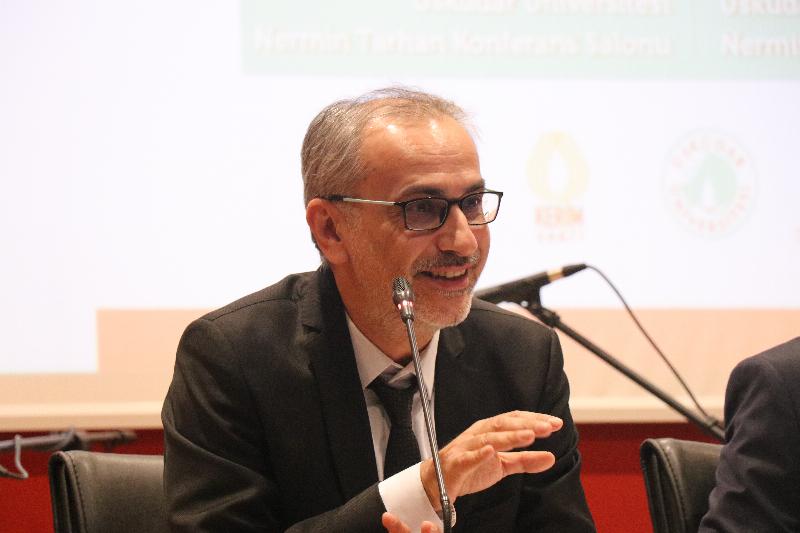
Prof. Dr. Barış Erdoğan: “Sociological and anthropological studies on Mevlid in Turkey are insufficient”
The last speaker, Prof. Dr. Barış Erdoğan, Head of the Department of Sociology at Üsküdar Üniversitesi, delivered a presentation titled "The Sociology of Mevlid: Its Place and Functions in Social Life in Modern Times." Erdoğan said; "I will try to explain to you the place occupied by Mevlid ceremonies, which express love for the Prophet (PBUH) through Süleyman Çelebi's work Vesîletü’n-Necât, in Turkish social life, and the social functions of these ceremonies, by adding my own perspective in light of the studies conducted by other sociologists. Every ritual has two functions. The first is an explicit function, and the second is a latent function. Now, the explicit function of Mevlid is to send greetings and blessings to the Prophet (PBUH) to attain intercession in this world and earn rewards. Its latent function is to be a tool that ensures unity and integrity in society. Although Mevlid occupies an important place in Turkish society, unfortunately, sociological and anthropological studies conducted in this area in Turkey are so few! Theologians or literary scholars are more interested in this topic, but its sociological dimension is quite weak. In Islamic geography, the Quran comes first, then Mevlid. Süleyman Çelebi's work appealed to the hearts of ordinary people. It found its place in their souls. We see Mevlid at circumcision ceremonies and wedding ceremonies; that is, from cradle to grave, in joy and sorrow, the Mevlid Ceremony is present in every area of Turkish social life. Especially, the recitation of Mevlid at rites of passage such as birth, marriage, and death has a special importance. Research shows that women show more interest in Mevlid ceremonies than men," he stated.
At the end of the panel, Ms. Emine Bağlı, the President of the Turkish Women's Culture Association (TÜRKKAD) and one of the Founding Members of the Kerim Foundation, and Mr. Selçuk Uysaler, the Secretary-General of Üsküdar Üniversitesi, presented plaques to the speakers in memory of the day.
Emine Bağlı: “Their principles are to implement faith and cultural awareness in a way that is distant from daily arguments. Our Mevlid tradition, in its various aspects, is one of the most beautiful examples of this reflected in society”
The second part of the program continued with a speech by Ms. Emine Bağlı, who spoke on behalf of TÜRKKAD and the Kerim Foundation. Emine Bağlı stated, "Language, history, wisdom, civilization, humanity, and sound judgment constitute the essence of these organizations. Their perspectives are broad and deep. Their work is long-term. Their principle is 'to implement faith and cultural awareness in a way that is distant from daily arguments.' Our Mevlid tradition, in its various aspects, is one of the most beautiful examples of this reflected in society," she said. In her speech, Ms. Bağlı mentioned the role of Nebahat Konu, the Art Director of the Nisa Turkish Music Ensemble, in continuing the Burdur Cumhur Women's Mevlid studies, which she took over from the late Ahmet Hatipoğlu, and Ms. Konu's contributions to the field.
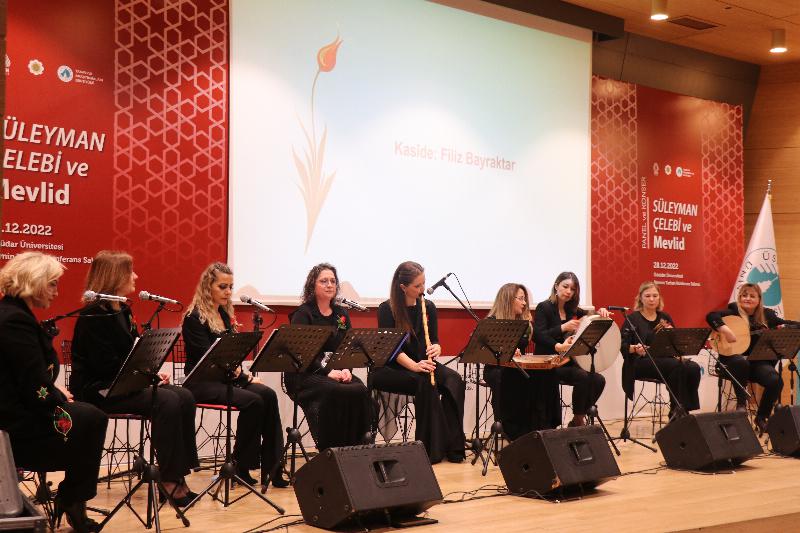
Following the panel, the Nisa Turkish Music Ensemble, with Nebahat Konu as its art director, offered an emotional experience to the participants with its Burdur Cumhur Women's Mevlid concert. The concert featured vocal artists Nebahat Konu, Neşe Dursun Saraç, Meltem Seyfelioğlu from the Ankara State Classical Turkish Music Choir, and Filiz Bayraktar, an artist from the Presidential Classical Turkish Music Choir; instrument artists Gül Güldaş Küçükşahin, Reyhan Yiğitbaşı İlmez from the Presidential Classical Turkish Music Choir, Sinem Hondoroğlu, an artist from the Istanbul State Turkish Folk Music and Modern Folk Music Research and Application Choir, and Arzu Kopuz Çelik, along with Nurten Yılmaz, a faculty member from Kocaeli University State Conservatory.
At the end of the concert featuring the Cumhur Mevlid, an exemplary text from Sufi prayers was formally recited by Cangüzel Güner Zülfikar, one of the Assistant Directors of the Institute of Sufi Studies. The prayer included the words: "What do we ask for that You do not give? There is no difficulty for You. There is no light and darkness, no evening and morning… O Lord, whatever Your will is for us, make it easy for us… that will which is sincerity and purity in Your servants and truthfulness and loyalty in their pledges, do not separate us from it! Bring us to Your selfhood without self, so that we may be adorned with Your attributes. Lead us from You to You without ourselves, and make the path of gratitude easy for us, so that we may be with You in obedience and service. O Divine, do not turn our faces away from the Qibla of faith and Islam, nor our feet from the path of monotheism and certainty. O Lord, keep us on the straight path You intend for us. O Divine, grant us chastity with Your protection, richness and prosperity with Your love, and after guiding us, do not make us among the misguided and those who incur Your wrath." (From Kenan Rifai's work titled Sohbetler).
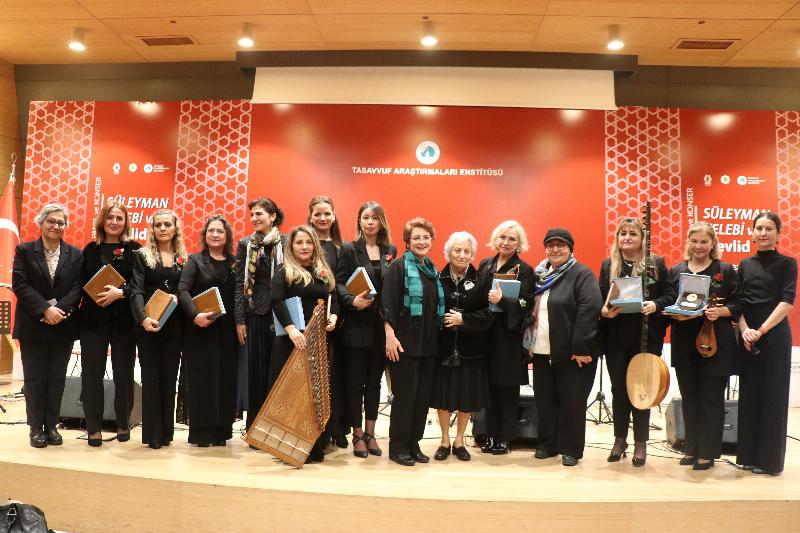
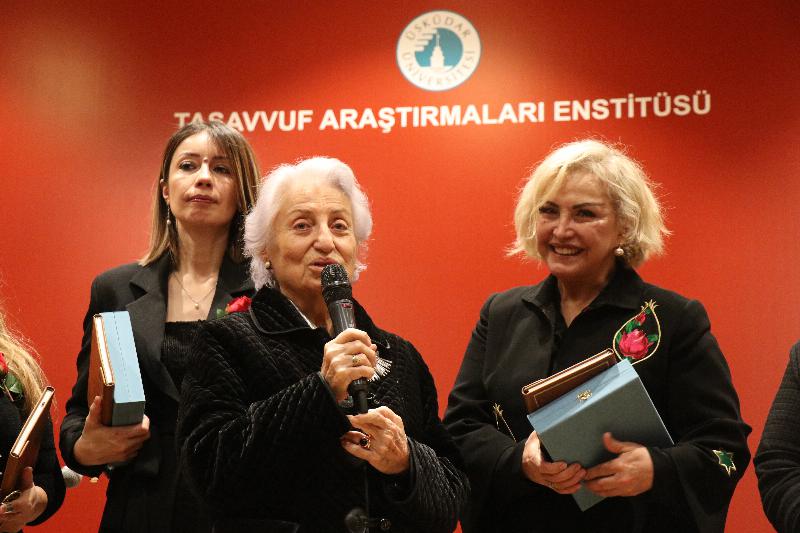
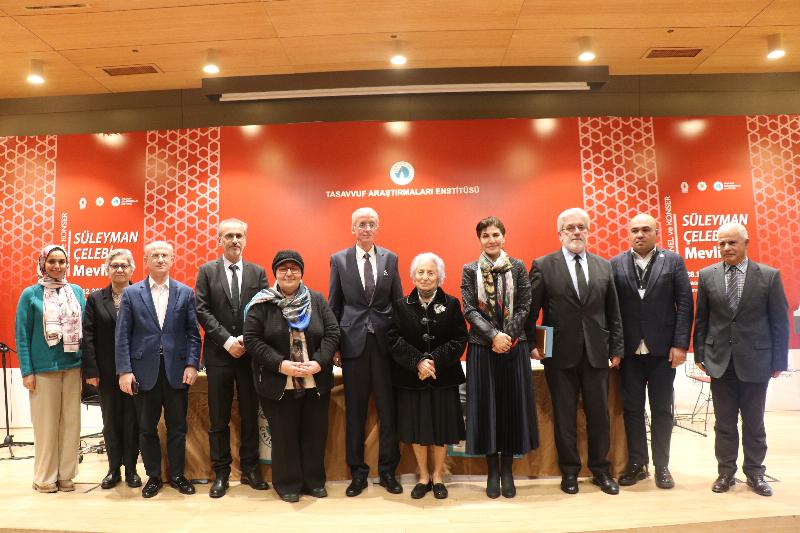
Prof. Dr. Elif Erhan, Director of the Institute of Sufi Studies, and Emine Bağlı, President of the Turkish Women's Culture Association, presented plaques to the members of the Nisa Turkish Music Ensemble. The program concluded after a group photo session.
Share
Update Date: March 01, 2026
Creation Date: January 02, 2023
Request a Call
Other News
- The book that read today's digital threats in 2014: Being a Conscious Family
- Experts warn: 'Instead of memorizing letters, teach pencil grip, scissor use, and coloring'
- School fear and school love both start in the family!
- Family is not merely transforming, it is being battered under a serious assault
- Artificial intelligence opens the door to early diagnosis in autism!