

Institute of Sufi Studies continues its education programs, which it launched in the Spring Semester of the 2014-2015 Academic Year, by opening four programs this year. Courses to be given by Uskudar University Rector's Advisor Cemalnur Sargut, Prof. Dr. Reşat Öngören, Lecturer Dr. H. Dilek Güldütuna, Dr. Arzu Eylül Yalçınkaya, and Lecturer Dr. Muhammed Bedirhan, will be conducted as interactive distance education.
Content
Sufism Education Programs Begin

The first of the newly opened programs will be given by Dr. Arzu Eylül Yalçınkaya on Wednesday, November 18, 2020. The study titled “Great Sufis in Our Sufi Tradition” covers the lives, works, Sufi understandings, and influences of prominent great Sufis in our Sufi tradition for 7 weeks. Some of these Sufis to be examined within the scope of the courses will be Ahmed Yesevi (d. 1165), Hacı Bektâş-ı Velî (d. 1271) Muhyiddin Ibn al-Arabi (d. 1240), Mevlânâ Celâleddin Rûmî (d. 1273), Sultan Veled (d. 1312), Yunus Emre (d. 1321), Hacı Bayram-ı Velî (d. 1430), Niyâzî-i Mısrî (d. 1694), and Ken’ân Rifâî (1950).
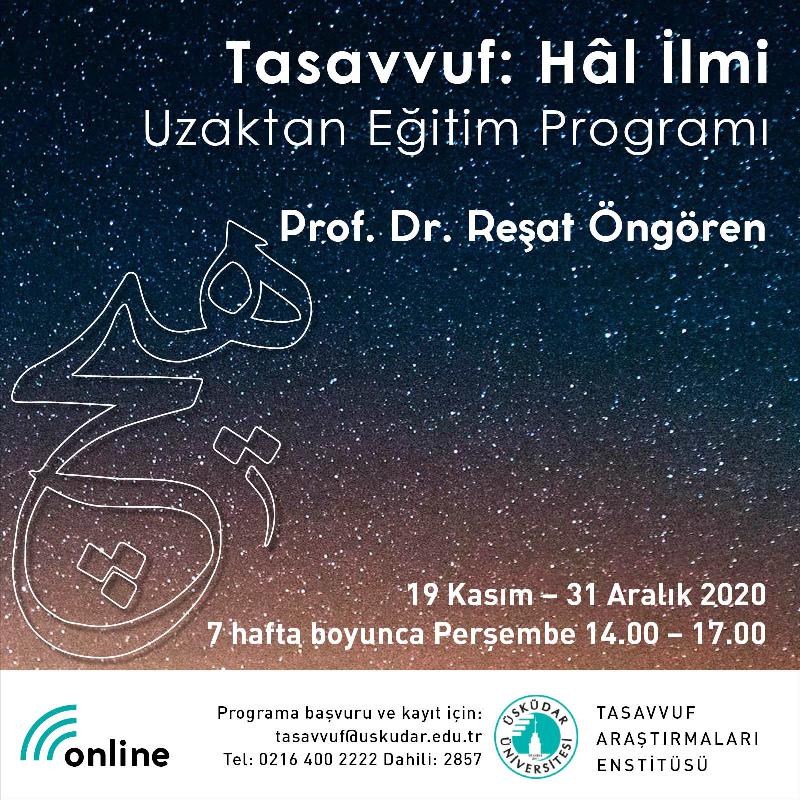
Sufism Courses from Prof. Dr. Reşat Öngören
The program titled “Sufism: The Science of Spiritual State,” prepared by Prof. Dr. Reşat Öngören, will begin on Thursday, November 19, and will also last for 7 weeks. In the courses, Prof. Dr. Reşat Öngören will evaluate the contributions of Sufism to our lives under the headings: “Tasting the Flavor of Faith,” “Looking at the World from a Sufi Perspective,” “To Know or To Be?”, “Life and Miracles,” “Futuvva and Malamatiyya,” “Dreams and Real Life,” “Sufism Education and Other Mystical Systems,” and “The Emergence, Functioning, and Functions of Tariqas.”
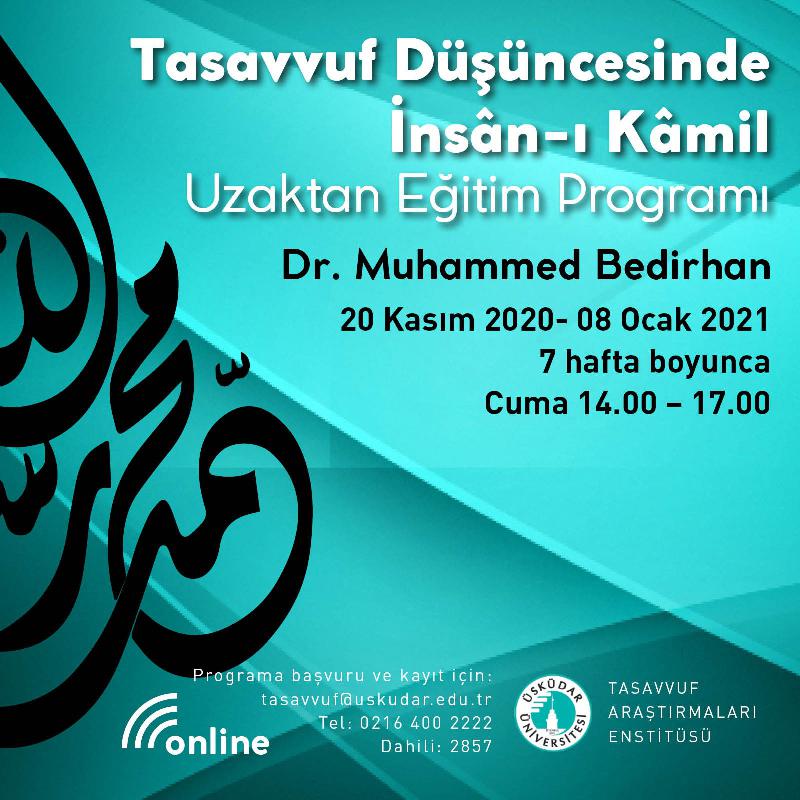
Lecturer Dr. Muhammed Bedirhan to Address 'Humanity in Sufism'
Another new program, which will meet participants for seven weeks, is titled “Al-Insan al-Kamil (The Perfect Human) in Sufi Thought.” Lecturer Dr. Muhammed Bedirhan will address “humanity,” one of the most significant problems Sufi tradition has tried to tackle since its inception, in his courses.
Evaluating the issue of humanity in Sufism through its relationship with the realm of existence, Lecturer Dr. Muhammed Bedirhan said, “This situation leads to humanity being the purpose of the creation of the universe and the goal of the universe, and the universe owing its existence and continued existence to the existence and continued existence of humanity. This understanding of humanity, found in the works of important representatives of Sufism such as Ibn al-Arabi, Sadreddin Konevî, Dâvûd al-Qaysarî, Molla Fenârî, and Abdülkerîm Jilî, has also gained a poetic identity in the language of poet Sufis like Mevlânâ, Yûnus Emre, and Niyâzî-i Mısrî. Within the framework of this course, humanity’s central ontological position and the existential and ethical journey process, or 'sayr u suluk', undertaken by humanity to achieve this position, will be examined.”
The education program, starting on Friday, November 20, will examine various theoretical works that describe humanity and its journey to perfection, i.e., becoming Al-Insan al-Kamil, such as Sadreddin Konevî’s Miftâhu’l-Gayb; Dâvûd al-Qaysarî’s Risâle on the Introduction to Sufi Science; Abdülkerîm Jilî’s Al-Insan al-Kamil, Al-Kamalât al-Ilāhiyya; Azîz Nesefî’s Zubdat al-Haqā’iq, Tanzil, Al-Insan al-Kamil; and İsmâil Hakkî Bursevî’s Lubb al-Lubb. In the courses, poems by Sufi poets such as Yûnus Emre, Niyâzî-i Mısrî, and Azîz Mahmûd Hüdâyî will be included to illustrate how the topic is constructed in literary language.
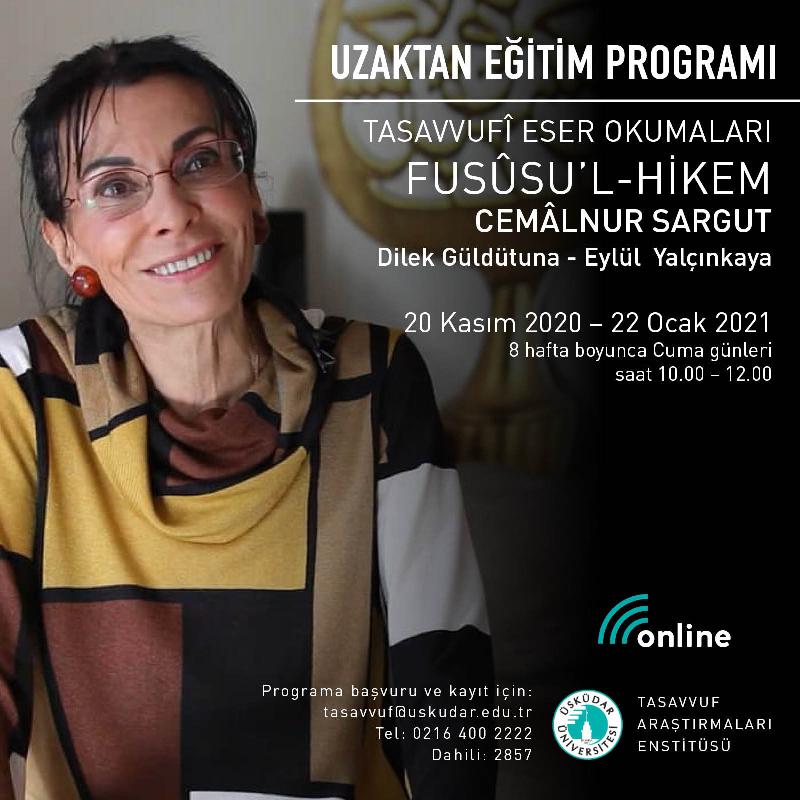
Fusûs al-Hikam Courses Begin
The final work of this semester will be the Fusûs al-Hikam courses, led by Uskudar University Rector's Advisor Cemalnur Sargut, which have been ongoing for approximately five years under the title of Sufi Work Readings. Cemalnur Sargut will be accompanied in the courses by Lecturer Dr. H. Dilek Güldütuna and Dr. Arzu Eylül Yalçınkaya. The program will begin on Friday, November 20, 2020, and will continue for 8 weeks, from 10:00 AM to 12:00 PM.
Ibn Arabi's Work: Fusûs al-Hikam
The work belongs to Ibn Arabi (1165-1240), also known by the epithets Muhyiddin (Reviver of the Religion) or Sheikh al-Akbar (the Greatest Sheikh). Ibn Arabi is regarded as a Sufi who, in his outward and inward journey from Andalusia to Damascus, united East and West in his works, interpreting and integrating diverse disciplines, philosophical and Sufi perspectives without exclusion, combining them with his knowledge.
Fusûs al-Hikam, Written in 1229
Along with the multitude of his works, two in particular, al-Futûhât al-Makkiyya and Fusûs al-Hikam, have shown great influence as the two works best reflecting Ibn Arabi's legacy. In contrast to al-Futûhât al-Makkiyya, which meticulously covers a wide range of topics, Fusûs al-Hikam, which he wrote in Damascus in 1229, is considered the epitome of his works due to its depth and intensity. For this reason, approximately 120 commentaries have been written on the work, the first of which belonged to Ibn Arabi himself. The work, initially read in small circles, gradually became known in wider circles and has continued to be a focal point of interest to this day.
Fusûs al-Hikam Features Prophets Mentioned in the Holy Quran
The name of the work also reflects its content. In the work, consisting of 27 chapters, each section is dedicated to a prophet mentioned in the Holy Quran, recounting a divine wisdom manifested in him. As expressed in the Hadith Qudsi as “Hidden Treasure,” although the Truth (Haqq) is unknowable and incomprehensible in its essence, the universe is the place of manifestation and revelation of the Truth, and the perfect human, who is the vicegerent of the Truth, is the perfection of this manifestation and the purpose of creation. By comprehending the wisdom manifested in each prophet's word, or reality, a new door opens for humanity in knowing the Truth (Haqq). Prophet Muhammad, on the other hand, is the Khatam al-Anbiya, meaning the Seal of the Prophets, because he is the last of the prophets, constituting the entirety of words (jawami' al-kalim) by affirming, completing, and unifying all prophets, and as the perfect manifestation of the Muhammadan Reality (Haqiqat-i Muhammadiyya), he unifies the beginning and end of creation. For this reason, understanding other prophets and their wisdoms has been a means to understand and know the Muhammadan Reality and Prophet Muhammad”.
Detailed information about registration and the calendar for the Sufism Education Programs can be accessed from the Institute's website: https://tasavvuf.uskudar.edu.tr/tr
Share
Update Date: February 26, 2026
Creation Date: November 13, 2020
Request a Call
Other News
- The book that read today's digital threats in 2014: Being a Conscious Family
- Experts warn: 'Instead of memorizing letters, teach pencil grip, scissor use, and coloring'
- School fear and school love both start in the family!
- Family is not merely transforming, it is being battered under a serious assault
- Artificial intelligence opens the door to early diagnosis in autism!