

Üsküdar University Faculty of Health Sciences Department of Ergotherapy, led by Prof. Dr. Sevda Asqarova, organized a special program for 'March 21 World Down Syndrome Awareness Day'. The program, which took place over Zoom and was moderated by Ergotherapy Club President Berkay Karpuz, was attended by Ergotherapy Department Club Presidents and expert occupational therapists in the field as speakers.
Content
Special Program for World Down Syndrome Awareness Day…
“Cognitive speeds are slow and delayed compared to their peers”
Serra Korkmaz, President of Üsküdar University Dyslexia and Ergotherapy Club, who spoke about the learning difficulties and mental processes experienced by individuals with Down Syndrome; “Children with Down Syndrome actually follow the same sequence in cognitive development as normally developing children. Despite this, their cognitive speeds are slow and delayed compared to their peers. As a result, learning difficulties can be observed. In addition, their perception of the environment, coordination, language development, and consequently communication-interaction skills, lead to negative outcomes due to the impact on neurological mental processes. A problem is experienced in one of the 'input', 'integration', 'memory', 'output' steps that enable learning. The unique cognitive profile of individuals with Down Syndrome has changed with development, life experiences, education, and the influence of the dynamic nature of the process.”
“Some processes inevitably tire the family”
Occupational Therapist İsa Kör, emphasizing the need for a multidisciplinary approach to children with disadvantages; “When children are born, they have pure intentions, they don't have the urge to mock others, but they learn many things from their families. After a certain age, the family wants to socialize the child and tries to change the child's social environment outside with that pressure. After a certain time, if there are no parents, they cannot enter a social environment. There are many individuals with Down Syndrome who perform daily living activities. There are institutions that aim to raise awareness in many people and show their employability. However, the problem here is that we cannot reach all children. Some processes inevitably tire the family. When we therapists manage the family and deal with our clients, we need to look at 20-30 year processes. Because whether the family can manage these processes is important. Sometimes some families cannot carry out these processes. At this point, we need to intervene where we see deficiencies in children by increasing different areas of interest. This is extremely important.”
“Music Therapy plays a significant role in the development of individuals with Down Syndrome”
Şevval Ateş, President of Üsküdar University Positive Adaptation in Ergotherapy Club, pointing out that Art Therapy has an effect on many diseases such as developmental delay, learning disabilities, personality disorders, depression, neurological disorders, and post-traumatic stress disorder; “Artistic activities in occupational therapy enable clients to express their feelings and thoughts using tools such as sound, rhythm, movement, color, form, pattern, and the like. All these artistic tools offer clients a different language to express themselves. By helping clients relax by focusing on the work they do, it helps them discover and develop their talents and skills, and contributes to the rebuilding of their self-confidence. Children with Down Syndrome are very happy in their work with music and various rhythm perceptions. Music education, which covers a wide range of all developmental stages of an individual, plays a significant role in the development of individuals with Down Syndrome.”
“Occupational therapy is a planned treatment that can be applied in many areas”
Melike Şahan, President of Üsküdar University Ergotherapy and Sensory Integration Club, who focused on the areas where sensory integration therapy can be used and intervention in Down Syndrome; “Sensory integration disorder is observed as modulation problems, sensory discrimination problems, and physical motor planning and coordination problems. It is used in the areas of postural physical problems, social-behavioral problems, and learning problems. Occupational therapy is a planned treatment that can be applied to individuals with Down Syndrome from the most basic activities such as infancy and sitting balance, walking, to many areas of life such as academic success and adaptation to social life. For this reason, the individual's condition should be monitored in an occupational therapy center.”

The most significant difference is seen in manipulative skills
Sevilay Tunç, President of Üsküdar University Cerebral Palsy and Ergotherapy Club, who spoke about the developmental differences between normally developing children and children with Down Syndrome; “In terms of the process of reaching motor development milestones, the most significant difference between children with Down Syndrome and their non-disabled peers is seen in manipulative skills. Disadvantages in individuals with Down Syndrome, such as heart conditions, the long duration required for the treatment process, and inactive life periods during treatment, cause individuals to reach motor development milestones later and lead to significant developmental differences between them and their peers.”
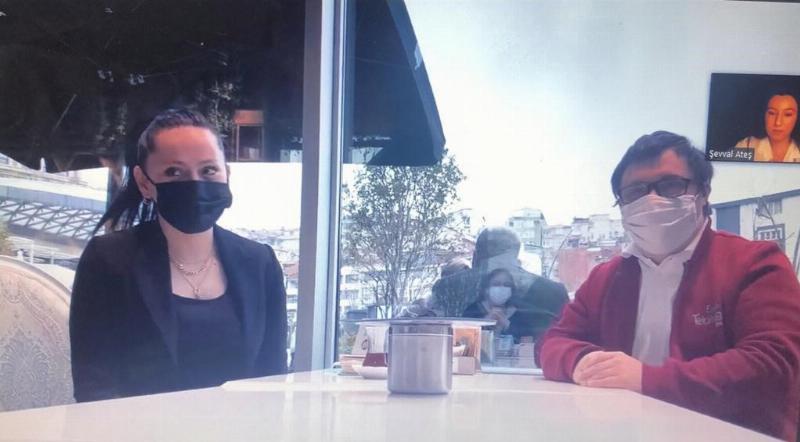
The program also included an interview conducted by the club presidents with Şermin Çoban, Project Coordinator of Tebessüm Kahvesi, and Emrah, an employee of Kahve. Tebessüm Kahvesi serves as both a workplace where young people with Down Syndrome socialize and a school where they receive education for their personal development.
Share
Update Date: February 27, 2026
Creation Date: March 24, 2021