

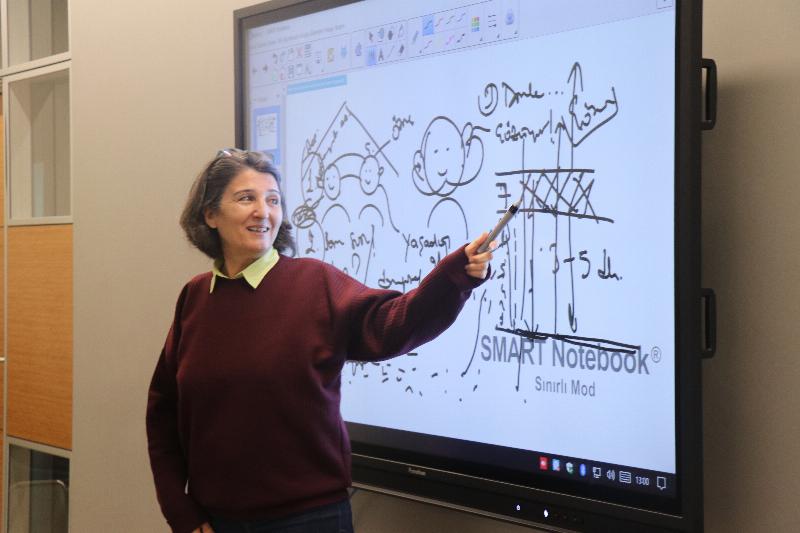
An event titled “Dialogue-Based Approach in Improving Interpersonal Communication” was organized within the scope of the University Culture Course of the Department of Nursing, Faculty of Health Sciences, Üsküdar Üniversitesi. In the event, Expert Psychiatric Nurse Selma Hasanoğlu conveyed to the audience, with examples, how communication should be established with children and patients.
Content
Selma Hasanoğlu: “Ask questions, be amazed, and listen!”
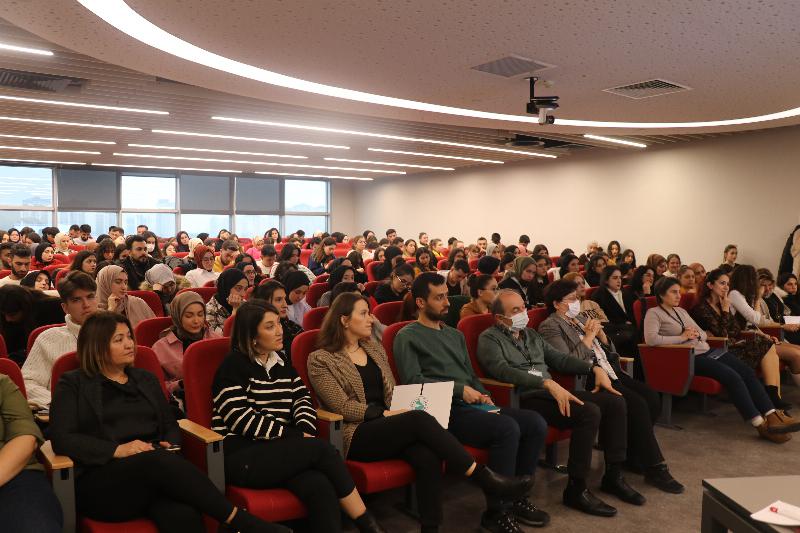
The opening speech of the event, held at the Galenos Conference Hall of Üsküdar Üniversitesi NP Health Campus, was delivered by Prof. Dr. Selma Doğan, Head of the Department of Nursing, Faculty of Health Sciences, Üsküdar Üniversitesi.
Selma Hasanoğlu: “Parents are the subjects of childhood.”
Stating that life means relationships, Hasanoğlu said, “The home environment is what primarily harms a child. It is the mother, the father. Childhood is very important; parents are the subjects of childhood. If parents are supported, they will have the opportunity to raise their children with less harm. Children are harmed in three ways: physical, sexual, and emotional abuse.”
“Parents want robots, not children.”
Stating that children cannot repair these abuses and seek professional help, Hasanoğlu said, “Parents expect their children to do things they couldn’t do themselves, and they constantly beat their children with words through talking. Don’t compare children because children already compare themselves; we are not needed. Parents want robots, not children; they don’t want problems to arise. Children confide in their parents the least. If parents cannot be a safe harbor for their children, children create safe harbors for themselves.”
“'Why' is a question for research, not relationships.”
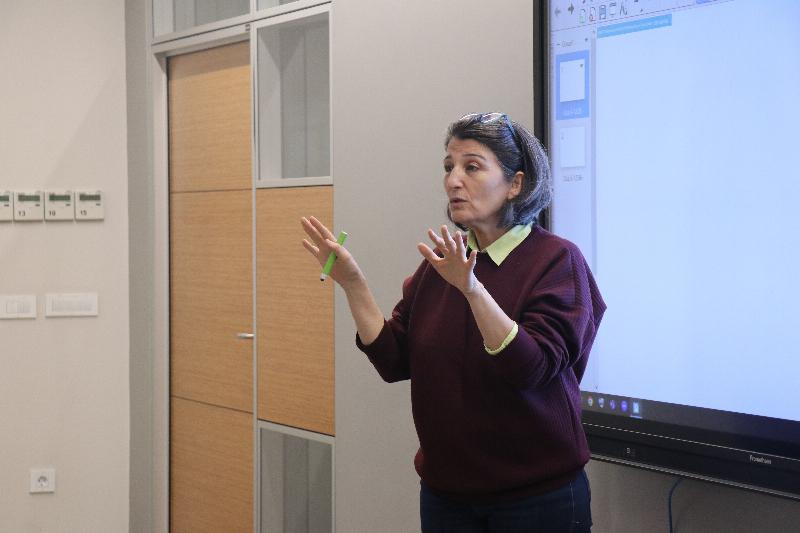
Emphasizing the importance of establishing eye-to-eye, mouth-to-mouth, ear-to-ear, equal-level dialogue in communication, Hasanoğlu stated, “Information should not be given to the patient in a hurry. Dialogue should be established. To listen means to hear what is being said. If children feel heard, they will recount events as they happened. Amazement is different at every age. To be amazed is to be a subject. 'Why' is a question for research, not relationships. The question 'why' has three answers: defense, anger, indifference. Instead of 'why,' a circular question should be asked. Such as 'How did it happen?', 'What happened?', 'What did you do?'. 'What do you feel?' is also a question for therapy, not for daily life. Don’t say 'I understand.' Ask questions, be amazed, and listen. We don’t listen to children; we hear them.”
The event concluded after participants' questions were answered.
Share
Update Date: March 01, 2026
Creation Date: January 11, 2023
Request a Call
Other News
- Social responsibility courses moved to the field
- Erasmus+ Orientation Week completed at Üsküdar
- Prof. Nevzat Tarhan: “Brain secretes ‘dark glue’ in social media lynchers!”
- Prof. Nevzat Tarhan: “Every segment of society should be able to say, ‘This constitution is my constitution!’”
- OHS releases guide for safe operation of industrial robots