

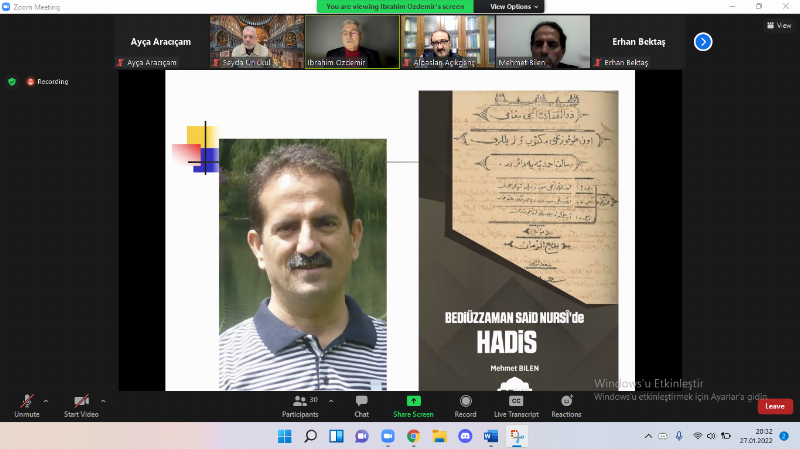
The guest of the January monthly talks organized monthly by the Risale-i Nur Research Platform (RİNAP) was Prof. Dr. Mehmet Bilen, Head of the Department of Hadith, Basic Islamic Sciences, Dicle University.
Content
Said Nursi and Hadith Topic Discussed at Risale-i Nur Research Platform
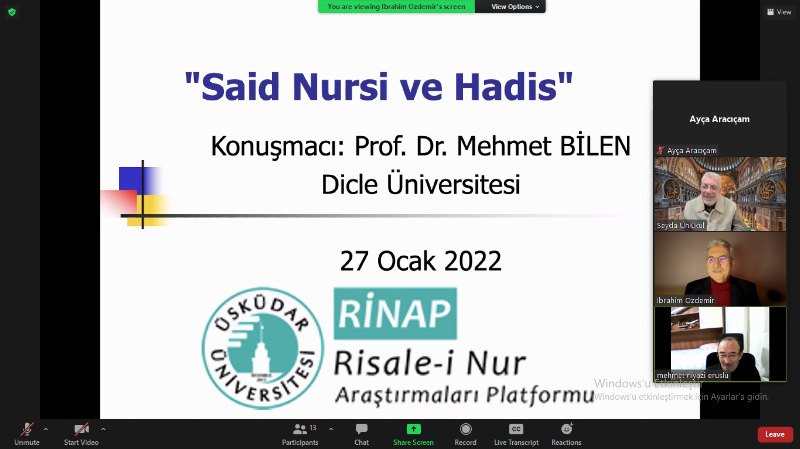
In the program moderated by Prof. Dr. İbrahim Özdemir, Head of the Philosophy Department at Üsküdar University, Faculty of Humanities and Social Sciences, Prof. Dr. Mehmet Bilen stated, “Hadith are the most fundamental point of transmitting the Sunnah of Prophet Muhammad to future generations in the form of lived practice.” He added: “Hadith are an important and the most extensive source of Sunnah. As seen in Bediüzzaman’s saying ‘Hadith is a mine of life, an inspirer of truth,’ the importance of Hadith is emphasized here. It is necessary to note that the Sunnah of Prophet Muhammad is conveyed to subsequent generations through Hadith in the form of lived practice. I believe this demonstrates how crucial a source Hadith is for learning the truths about life.”
“We must grasp the essence of the concept of Hadith”
Emphasizing the importance of fundamentally questioning the attribution of the concept of Hadith, Prof. Dr. Mehmet Bilen said, “When defining the concept of Hadith, two different definitions are made. In the first sense, there is an absolute definition stating that Hadith are the words, actions, and tacit approvals of Prophet Muhammad. However, the more accepted definition is ‘words, actions, and tacit approvals attributed to Prophet Muhammad.’ The narrations that we can call Hadith have been attributed to Prophet Muhammad by scholars. Whether these narrations meet the criteria was determined through various studies by scholars, and after their attribution to the Prophet was questioned, they were declared as authentic (sahih) Hadith. Therefore, it is very important to emphasize this point in the definitions.”
“The writing of Hadith points to 2 distinct periods”
Bilen touched upon the historical process of Hadith from past to present; “Hadith were not officially committed to writing, but some Companions created private scrolls with the knowledge of Prophet Muhammad, though mostly they were transmitted through oral tradition. That is, the narrations of the Prophet were preserved in memory. This continued almost throughout the 1st Hijri century. Even after the time of Prophet Muhammad and his students, there were those who wrote Hadith. At the end of the 1st Hijri century, during the reign of Umar ibn Abd al-Aziz, the writing down of Prophet Muhammad’s Hadith began with his directives sent to the governor of Medina and other governors. The reason for this was the concern that scholars were dying and Hadith might be lost. Thus, we see Hadith being committed to writing by the caliph’s order. We call this period the 'tadwin' (compilation) period. The private writing process by the Companions during the Prophet’s time is called 'kitabah' (scribing). From the perspective of the Hadith era, this points to two distinct periods. Subsequently, the 'tasnif' (classification) period begins. The 'tasnif' period involved compiling Hadith into books, categorized by subject and by the name of the Companion, thus making Hadith easier to access.”
“People need to interpret the Sunnah as a model for life”
Underlining that in Islam, the Sunnah should be made a purpose of life not only in an individual sense but also in a societal sense, Prof. Dr. Mehmet Bilen stated: “The Sunnah is not merely confined to the individual actions of Prophet Muhammad. What we call the Sunnah of Prophet Muhammad, the lived form of the Quran, also attracts attention with its social and universal dimensions. The lifestyle he established, the Quranic explanations and practices he presented, provide us with all kinds of material for a Sunnah-based life, both individually and socially. If we only focus on its individual dimension, we would disregard a large part of the Sunnah. Unfortunately, this is the prevailing understanding today. When people think of Sunnah, they often think of individual acts like wearing a ring or lying on one’s right side. The aspects Prophet Muhammad emphasized in human interactions and how he built society in a positive direction illuminate many of our social problems today.”
“Hadith carries measures that build the Islamic model”
Adding, “Making Islam the top priority, the ultimate ideal. Human relations, actions towards the poor, the social dimension of the Sunnah are highlighted,” Prof. Dr. İbrahim Özdemir said: “It is also understood that people who take Prophet Muhammad as a role model show mercy towards animals and strive not to be wasteful. In this way, the importance of the Sunnah in human life is reflected in every social sense.”
Traces of Isra'iliyat can be found in Hadith sources
Prof. Dr. Mehmet Bilen, drawing attention to the existence of fabricated (mawdu) hadith from every non-Islamic culture in some Hadith sources, stated: “We see that weak hadith have acquired a broad meaning, extending to narrations fabricated by non-Islamic cultures and even anti-Islamic individuals with the aim of corrupting the religion. Some scholars have also evaluated Isra'iliyat in this way. Üstad Bediüzzaman also draws attention to Isra'iliyat. He particularly highlights figures like Ka’b al-Ahbar, emphasizing that their knowledge, along with that of the People of the Book who became Muslim, was incorporated into Islam. Such figures are brought to the forefront as sources of Isra'iliyat. They are less common in Hadith books compared to Tafsir (exegesis) and history sources. This is because Hadith scholars consider strict conditions when evaluating narrations. They acted more rigorously; nevertheless, it must be said that some Isra'iliyat narrations have infiltrated Hadith sources. Said Nursi specifically emphasizes that in interpreting the Quran, it should be interpreted with the Quran itself or with authentic Hadith, and that finding the direct meaning of the Quran and Hadith through such Isra'iliyat reports is incorrect.”
Reporter: Ayça Aracıçam
Share
Update Date: February 28, 2026
Creation Date: January 28, 2022
Request a Call
Other News
- The book that read today's digital threats in 2014: Being a Conscious Family
- Experts warn: 'Instead of memorizing letters, teach pencil grip, scissor use, and coloring'
- School fear and school love both start in the family!
- Family is not merely transforming, it is being battered under a serious assault
- Artificial intelligence opens the door to early diagnosis in autism!