

Üsküdar Üniversitesi Faculty of Humanities and Social Sciences 2022-2023 Fall Term Faculty Seminars continue without slowing down. In this week's seminar program, Political Science and International Relations Department faculty member Prof. Dr. Nergiz Özkural Köroğlu made a presentation titled “Russia-Ukraine Relations from the Perspective of International Relations Theories”.
Content
Russia-Ukraine relations discussed in the context of international relations theories…
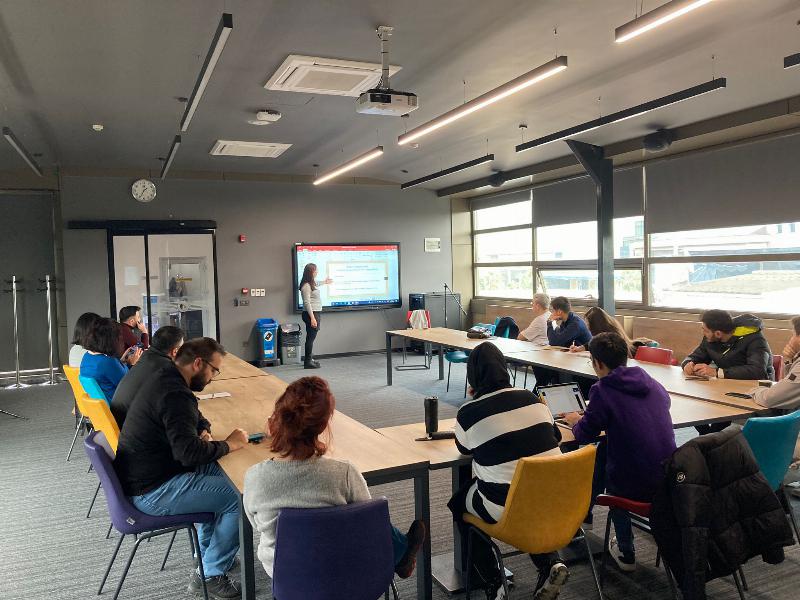
The Russian invasion of Ukraine was discussed as the main topic
Prof. Dr. Nergiz Özkural Köroğlu, who addressed the 2022 Russian invasion of Ukraine as the most current and critical international relations event, stated that she would discuss the possibilities of examining different dimensions of the same cases through other international relations theories alongside the realist paradigm. Köroğlu said; “The realist paradigm is predominantly used in case analyses in the field of international relations.”
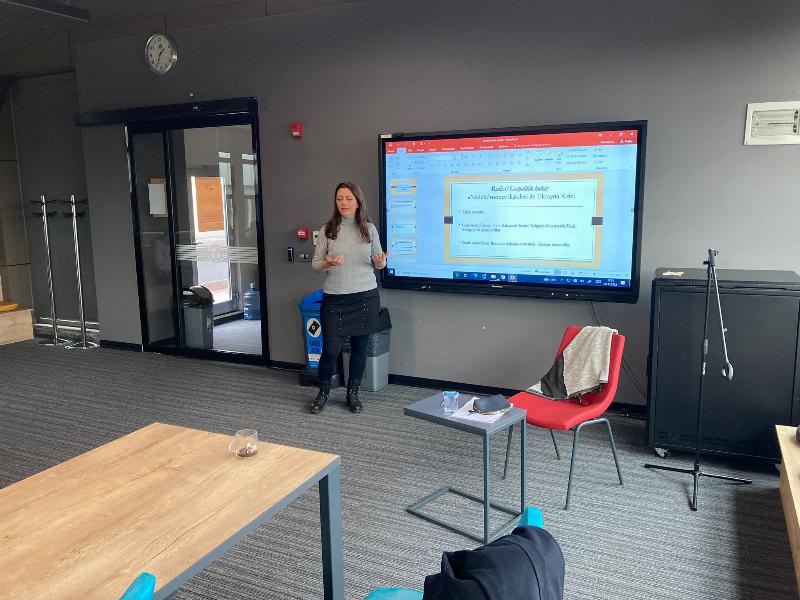
Social constructivist perspective asks 'how'
Prof. Dr. Nergiz Özkural Köroğlu, mentioning that the realist perspective focuses on military capacity, geography, and underground resources, said; “When questioning the causes of Russia's invasion of Ukraine, analyses can be presented through realist/geopolitical and social constructivist perspectives. Accordingly, while the realist paradigm offers a deterministic approach through cause-and-effect relationships, the social constructivist perspective focuses on the process by asking 'how'. The realist perspective concentrates on military capacity, geography, and underground resources.”
“Russia's natural gas wealth is used as an important tool for power dominance”
Prof. Dr. Nergiz Özkural Köroğlu drew attention to the fact that the tensions with Russia resonated at a societal level; “When searching for the causes of the invasion, we can see the results of Russia's power maximization, conceptualized based on Mackinder's heartland theory and Eurasianism, in the invasion of Ukraine. Furthermore, Russia's rich natural gas reserves are also used as an important tool for power dominance. When examining the reasons for the Russia-Ukraine war, a case analysis using a social constructivist approach to understand how the process unfolded reveals the importance of historical and cultural factors such as identity division in Ukraine (Europeanization/Russification) and popular uprisings in Ukraine. In Ukraine, caught between Europe and Russia, identity issues are followed by negative developments in internal politics, and especially with the EU's borders reaching Ukraine in 2004, tensions with Russia have resonated at a societal level.” she stated.
The seminar concluded with participants' questions being answered.
Share
Update Date: February 26, 2026
Creation Date: December 05, 2022
Request a Call
Other News
- The book that read today's digital threats in 2014: Being a Conscious Family
- Experts warn: 'Instead of memorizing letters, teach pencil grip, scissor use, and coloring'
- School fear and school love both start in the family!
- Family is not merely transforming, it is being battered under a serious assault
- Artificial intelligence opens the door to early diagnosis in autism!