

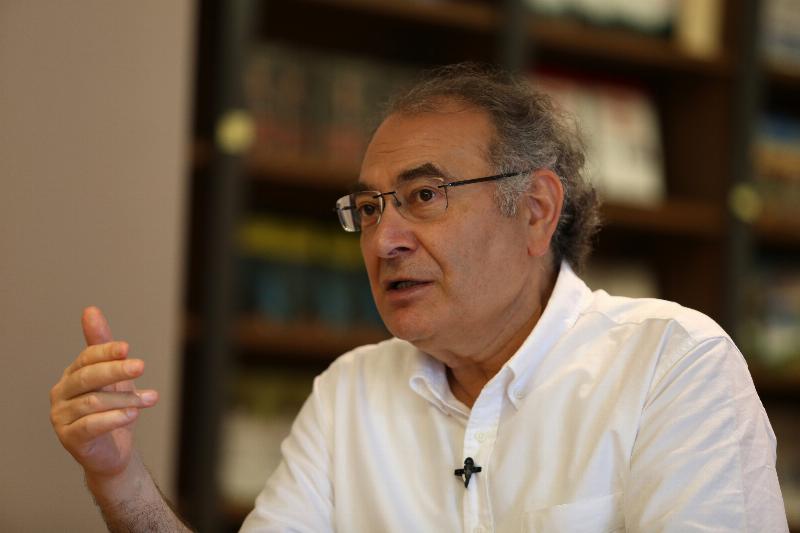
Üsküdar Üniversitesi Founding Rector Psychiatrist Prof. Dr. Nevzat Tarhan made evaluations regarding the month of Ramadan and the psychology of spirituality in his interview with Milli Gazete.
Content
“Ramadan is a period for one to find a mirror for themselves”
Ramadan curtails excessive desires, wants, and feelings of unrestrained behavior. In Ramadan, self-consciousness and self-awareness emerge. Therefore, Ramadan is an opportunity for this self-consciousness. Ramadan is a period for one to be a mirror to oneself, a period to find a mirror for oneself. In Ramadan, a person can self-reflect. Ramadan provides an opportunity for a person to question their excessive desires, ambitions, and insatiability. Ramadan is a month of meaning... What happens? Ramadan is the month for a person to change the meaning they give to the world... The meaning they give to life, to time, and to themselves changes.
How does the month of Ramadan repair the spirituality and psychology of believers? What are the remedies offered by the month of Ramadan for the troubles we experience?
Among the remedies offered by Ramadan, there are remedies for the individual, remedies for society, and a universal remedy; in other words, Ramadan offers three important remedies... The first remedy provides an opportunity for the individual to discipline their ego; that is, a person sets aside time and an environment to discipline their desires and impulses, because what are the emotions that cause people to make the most mistakes, for example, think about it... One is greed, another is ambition, and another is disrespect, shamelessness, and mercilessness. People with these emotions, for instance, greedy individuals, ambitious individuals, or those who do not know their limits, rights, and laws, those who are limitless and irresponsible, are the biggest targets for liars and schemers... For example, liars prey on the ambitious and greedy; they set up a scheme for those who are very desirous of money, wealth, or fame, they give them things using fake marketing techniques, and gradually take back what they've given, magnifying it; they take one and give two, they take something from them and give back twice the price. After doing this three or four times, they create a false trust... After this, they take everything and give nothing. Think of incidents like Çiftlikbank; there, they keep giving and giving, generally trapping insatiable, greedy individuals with high expectations... Such people always exist in society; an incident occurs, and 20-30 years later it's forgotten. Someone else comes and does similar things, the environment changes, and they change their methods; these people always find those who are ready to be deceived... So, what is Ramadan's connection to this? Ramadan curtails excessive desires, wants, and feelings of unrestrained behavior. In Ramadan, self-consciousness and self-awareness emerge. Therefore, Ramadan is an opportunity for this self-consciousness. Ramadan is a period for one to be a mirror to oneself, a period to find a mirror for oneself. In Ramadan, a person can self-reflect. Ramadan provides an opportunity for a person to question their excessive desires, ambitions, and insatiability. Ramadan is a month of meaning... What happens?
“Ramadan is the month for a person to change the meaning they give to the world”
Ramadan is the month for a person to change the meaning they give to the world... The meaning they give to life, to time, and to themselves changes. For example, theft incidents decrease by 50% in Ramadan. 50% of alcoholic individuals do not consume alcohol in Ramadan, which is why the livers of alcohol consumers in Turkey relax during this month. So, there is something in Turkey; Ramadan has had an effect that prevents alcohol from turning into a disease, meaning Ramadan changes the meaning a person gives to excessive wants, desires, impulses, and insatiable, limitless behaviors, making them solely worldly. Because humankind, by making them think that it's not just worldly but that there is also life after death, gives the person an opportunity to change their priorities.
“The evolution of the soul is with love”
Therefore, Ramadan's benefit to the individual is to re-evaluate their importance and priorities... That's why we also call Ramadan a month of moratorium, a month of temporary pause, a psychological pause from desires, impulses, ambitions, and wants; it says, stop, think, start again. Life, therefore, the restarting of the 12th month causes a person's spiritual progress, spiritual ascent; the stations of the ego rise with greed and desire, the stations of the soul rise with love. The evolution of the soul is through love, the evolution of the ego is through concrete pleasures, while the evolution of the soul is through abstract pleasures. What are abstract pleasures; it is being able to manage love, for humans to be able to love spiritual things, not material things, to experience it as a universal emotion, to establish a heartfelt connection with the Creator, Ramadan has been given great meaning in our culture as an opportune month. In Turkey, when projects and plans were made to change culture, Ramadan became the most resistant social behavior to cultural change; those who wanted to change our culture through Ramadan and Eid holidays never succeeded. Therefore, Ramadan and Eid are areas that remained unchanged during the period when our culture was tried to be altered, and it is important to know this.
“Turkey has been a victim of cultural imperialism at one point”
Turkey has been a victim of cultural imperialism at one point. There is not only monetary and material imperialism but also cultural imperialism. What is there in monetary imperialism? It exploits you with taxes. What has happened in monetary imperialism now? It has transformed into international companies, a tool of exploitation, and they use culture in this, making the world a single culture, managing cultural behavior, and exploiting the world through culture. Our culture tries to resist this; Japanese culture has protected itself, resisted. Korean culture has protected itself in the same way, but we have not been able to protect ours, which is why it has gone as far as giving English names to their children, that is, this degree of cultural imitation... We have aroused a sense of inferiority in Western culture, and because it was aroused in us, we called Western culture superior. We called ours a low culture and tried to imitate them. We have become the object of cultural imperialism. Ramadan is an area that resists this; therefore, Ramadan is very important for us, like protecting our language... Using Ottoman words is very important for the language. It is necessary to be able to use them. Ramadan is also a very good opportunity to return to our cultural roots, in terms of its social dimension. That is why those who reject our cultural roots have called Ramadan the 'Sugar Feast'. They try to pass Ramadan without pronouncing the word 'Ramadan,' but interestingly, surveys are conducted in large companies, groups, and holdings; more than 50% of people fast in Ramadan, they want to fast. They want to fast in some way, whether at the beginning or at the end of Ramadan, so this is a code preserved in our culture, and it must be kept alive. This is on the social side of Ramadan, and on the other side, it is a month that increases communication among people; the feeling of compassion rises in people.
“Unconditional loving compassion; this is called mercy”
How does the month of Ramadan provide self-control in the spirituality of our people? What can you say about the month of Ramadan, which we experience with intense worship, building up believers? Islamic geographies are very troubled... What should we do, in accordance with the wisdom of the holy verse “Believers are but brothers,” to remember our brothers and sisters living in these geographies during the month of Ramadan and to build bridges of affection?
Now there are two types of love; one is unconditional loving compassion, which is called mercy, and the other is conditional love. Compassion is a love with a clear object... It is unconditional, unqualified love like a mother's love for her child. In Ramadan, this becomes loving for the sake of Allah. What is added to love in Ramadan? You love, but you love for the sake of Allah, in this case, it becomes a meaningful love. What is there in compassion in Ramadan? There is loving with an effort to help. What is there in mercy? There is loving without any expectation of return. Like the love of Allah for His creations, like the name Rahman, what is in the name Rahman? There is great mercy. The equivalent of mercy from person to person is love, compassion. In fact, the effort of the strong to help the weak is mercy. Therefore, there is a hierarchy in the word mercy. The emotion of mercy has a greater dimension specific to Allah; there is Divine mercy, grace. That is why it appears in 113 of the 114 surahs in the Holy Quran, beginning with Rahman and Rahim... Because the main definition of the Quran appears as Rahman. When we do a conceptual analysis of the Quran, the most emphasized concept is the concept of mercy. The second is Divine pleasure, the third is justice, and the fourth is the concept of infaq (spending for Allah's sake)... When we look at the concepts of the Holy Quran in Ramadan, these concepts are also rising concepts in Ramadan; it is the month of living the meaning of the Quran. To live the meaning of the Holy Quran, one must also think with the concepts in the Holy Quran; justice, infaq, sharing. These concepts form the psychological framework of the Quran. The Holy Quran has brought these concepts to the forefront, vivified them greatly. The month of Ramadan is an important opportunity to revive these concepts in the Holy Quran. What is there in the month of Ramadan? A very rich person says, "I should give what is more than my need to those in need." This concept of infaq is also the concept of justice. A just person thinks they are a guest in the world, they think they are a trustee of wealth. A tenant does not say, "This house is mine," but says "it's a trust," takes good care of it, but also pays rent to the trustee.
“Ramadan is actually the rent payment of a social society to the creator”
Ramadan is actually the rent payment of a social society to the Creator. Being a good person is the rent paid. The month of Ramadan is an opportunity for a person to show gratitude to the Creator for His trusts, such as health, material possibilities, and many opportunities in the world. And this gratitude is indeed one of the most important meanings. There is a benefit beyond death for a person in being a good servant, being a good person; being a good person is actually making an investment beyond death. These are spiritual investments, spiritual trade, since life is not only composed of worldly life, because having a life after death is now a necessary existence. Existence after death is a requirement of reason through methods of reasoning, that is why the concepts of resurrection and the hereafter are among the most frequently mentioned concepts in the Quran. The concept of hamd (praise) and the concept of shukr (gratitude) - the revival of these concepts in Ramadan strengthens social bonds; therefore, the most important thing about Ramadan is that it strengthens bonds within the family and society and adds value to a person's life.
“Ramadan is the month that adds high values to human life”
Therefore, Ramadan is a month that adds high values to human life, an opportunity. We must teach our children within the social structure, otherwise, our children today are growing up worldly. Worldliness, secularism, has become a global ideology, meaning everything is in this world, there is no other life after this world, and it also instills the feeling of no accountability. A person says, secularism is the ideology of no accountability, inorganic matter created it, so there is no one to whom I owe an account, no one to question me, I can live as I please… But Ramadan says; friend, you cannot live as you please, you are not aimless, you are not irresponsible, there is a truth like death, you need to explain what comes after death, you need to give meaning to what comes after death, if you cannot do this, you will lose life after death, you will lose accountability, therefore these are Ramadan's universal messages… If we ask what Ramadan's universal messages are, they are adding meaning to our lives, and establishing a heartfelt connection with the Creator. It is to connect hearts not to multiplicity but to sovereignty… That is, to direct oneself towards spiritual rather than material connections; if a person can direct themselves towards these, they will find inner peace in the month of Ramadan because they feel part of a much greater meaning. Since the search for meaning is genetically coded in humans, no other living being besides humans has a search for meaning; if you look into the inner world of a cat, dog, or horse, a horse is for running, for example, a dog's imaginary world has bones. A cat's imaginary world has meat, meaning their imaginary worlds constitute their meanings. Therefore, for humans, it offers an opportunity to re-organize the meaning and purpose of our lives as a universal message, and here, at the top of the hierarchy of importance, is placing Divine pleasure, then comes our duty towards our homeland, our duty towards humanity, our duty towards our mothers and fathers, but at the very top is our duty towards the Creator. We must establish our hierarchy of meaning this way.
“Eliminating the fear of death…”
If we establish it this way, because we add meaning to what comes after death, we eliminate the fear of death and the fear of annihilation, and we also fulfill the desire for endlessness. Because the desire for permanence, the desire for immortality, is genetically present in humans because humans have a "clock gene." The clock gene also has this time perception of what comes after death, and humans also have a second gene, the "space gene." The spatial gene... Unlike other living beings, humans have a geometric, conceptual thinking code, and by using these codes, a person searches for the meaning of life; there is a metacognitive, supra-mental gene in humans... Look at the supra-mental genes: first, genes related to the search for meaning, second, the concept of time, there is validity for the clock gene, third, there is a gene for awareness related to death... And fourth, there is a gene for seeking novelty... Constantly open to new experiences, these four genes as metacognition genes make people ask: "There is a Creator, He sees me, what does He want from me after death?" They ask questions like, "Who am I, where should I go, why should I walk?" They ask questions like, "What is the meaning of life, what is eternity, what is the meaning of eternity?" These questions exist in humans; only humans question eternity, only humans question the concept of time. No other living being asks what will happen to them in 10 or 20 years... But if a person wants to elevate themselves beyond the animalistic level, Ramadan is an opportunity for us to raise ourselves from the animalistic to the human level... What was there at the animalistic level? Eating, drinking, reproducing... There is Maslow's pyramid of psychosocial needs; at the very bottom of that pyramid comes eating, drinking, reproducing. In the second place is security, in the third place is loving and being loved, and at the very top comes self-actualization... This is the search for meaning. A person's search for meaning is at the very top of the psychosocial needs pyramid. In this month of Ramadan, fulfilling our desires, questioning the meaning of life, understanding existence—Ramadan is not just a month for thinking of the poor, not just a month for disciplining the ego, but a month of existential inquiry: why does life exist, why do I exist? People are not asking how to perform prayer now, but why to perform it. The science of Kalam needs to be explained to society right now...
“What is Ilm al-Kalam (Islamic scholastic theology)? Imam Ghazali says it is a science for the elite!”
For young people, the most important dimension of Ramadan, for example, what is Ilm al-Kalam? Imam Ghazali says it is a science for the elite, only those who have reached a certain level can explain it. But we have now reached an age where a high school student can easily ask the questions that the 'elite' would ask… Therefore, when no answer is given, a young person says, 'A religion that cannot answer my questions cannot be my religion.' That is why we need to explain Ilm al-Kalam to young people. Ramadan is an opportunity for this. If you explain Ramadan as a month of meaning, a month of existence, the existential dimensions of a person, which we will translate with philosophy and Islamic philosophy, Ilm al-Kalam is Islamic philosophy; so, it is an opportunity to explain this to young people… What does Islamic philosophy deal with? It deals with existence, it deals with life, what is the meaning of life, it deals with this, what is life after death, it deals with this… In other words, Islamic philosophy provides answers to such questions of reason. That is why we misunderstand Islamic philosophy; there is a greater need for explanation; it is already referred to as Ilm al-Kalam. I believe that for young people, Ramadan should be an arena where Islamic philosophy is highlighted, discussed, and answers to their questions are found.
Share
Update Date: February 27, 2026
Creation Date: April 21, 2021
Request a Call
Other News
- Social responsibility courses moved to the field
- Erasmus+ Orientation Week completed at Üsküdar
- Prof. Nevzat Tarhan: “Brain secretes ‘dark glue’ in social media lynchers!”
- Prof. Nevzat Tarhan: “Every segment of society should be able to say, ‘This constitution is my constitution!’”
- OHS releases guide for safe operation of industrial robots