

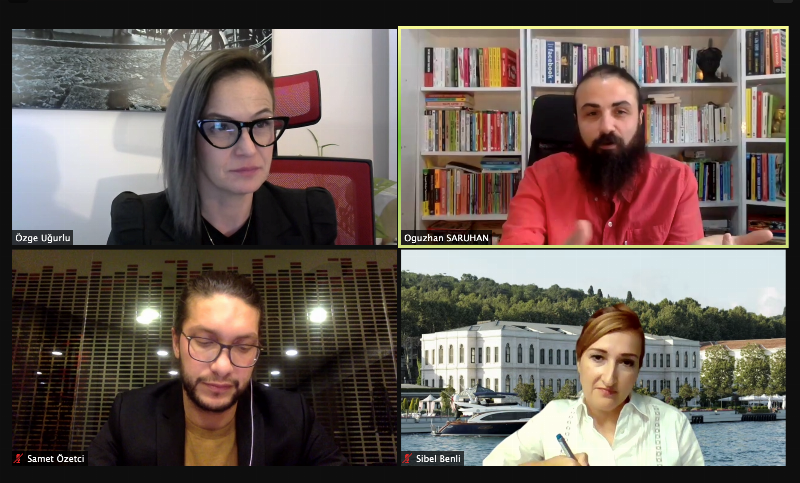
The Public Relations Symposium, moderated by Dr. Lecturer Özge Uğurlu Akbaş, Head of the Public Relations and Publicity Department at Üsküdar Üniversitesi Faculty of Communication, was held within the department. Üsküdar Üniversitesi Faculty of Communication Dean Prof. Dr. Nazife Güngör, Gümüşhane University Faculty of Communication Public Relations Department Dr. Lecturer Ersin Diker, Four Seasons Hotel Public Relations and Communication Director Sibel Benli, Street1227 Agency Founder Oğuzhan Saruhan, and Whalter Kranz Founder Samet Özetci were guests at the symposium.
Content
Public Relations Symposium Held
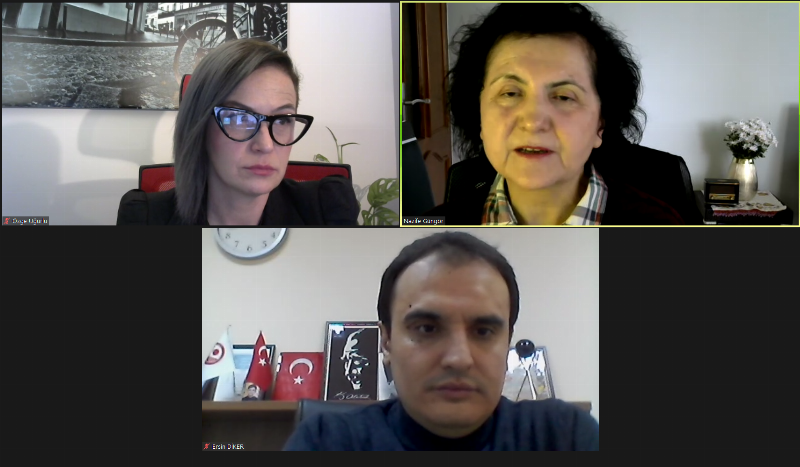
The public relations and publicity department, which started its education within Üsküdar Üniversitesi Faculty of Communication in 2016, organized an event as a department that strives to both ensure the profession is given due value and to evaluate existing activities in the sector together with academic studies. In this year's fourth event, our esteemed academics who have added value to the field of public relations with their academic works and names who will share their experiences in the sector came together.
Dr. Lecturer Özge Uğurlu Akbaş; “Evaluations to be made under the title of public relations aim to provide students with different perspectives”
Dr. Lecturer Özge Uğurlu Akbaş stated; “Evaluations to be made under the title of public relations aim to provide students with different perspectives by prioritizing the consideration of academia together with the sector. Public relations is a discipline that involves the process of correctly managing image, reputation, and perception among target audiences. It will be possible for our students who want to practice the public relations profession to both carry out scientifically based applications and also be aware of the philosophy of public relations and be able to follow new developments.”
“Within Media Transformation in Sectoral Trends”
Dr. Lecturer Özge Uğurlu Akbaş, Head of the Public Relations and Publicity Department, spoke about the connection between target audiences and digital media evolving during the pandemic. Akbaş said; “During this process, institutions have made their previously established relationships with target audiences, who were able to develop their digital infrastructures, more sustainable. And the work carried out by institutions that made people feel they were by their side was followed more by people. These are the things that particularly develop the positive aspect of the public relations field. We encountered communication efforts that emphasized togetherness, hope, and people being united, enabling people to support each other during the pandemic. Therefore, if we look at sectoral trends and accept that they largely progress through social media and digital platforms, and if we proceed with this acceptance, I believe that certain skills in public relations, such as digital content creation, digital storytelling, and social media management, are also part of this transformation. One of the management processes that becomes even more important is for institutions and brands that can take proactive measures and correctly manage global crises to make their target audiences feel in order, and to be able to provide accurate and rapid responses to changing needs and expectations.”
“Research is actually at the core of strategic public relations”
Dr. Lecturer Özge Uğurlu Akbaş gave examples of strategy in Public Relations. Akbaş said; “Just as a table becomes more functional and usable when its four legs stand firmly on the ground, all aspects of public relations, especially from a campaign process perspective, must be properly grounded. We also need to base certain elements such as creative ideas, arousing interest, attracting attention, and being known, which we will build upon, on that strong foundation. For this reason, I believe that target audience research, consumer research, and attitude research are very important in public relations studies for establishing correct strategies, and that all strategic decisions should be made based on these research results.”
Dean of Faculty of Communication Nazife Güngör: “We need to plan correctly in line with our mission”
Güngör emphasized the great importance of the academic community coming together in academic events; “Our event has been held for 4 years. It is of great importance for the academic community to come together in academic events. Because what you call scientific life is constantly progressing. It needs to continuously develop itself and continue with various contributions. Now, in today's scientific age defined by digitalization, we need to guide this dynamism in the right direction. Science is inherently something that should benefit humanity and is functional. But people must also contribute correctly to its course. Otherwise, it brings harm. In such works, we need to come together and discuss what is happening, what will happen, what will start. Because on one hand, we must discuss what is happening. And based on what is happening, with the lessons we derive, we need to make predictions about what will happen in the future, and from these predictions, we need to make correct plans. We need to plan correctly in line with our mission. The priority is to educate students, to train professionals in this field. Therefore, the more we proceed with correct steps and shared experiences in this field, the more qualified the professionals and industry experts we train will be.”
Dean of Faculty of Communication Nazife Güngör; “Started to be marketed in politics”
Dean of Faculty of Communication Nazife Güngör spoke about public relations emerging from the realm of PR events and becoming a field in its own right. Güngör said; “As you know, starting from the mid-1960s in the US, many agencies were established in this field, providing services, expertise, professional support, and training people in public relations and advertising. It is also an event of perception, an event of image-making. For example, it entered politics. All politicians started to have image makers. It started to be marketed in politics. In what we call political advertising or political communication, this perception, public relations, emerged from the PR event and began to become a field in its own right. Therefore, public relations did not merely emerge as a small branch or a standalone field. It grew and continued its path by giving rise to other disciplines. At the point we have reached today, with digitalization, there is a social media phenomenon, and these platforms, social media channels, now have to work together with public relations professionals, PR specialists, PR academics, and professionals. Because it is both a very important activity area for public relations practitioners and has already started to take shape as a public relations phenomenon in itself.”
“Public relations is a segment of the economy”
Dean of Faculty of Communication Nazife Güngör stated; “There is a need to bring together the results from the conducted research and to develop and introduce new concepts and models. Public relations is, on one hand, a social event, on the other hand, a communicative phenomenon, but also holds a very important place within the economy. It is a segment of the economy. Therefore, the continuous developments in economic processes, changes in social processes, the communicative process, and constant renewals in the functioning of communication direct us to rethink the concept of perception, and to continuously innovate and reflect on the concept and phenomenon of perception-based, perception-focused public relations. Therefore, it's not 'we did it, it's complete, this is it.' We are doing, we will work, we will continue, we will think, we will share. Only then will the field develop, and for the field to establish itself and continuously maintain its existence by evolving, it needs to be constantly updated with new developments, new processes, and new needs, and continuously supported with new contributions. For that reason, we need to do this together. On one hand, academia needs to continuously come together and exchange ideas, and on the other hand, the relationships between academia and the sector, where it trains and sends professionals, must constantly continue.”
Dr. Ersin Diker: “On one hand, we teach, on the other hand, we continue to learn”
Dr. Ersin Diker said; “I am a faculty member in the Public Relations Department at Gümüşhane University Faculty of Communication. I also serve as assistant dean. I completed my undergraduate, master's, and doctorate degrees at Selçuk University. I completed my undergraduate degree in Public Relations, my master's degree in Advertising, and my doctorate in Public Relations and Publicity. I have been working at Gümüşhane University Faculty of Communication for over 10 years. I started as a research assistant while pursuing my master's degree. And I am still continuing. We continue to read, research, and learn. On one hand, we teach, on the other hand, we continue to learn.”
“The pandemic process further accelerated the transformation”
Diker stated, “Public relations is a dynamic, constantly changing field, and we need to stay current;” “Gümüşhane is a distant place from Istanbul, and we also utilize technology in the sector. Therefore, even if there is a physical distance, there is also a digital closeness. During the pandemic, some writers and thinkers viewed it as a revolution, but I see it as a transformation. In fact, in an era where transformation was already happening, the pandemic process further accelerated this process. We adapted very quickly. With the pandemic, this situation accelerated and spread. We produced a communication research book consisting of 14 chapters, featuring academics from various universities in Turkey. The Covid-19 process brought forth new concepts for us. In this book, we collected many studies. Many studies, many books emerged. No matter how much we normalize, the process continues. Future studies will be conducted under the name 'Post Covid,' focusing on 'What has changed? What has transformed?' We will conduct special research on this. During this pandemic, we observed an increase in social media usage and digital platform usage, and we presented this with scientific data. These studies also revealed how fast the digital transformation process is.”
“Institutions started using social media to communicate with consumers”
Dr. Ersin Diker spoke about how institutions communicated with target audiences during the pandemic; “Social media usage figures increased. The social media platforms we frequently use in our lives also increased, and one of them is TikTok. As you know, TikTok became the most downloaded social media application during the pandemic, both in Turkey and globally. Now, institutions also opened TikTok accounts to communicate with consumers and started communicating with consumers from there. Social media changed communication processes in institutions. With the pandemic, institutions that did not use social media accounts or did not use digital platforms much began to exist to communicate with consumers, listen to target audiences, and provide solutions to their problems. During the pandemic, I can say that the duration of social media usage increased considerably. Collecting what we call big data from social media and presenting studies with this data is among the leading works we observed in this field. If we look in the consumer context, we observed that people who had never used social media in their lives during the pandemic were forced to use digital platforms, made mobile purchases, and used mobile banking. We also saw that institutions emphasized 'we will overcome this together' in their advertisements to maintain social solidarity and carried out works that suggested life would continue and we would see happy days.”
SWOT analysis is a fundamental study!
Dr. Lecturer Ersin Diker also included SWOT analysis in his speech. Diker said; “The foundation of strategic planning is actually SWOT analysis. We can determine where we will arrive and how we will arrive using the data from SWOT analysis. What will we say in public relations campaigns? How will we say it? And where will we say it? We actually build these upon the data from SWOT analysis. While crisis periods may be seen as a threat for most companies, I actually believe it is necessary to consider them as an opportunity. Because when we turn that threat into an opportunity, we will definitely profit. SWOT analysis reveals how we will do these things. Of course, merely obtaining data is not enough; the data also needs to be interpreted correctly. Experts in the field or those who have received this training will perform this correct data science. In this sense, the interpretation of the data that emerges with SWOT analysis will also reveal what and how we will communicate in subsequent public relations campaigns.”
Sibel Benli: “You can always differentiate yourself by standing out in communication”
Sibel Benli said; “When we look at Four Seasons, a global brand established by opening its first hotel in such an unglamorous sector, it has a very beautiful story. It celebrated its 60th anniversary this year, and its founder, Isadore Sharp, is happily still with us. He was an architect working in construction with his father at the time, and he unexpectedly found himself opening a hotel, and later, with correct strategies and decisions over time, it became the Four Seasons brand of today. Our first hotel in Istanbul was launched in 1996 in the Sultanahmet area. Our second hotel is located on the Bosphorus. Currently, we are providing services with both our hotels. The Four Seasons establishment story starts with a very simple, beautiful intention: the desire to treat every guest like family. When I started working in this sector in a junior position at another hotel in 2001, the communication methods used with both guests and the press were very different. When a press release was to be shared, it was sometimes sent as a letter or by post, depending on the content to be shared and the seniority of the person you wished to reach. For example, this was still active in 2001. Of course, it was also sent by email, but today there is a different world. Core values are actually the building blocks that demonstrate a brand's identity today. No matter how much technology changes, you can differentiate your identity in this sea of sameness by preserving values in a labor-intensive industry and always standing out in communication.”
Oğuzhan Saruhan: “If you don't produce, you cannot survive”
Oğuzhan Saruhan said; “In 2018, I wrote the book "Do You Want to Be a Social Media Monster?" It was a blog-like book with short, platform-based information, generally explaining personal branding through social media. It is one of the best-selling books in its field. Others couldn't catch up to it, but in 2020, I wrote the book "10 Rules for Survival in the Digital Age." I call YouTube the User Manual for the New World. Because it has whatever you're looking for. We now tell brands that if you don't produce content, you cannot survive. The ball wasn't in our court before. Now everyone has a ball at their feet because there's a concept. As Harari said, the Internet was one of the discoveries that most profoundly affected and changed the world. The Internet is not a tool that poisons our lives but a technology that makes our lives more democratic, so if something is to be told, effective internet usage can be told.”
Samet Özetçi: “Our team being young is not a disadvantage”
Samet Özetçi, noting that newspapers and magazines can still be seen as important, said, “As I mentioned, I want them to be inspired a little more in terms of understanding digital, using digital platforms, and analyzing communication. Our team is very young, but being young is not a disadvantage. Newspapers and magazines can still be considered important. It might be more accurate to say they are important, but not as important as they used to be. The fact that we use new platforms and our colleagues come from within these platforms actually made us a little different. We also have computer engineer colleagues within the team. They perform data visualization. Beautiful data emerges for brands' digital marketing side, which all other communication departments you can think of can use, and data is visualized. This creates insights for these brands. We also offer this service to other agencies.”
Share
Update Date: February 28, 2026
Creation Date: November 25, 2021