

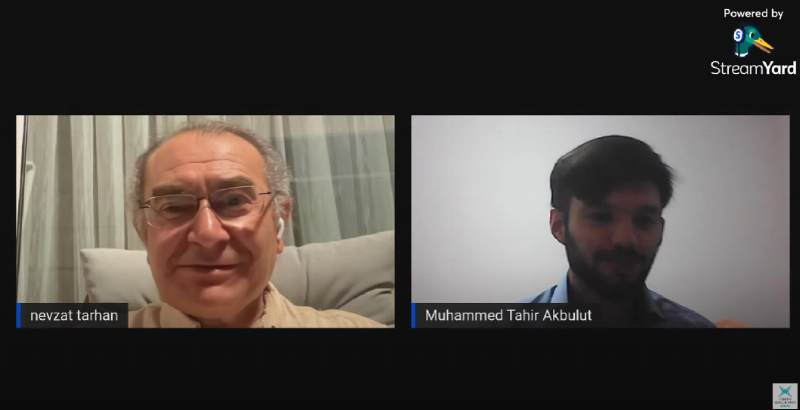
Psychiatrist Prof. Dr. Nevzat Tarhan, Founding Rector of Uskudar University, attended the seminar titled ‘The Yeast of Creation’ organized by the Ankara University coordination of the Turkey Youth Foundation (TÜGVA). Tarhan, focusing on the concepts of human nature, genetics, and epigenetics, stated; “Our genetic codes related to our nature, not being genetic due to the influence of our genes, enabled us to understand epigenetic effects. Epigenetics are actually changes made by the environment in genes, things we perceive as our temperament, our personality. In fact, we can also say these are things we learn between 0-3 years of age.”
Content
Psychology is summarized in 3 words: Mind, Brain, and Culture
“Between 0-3 years, a child’s brain, not body, grows”
Prof. Dr. Nevzat Tarhan, Founding Rector of Uskudar University, pointed out the critical importance of a child growing up in a trusting and loving environment. Tarhan stated, “You have chosen a beautiful, very profound concept when naming it ‘The Yeast of Creation.’ It resembles the yeast of human creation or human nature. When we look at human creation, first there is a genetic creation. Secondly, we have genetic codes, but humanity, unlike other living beings, is born into the world to learn, whereas other living beings are born having already learned. For example, a duck hatches from an egg and immediately swims when it sees water. Its mother doesn’t teach it to swim, but a human needs to make an effort to learn to swim, take lessons, hire a coach, get an education. In medicine, humans are considered to be born premature psychologically and mentally. They are born early. And it’s interesting that 60-70% of what a child eats between 0-3 years goes to the brain. Between 0-3 years, it is a child’s brain, not their body, that grows. This is something neurobiology has recently discovered, and humans learn more than 50% of everything they learn in their entire lives between 0-3 years of age. The 0-3 age period has become very important, and the most important thing at that age is the mother and family. It is important for a child to grow up in a trusting and loving environment. In other words, this is the primary need in the human creation mode.”
Psychology’s new field: Cognitive psychology
Prof. Dr. Nevzat Tarhan, speaking about a new field of psychology and how promising this field is, stated, “Currently there is a new field of psychology. It is called cognitive psychology, a branch of psychology that views humans like computers. It examines humans as if they were computers and tries to analyze them in that way. It’s called cognitive psychology; this psychology has a wide-open future, it’s a new psychology. Therefore, when we develop cognitive psychology, we can perfectly adjust human ‘factory settings,’ which is what we call the yeast of creation. One of the first things that gets disrupted here is identity, the first things a person learns, a child learns their identity. The second learning situation, related to their nature, occurs during adolescence. During adolescence, the brain ‘blooms’ again. Synapses in the brain, connections in the brain, suddenly grow, the network opens up, and then it is pruned according to the person’s environment and relationships, and their personality emerges. Our personality structure emerges this way. We have 12 main personality structures, which we call basic human nature. Some are introverted, some are extroverted, some are perfectionists.”
“The biggest traumas in children begin between 0-3 years of age”
Tarhan, commenting on the necessity of thoroughly understanding and examining the 0-3 age period if we are to return to our existential settings, said, “Our genetic codes related to our nature, not being genetic due to the influence of our genes, enabled us to understand epigenetic effects. Epigenetics are actually changes made by the environment in genes, things we perceive as our temperament, our personality. In fact, we can also say these are things we learn between 0-3 years of age. Because during the 0-3 age period, the brain ‘blooms.’ The brain’s network, nerve cells, are active, like how flowers suddenly bloom in spring within a few weeks, and everything turns green. While that happens, the brain prunes. Is there a loving environment for the person? Is there a trusting environment? Is there a stable, consistent, continuous relationship, or is the child neglected? The biggest traumas in children begin between 0-3 years of age. Therefore, if we are to return to our factory settings, our existential settings, which are our innate settings, we must first thoroughly know and examine the 0-3 age period. We need to understand the problems there, and who is in the best position to know what is appropriate for human nature? For example, who is in the best position to know if a washing machine or a refrigerator is beneficial? It’s the factory that produces that machine. If all else fails, take it to the factory service; they will know and fix the error. If we are to look at a human’s factory settings, who is in the best position to know that most accurately? It is their creator, the one who placed their genes, who wrote their DNA, who coded their DNA.”
“Being traditional is good, but being traditionalist is wrong”
Prof. Dr. Nevzat Tarhan mentioned that the two codes learned later are sexual identity and morality. Continuing his discourse in this context, Tarhan stated; “Howard Gardner developed the theory of multiple intelligences in the 1980s. Most people have logical intelligence, as well as emotional intelligence and social intelligence. A professor from Harvard, his thesis made a tremendous revolution. And here, in multiple intelligences, intelligence is not singular; for example, there is natural intelligence, and now he is working on a new intelligence: moral intelligence. He is researching whether humans have innate moral codes, and he could not find them. There are no innate codes. Morality is learned later. There are two things learned later: first, sexual identity, and second, morality. Both are learned later. Society teaches it, it is learned culturally. For example, marriage is cultural. That’s why culture is very important here. That’s why psychology is summarized in 3 words: Mind, brain, and culture. There is the brain, the brain is processed. There is the mind, but society teaches it, and it comes together with this. So, if we summarize psychology in 3 words, we can say mind, brain, culture. The minds of young people today are very confused. What our mothers and fathers taught is different, what modernism taught is different, what the social system, the cultural system taught is different. Children’s minds are very confused. These confused minds need to be enlightened with evidence-based information. Our traditions are beautiful, we will take from tradition, but it is important not to forget what tradition means. Being traditional is good, but being traditionalist is wrong.”
“Science enlightens our minds, religious sciences enlighten our hearts”
Tarhan, commenting on the idea that the most appropriate thing to do for the yeast of creation is our education system, said, “Currently in Turkey, an attempt is being made to establish a balance between science and religious sciences. Hopefully, if we achieve this, young people more aligned with human nature will be raised. The most suitable thing we can do for our innate nature, for the yeast of creation, is our education system. It is to transform our education system into a ‘madrasa-i zül celaleyn,’ meaning an education system where science and religious sciences are studied together. This is actually not very difficult. Currently, there are some studies before the Board of Education. They will address them. When science lessons are taught, they will be taught in a way that makes students think these science lessons are the art of God. While our education system teaches the same lessons, that education system, including physics, chemistry, and mathematics, can suddenly become a lesson in faith. When you read about trees, birds, Newton’s laws, Archimedes’ laws, remembering God and saying, ‘How beautifully God has created,’ then mind and heart will unite in those children’s brains. Science enlightens our minds. Religious sciences enlighten our hearts. When the two come together, it creates a synthesis of mind and heart. When there is a synthesis of mind and heart, the student’s motivation increases. The student’s effort and zeal will then increase, and they will uphold our values without asking the question of whether God exists or not in their minds. Otherwise, the reason for not upholding our values currently is the lack of a need to believe in the background. Because children do not feel the need to believe, they don’t believe. They continue by saying, ‘I don’t need to believe anyway.’”
“Educate your children with persuasion, conviction, and love”
Prof. Dr. Nevzat Tarhan, addressing which sexual identity role parents should raise their children with at a young age, emphasized that the child would assume that role in later life. Tarhan stated, “Let me tell you, there is no third sexual identity gene, but homosexuality is a social situation, a social norm. Society may or may not approve, a parent may or may not approve. Therefore, with whichever sexual identity role parents raise their children from a young age, the child will be in that role in later life. That’s why for parents, the period of 0-3 years, or even 0-10 years, is critical; after 10 years, it becomes very difficult. When sexual identity problems come to us, after 10-12 years, after the child enters adolescence, and after 18 years, we are already living in an age of freedom. We are living in a period where freedom is global and considered right. In such a period, we cannot forcibly change an 18-year-old, we cannot educate them with shame, prohibitions, or sin. Therefore, we must realize this: educate your children with persuasion, conviction, and love. They asked Ibn-i Khaldun, ‘How should we raise our children?’ He said, ‘There is no need for anything special to educate your child. As the mother and father are, so will the child be.’ Freud also identified this in sexual identity, and when examining topics related to homosexuality, he observed cases where there is such a dominant, protective mother, an overly loving, overly affectionate mother who has excessively smothered the child, an ‘invasive’ mother, and an anti-male mother who always criticizes the father. If a mother criticizes the father to her child, that child has a potential to be homosexual. The child then identifies with the mother, establishes their sexual identity with the mother, choosing the mother as a role model in sexual identity. This is because the mother denigrates, criticizes, and devalues the father. Therefore, mothers devaluing fathers disrupts a child’s sexual identity.”
“We will teach children by offering options, not by giving commands”
Prof. Dr. Nevzat Tarhan advised families to be role models for their children instead of giving advice. Tarhan stated; “Learned helplessness, learned optimism, pessimism—all of these are mistakes parents make with their children. For example, let’s say a daughter excitedly brings her father a gift. A beautiful gift. When her father receives the gift, he doesn’t kiss her enthusiastically, saying, ‘What a beautiful gift, my daughter!’ Do you know what he says? ‘What do you want after this? Tell me why.’ What is he teaching his daughter? He’s teaching skepticism. He’s teaching distrust. Will that girl ever buy her father another gift? No. That’s why, in raising our children, we cannot educate our children by preaching or giving lectures. We teach our children by being role models. For example, we will teach children by offering options, not by giving commands. For instance, he tells the child, ‘Take this T-shirt and wear it.’ ‘I won’t wear it,’ ‘You wore it, you didn’t wear it,’ parent-child battles begin. However, what do smart mothers do? They take out 4-5 T-shirts. They make one more appealing, saying to the child, ‘Look, it’s cold like this, it would be good if you wore one of these T-shirts.’ The child chooses one. The child says, ‘I chose it.’ This satisfies their sense of autonomy. The mother also doesn’t lose control. That’s why we tell mothers to offer options instead of giving commands. Be an example instead of giving advice.”
“Love plus justice equals trust”
Prof. Dr. Nevzat Tarhan, emphasizing that there should be a discipline where feelings of love and trust are given together to the child, stated that if such a discipline exists, the child will be won over. Tarhan stated, “When educating a child, we must educate them not with shame, prohibition, or sin, but with persuasion, conviction, and love. When we teach this, that child will naturally adopt our values. Therefore, if you want a person to do something, what is the characteristic of power? What is power? It is the capacity to change a person’s behavior. Now, behavior is changed in two ways. One is by intimidation. When the fear is gone, that person cannot do it. Finished. In this era, when a child leaves the family, they become the opposite of what they were when intimidated. Lasting discipline is not achieved through intimidation. Therefore, there must be discipline with love. It must be a discipline where feelings of love and trust are given together. If there is such a discipline, we will win that child over. To provide discipline with love and trust in the family, it is also necessary to be fair. If there is justice, then love plus justice equals trust. If justice is not added to love, trust does not form. If you favor one child and not another, then without justice, the child starts not listening to the parents. That’s why power is the capacity to change behaviors, and here, if we want to make a horse drink water, can we make it drink by hitting its head repeatedly? We cannot. What do we do? We make the horse thirsty, and it will go and drink the water by itself. Therefore, we must make the child feel a need. When the child feels a need, they will start searching themselves. Currently, the Western world has started to feel a need for God. They cannot solve existence right now. They have tasted all kinds of worldly pleasures. They saw that there is death, and there is no remedy for death.”
Share
Update Date: March 01, 2026
Creation Date: August 15, 2022
Request a Call
Other News
- Social responsibility courses moved to the field
- Erasmus+ Orientation Week completed at Üsküdar
- Prof. Nevzat Tarhan: “Brain secretes ‘dark glue’ in social media lynchers!”
- Prof. Nevzat Tarhan: “Every segment of society should be able to say, ‘This constitution is my constitution!’”
- OHS releases guide for safe operation of industrial robots