

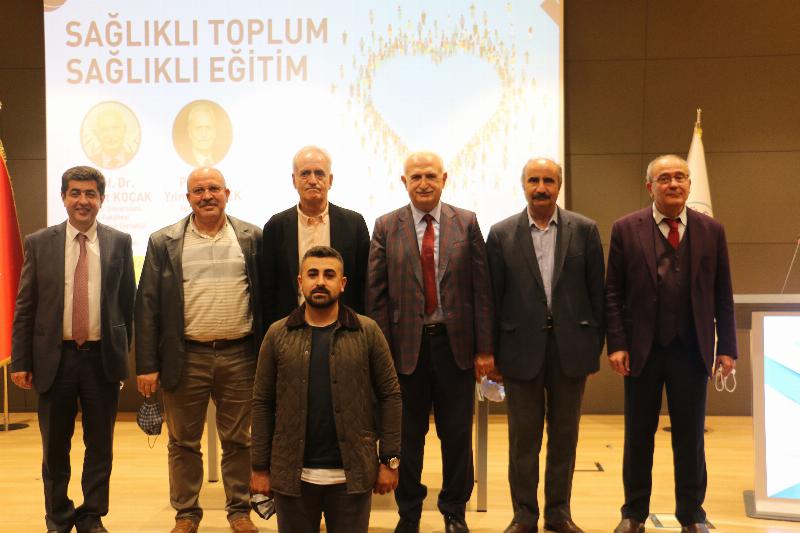
Within the scope of Üsküdar University's University Culture course, a symposium titled “Healthy Society, Healthy Education” was held. At the symposium moderated by Üsküdar University's Vice Rector and a member of the Faculty of Medicine's Department of Cardiovascular Surgery, Prof. Dr. Hikmet Koçak, Educator-Author Prof. Dr. Yılmaz Özbek made important evaluations in the field of a healthy society. Stating that everyone needs social sciences and that social sciences nurture individual culture, Özbek said, “Information, like ignorance, can play tricks on us.”
Content
Prof. Dr. Yılmaz Özbek: “Information, like ignorance, can play tricks on us”
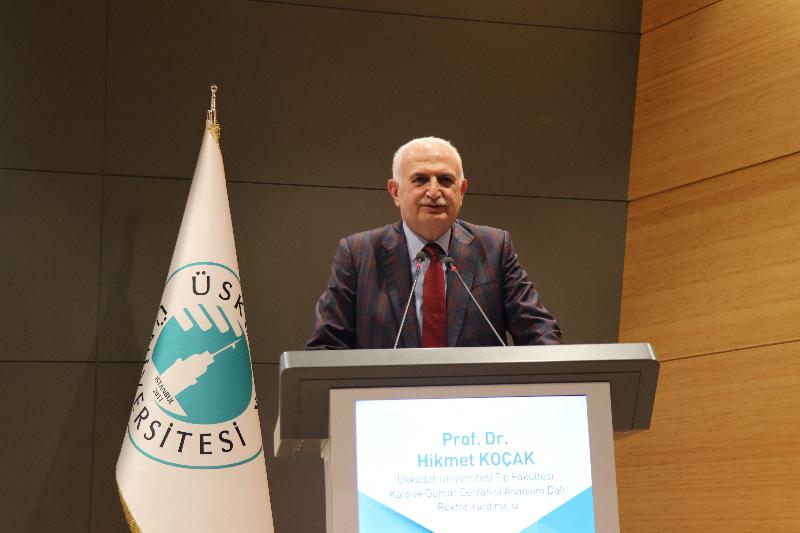
Prof. Dr. Hikmet Koçak: “Education has no age”
In his speech, moderator Prof. Dr. Hikmet Koçak emphasized the education given by the family, stating that if education is healthy in a society, then society will also be healthy. Koçak said; “If education is healthy, society will also be healthy. Education begins when a child is born. The most important age for education is between 3-5 years old. The mother's influence is very important in this education. We are all university graduates, and if we look back at our past, we realize that family education is one of the most crucial periods within the educational cycles we received. Education has no age. Prophet Muhammad has a beautiful saying on this matter: ‘Seek knowledge from the cradle to the grave,’ emphasizing that education should continue throughout our lives.”
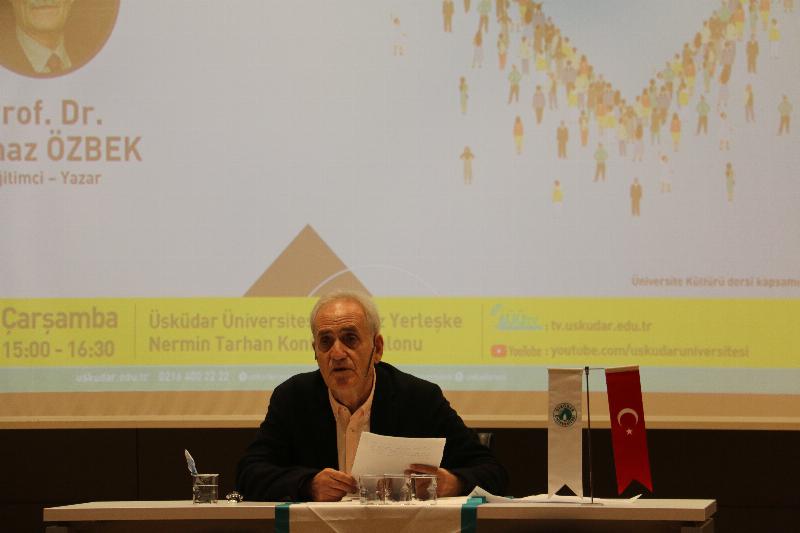
Prof. Dr. Yılmaz Özbek: “I never blamed students regarding education”
Prof. Dr. Yılmaz Özbek, the guest of the “Healthy Society, Healthy Education” symposium, made striking statements about education in Turkey. Özbek advised young people on education: “I have a concern, and I am here so that this concern spreads to you. I wished you concern, not happiness. I wanted the problems of the world and our country to be your problems, your ideals, your principles, and for you to sweat and fight for them. There is a situation that has long made me unhappy: the state of education in Turkey. Rulers, teachers, and students complain about it. I am here today because I question how we can develop a new perspective on education. My speech contains judgments and generalizations. However, these generalizations do not encompass the whole. Systems have old, new,, good, and bad aspects. If there's a problem in the system, we voice it, a new system emerges, but what's important here is to change the perspective. I never blamed students. Adults raise students as they are. I blame myself as an adult, not the students. I am in favor of criticism because the shortest path to a healthy society is through criticism. There is no word for 'luck' in Chinese. They attribute whatever happens to them to what they did or did not do. Based on this, what happens in education stems from what we do or don't do.”
Prof. Dr. Özbek: “Art has not been a rising value in Turkey”
Prof. Dr. Yılmaz Özbek, touching upon the characteristics of an enlightened person, said: “I am 74 years old, but I have excitements, I have concerns. My body may wrinkle, but I want my soul not to wrinkle, so that young people's souls also do not wrinkle. An enlightened person cannot be happy; they have no such concern as being happy. Because an enlightened person deals with the problems of society. For those with sensitive hearts, the world is a hell. As Descartes said; “I think, therefore I am.” Most philosophers criticized this statement, some saying that “I share, therefore I am human.” is more accurate. Because sharing is a matter of the heart. To make others' problems your own is a metaphor. ‘Is Turkey civilized, what makes a country civilized?’ We can determine this by looking at other countries. Unfortunately, social sciences and art have not been rising values in Turkey. Health sciences, medicine, and natural sciences hold high value within themselves. Parents direct young people towards quantitative fields. Areas like literature and art are generally not given importance. Of course, there are exceptions.”
Prof. Dr. Özbek: “The game of knowledge can be harder than ignorance”
Prof. Dr. Özbek, talking about a survey he conducted with his students, said: “I conducted a survey asking my students to list the values they consider important. Some of the items in the survey were: transparency, responsibility, self-respect, self-control, self-criticism. According to the results, many of these items I listed were not even among the last ones. I was very impressed by this result; you can learn concrete values in life, but you cannot deepen in abstract values, they remain incomplete. You can gain these by studying social sciences. When I researched the education system in America, I saw that play and entertainment are at the forefront. Imitation is not a bad thing. We learn to live by imitating as babies. Later, the stage of creativity is reached. Great artists create their unique works by starting with imitation and finally presenting an original work. A painter cannot become a good painter without making bad paintings. If we tell children they are doing a good job when they draw, we encourage and make them happy. Democracy is individual culture. And what makes a person an individual is social sciences. One doesn't have to study social sciences. Everyone needs social sciences. Because social sciences nurture individual culture. Information, like ignorance, plays with us. The game of knowledge can be harder than ignorance. We can detect mistakes, but we continue to make mistakes we believe to be correct, without realizing them.”
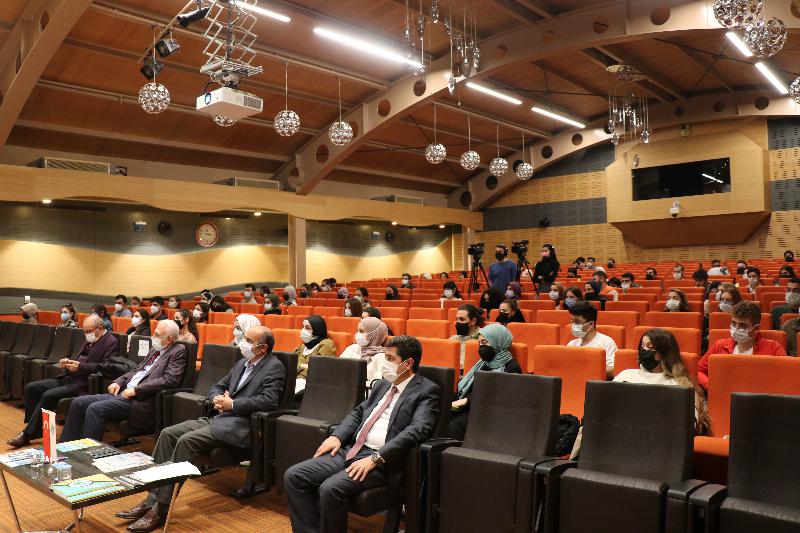
Prof. Dr. Özbek: “We must make educational institutions less boring”
Prof. Dr. Özbek stated that educational institutions need to innovate: “Young people know communication tools better than we do. We don't expect young people to transfer information to us. We want to think, question, and produce things with them. Because we will need this greatly when we are alone. Socrates said; ‘I teach nobody anything; I only make them think.’ Socrates had an illiterate child solve the Pythagorean theorem by asking simple questions. According to this, what matters is how deeply you know something, rather than how much you know. If we know something, we can be productive. Therefore, we must abandon rote learning. We can make educational institutions less boring, providing environments where students can develop themselves, have fun, and feel a hunger for knowledge and learning. There are no bad, lazy students. There is an inadequate and unhealthy approach. Somewhere in the world, children are being prepared for adult life. Preparing children for adult life means ensuring they are equipped to fulfill the responsibilities they will undertake in adult life tomorrow. Education is not just about school.”
Prof. Dr. Özbek: “Everyone who puts in effort reaches somewhere”
Prof. Dr. Özbek; “We must encourage young people to ask questions. A person who asks questions is one who says ‘I exist,’ who is hungry for knowledge and wants to reach it. There is no shortcut to increasing self-confidence than this. They will perceive information transfer as education and adopt learning without questioning as teaching. Such young people will be of no benefit to themselves or society. The importance you give to yourselves is more important than the effort given by your teachers and family. Karl Marx has a saying; “If you cannot produce love, you are not a good producer.” If your motivation does not come from love, it remains incomplete, insufficient. We cannot make young people love learning by scaring them or keeping them under pressure. By enumerating our principles, by building walls between us and them, we can make them love neither school nor ourselves. The desire and curiosity of students who are not allowed to be silly and are not encouraged will not develop, and what exists will fade. Their self-confidence will be hampered, and they will not feel valuable. Every person has areas they are talented in. One puts in a lot of effort, another less. But everyone who puts in effort reaches somewhere. The most valuable inheritance is roots and wings. In my opinion, we must raise people with strong roots, equipped to overcome life's difficulties. Wings are a metaphor for freedom. Dear young people, following only reason does not always lead us to a good place. When reason and heart walk together, when they cooperate, a beautiful and meaningful existence reveals itself.”
Share
Update Date: February 28, 2026
Creation Date: November 05, 2021
Request a Call
Other News
- The book that read today's digital threats in 2014: Being a Conscious Family
- Experts warn: 'Instead of memorizing letters, teach pencil grip, scissor use, and coloring'
- School fear and school love both start in the family!
- Family is not merely transforming, it is being battered under a serious assault
- Artificial intelligence opens the door to early diagnosis in autism!