

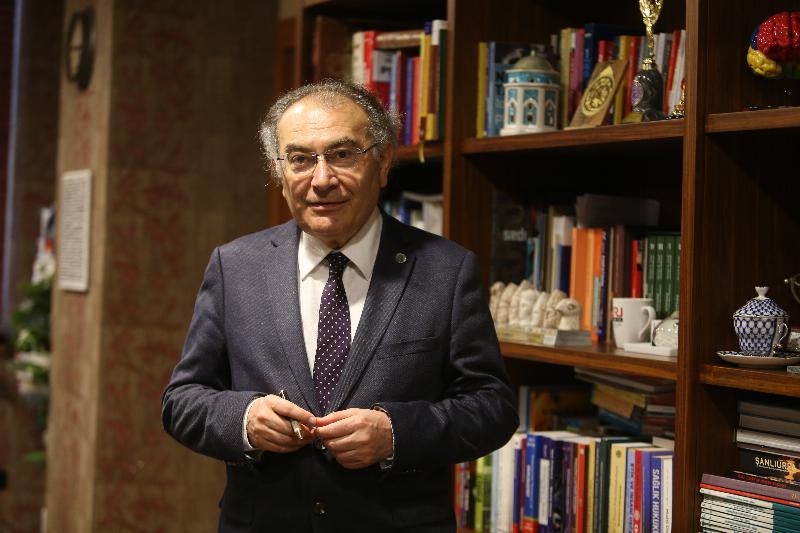
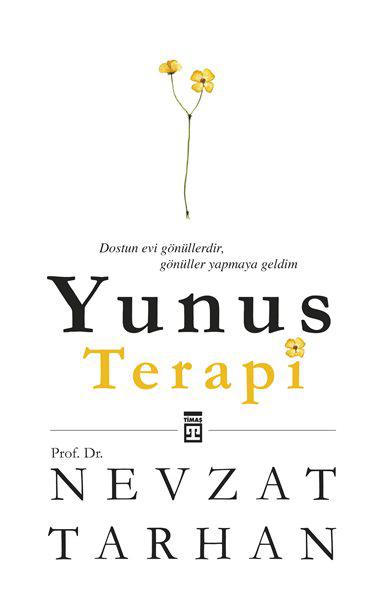
Üsküdar Üniversitesi Founding Rector Prof. Dr. Nevzat Tarhan, participated as a speaker in the program organized by Timaş Publications within the scope of the Yunus Emre Commemoration Year. Answering the questions of Television Journalist Zahide Ülkü Bakiler, Tarhan made evaluations on the “Yunus Therapy” book. Stating that he decided to write the Yunus Therapy book as a result of a need, Tarhan said; “I realized that some researchers in the West systematized our culture, Anatolian wisdom, and developed a methodology to turn it into a science called “positive psychology”. However, in their studies, unfortunately, they did not reference Mevlana, Yunus, or Saadi Shirazi. As a result of a few years of work, I wrote my Yunus Therapy book.” He said.
Content
Prof. Dr. Tarhan: “The Yunus Therapy Book emerged from a need”
“The Yunus Therapy Book emerged from a need”
Zahide Ülkü Bakiler: How did you decide to approach Yunus Emre with an interdisciplinary perspective and create such a book?
Prof. Dr. Nevzat Tarhan: The Yunus Therapy Book emerged from a need. In 2009, a conference titled “Positive Psychology” was held in the United States. When I researched what this first-ever conference was about, I saw that its history went back to the 1990s. Until then, emotions were not accepted as a scientific category. In 1994, Portuguese neuroscientist Antonio Damasio published a book called Descartes' Error. After that book, new research was done in the field, and the concept of “emotional intelligence” was born. When I examined the concept of emotional intelligence, I realized that some researchers in the West systematized our culture, Anatolian wisdom, and developed a methodology to transform it into a branch of science called “positive psychology.” I thought this was our fault: “We didn't do it, they did, but it's a good thing they did,” I said. However, in their studies, unfortunately, they did not reference Mevlana, Yunus, or Saadi Shirazi. This is an approach that seeks truth from a scientific perspective, without saying “good or bad,” “right or wrong,” using the East but belittling it. Meanwhile, I also did Yunus readings and learned about him anew. I started the work with the question, “What can I do related to Yunus?” After a few years of work, the Yunus Therapy Book emerged in April 2013.
Meanwhile, positive psychology studies in the West developed further, and Harvard University included the topic in its curriculum in 2015 with a course content covering many values under the name of “compassion, gratitude education.” In 2018, similar courses began to be offered at Yale University. We even have information that 3 million people in America took this course. We included this content in our curriculum at Üsküdar Üniversitesi in 2013 as a “rectorate course” and set measurable goals for becoming a good person.
“Morality is not genetic; it is learned later”
Is the West trying to retreat from positivist thought with these moves?
The goal of the West is to seek truth. Currently, they are discovering emotions by abandoning positivist reductionism. This is because scientific evidence regarding emotions and wisdom has emerged. In the 2010s, when I talked about “the neurobiology of morality” in my book The Psychology of Faith, people said, “Is there such a thing as the neurobiology of morality? Morality and conscience are innate. Even if a person does not believe in God, they do not lie; they listen to the voice of their conscience. They are moral simply because they are human.” However, no; morality is not genetic; it is learned later. There is a case known as the “Elliot Case,” documented in Daniel Goleman's book, which supports this. Elliot, an American lawyer in his 40s, highly successful, prominent with his work and cases, suddenly began to experience a personality change. He woke up late, didn't care about anyone, started confusing friends and foes. Due to this change, he couldn't maintain his marriage and divorced. He lost his money. When an MRI was performed, a tangerine-sized tumor was detected in the frontal lobe of Elliot's brain. The tumor was surgically removed, and the patient partially recovered, but because there was tremendous destruction in the brain, almost all the learned skills of work ethics and social morality were lost. This situation, which occurred due to an operation in the frontal lobe of the brain, shows us that what makes a human being human is the frontal lobe of the brain. Without the frontal lobe, civilization would not have developed. What teaches civilization is the learning capacity in this part of our brain.
“Humans are born candidates to be either good or bad people”
Humans are born candidates to be either good or bad people. To support this, there are “wild child examples” that have entered the literature. The most well-known of these is the case of Oxana Malaya, who lived in Ukraine. Malaya, the daughter of alcoholic parents living on the edge of a forest, grew up among dogs because her parents did not care for her. She was found by neighbors when she was ten years old. There is a video recording from when she was found. The video shows that this ten-year-old girl runs like a dog, barks like them, and eats like dogs. Malaya was taken to a rehabilitation center. There, she learned to be human, to love, let alone her sexual identity, later. She even started to speak properly only after spending ten years in the rehabilitation center. If this child had disappeared at the age of one, she would have either died or become irrecoverable. This case shows us that morality and humanity are learnable.

“Science rediscovered Eastern wisdom”
Neuroscience overturned many philosophical theories. This opened a new door, and as a result, Descartes was questioned. Science, being an effort to seek truth, rediscovered Eastern wisdom. And it's a good thing it did. In my book, The Psychology of Emotions, published in 2006 – which was a collaborative work – I addressed topics related to the right brain, left brain, frontal brain, and positive and negative emotions. The Psychology of Emotions became a pioneering and important book in this sense. In fact, at the time of its publication, there was no similar book in America that analyzed emotions in such a way. Perhaps such a work has been published by now.
“Yunus Emre is one of the arteries of Anatolian wisdom”
Returning to Yunus Emre from here, Yunus, like Mevlana and Sheikh Edebali, is one of the arteries of Anatolian wisdom that founded the Ottoman Empire... These individuals sowed the seeds and raised people. Why did the Ottoman Empire not emerge in Palestine or the deserts of Arabia, but in Anatolia? Because Anatolia produced a culture of brotherhood, which included Mevlana and Ahi Evran. Thanks to this culture, the Oghuz Beys did not make the mistake that the Seljuks did. After Melikshah died in the Seljuk Empire, a struggle began among his sons. While Tapar and one brother established a state in the Azerbaijani regions, and another brother established a state elsewhere; the Crusaders entered Jerusalem. Jerusalem remained under Crusader rule for ninety years. Seeing all these negative experiences, the Ottomans sacrificed their own children but did not involve the people in family feuds. This sacrifice of the Ottomans is highly respectable. They also learned a lesson from the defeat by Timur. For example, Mehmed Çelebi – whose hometown is Merzifon, also my hometown – built the Madrasa Mosque and has an endowment in his name. It will be seen in my family tree that my grandfathers also taught there. That was the second founding of the Ottoman Empire. After this, the Ottomans were effective for four or five hundred years, achieved Pax Osmanica, and established a global Ottoman peace. At that time, chaos reigned in Europe. Now, we are living in the era of Pax Europa.
The mothers of the Ottoman Empire: Yunus Emre, Mevlana, Ahi Evran, Sheikh Edebali…
So, in your study of Yunus Emre and your evaluation of his message through such a work, did the similarities between Yunus's era, the “climate zone” he influenced, and today's life play a role?
Absolutely right… Yunus's era was an interregnum. As I stated earlier; Yunus Emre, Mevlana, Ahi Evran, Sheikh Edebali were instrumental in the birth of the Ottoman Empire. They were the mothers of the nascent Ottoman child. But let us not expect a Yunus like in that era to emerge among us now. Let us not go to Yunus's time and wander from door to door like him, or perform Mevlana's rituals, practices, or dervish dance, but let us bring Mevlana's fundamental ideas and Yunus's fundamental ideas to today, and dress them in today's attire. But let the inner person be Yunus, be Mevlana...
However, some seek Islamic tradition in eating with their hands, or dressing like Yunus or Mevlana. There is no need for such a superficial Islam, a “Wardrobe Islam.” Just as we use the cars and wear the fabrics of this era, let us live Islam with its essence. By “essential Islam,” I mean an Islam dominated by morality, love, compassion, and mercy. That is Anatolian wisdom.
“Yunus Emre touched everywhere”
In the Yunus Therapy Book, while talking about the importance of ideals and imagination, you underline that Yunus established a balance between them. In this respect, what kind of additions did Yunus Emre make to the general dervish model in our minds?
The difference between Yunus and other Sufis is that Yunus, along with dervishhood, also had a hyperactivity stemming from Central Asia. He was restless… The fact that his shrine is in many parts of Anatolia, in Karaman, Malatya, Eskişehir, and Azerbaijan, also shows this. He traveled a lot. He touched everywhere. When he was around eighty, after writing Risale-i Nusuhiye, which contains his advice, he went to a place near Kütahya, and a shepherd he met on the mountain read his poems to him without knowing he was Yunus. Upon this, Yunus said, “I have done my duty!” This shows us Yunus’s vision. We cannot distinguish between vision and mission. Vision is the highest thing a person can be, while mission is the highest limit of what they can do. A person first has a vision; this is the ego ideal. Their mission determines what they can do to reach this goal. Therefore, there is no mission without a big, strategic goal.
Some people have strong imagination; this is a beautiful thing… People with strong imagination dream, but intelligent people dream with a purpose. Children, schizophrenics, or dreamers who satisfy their ego with their dreams, dream dreams detached from reality. However, idealists have goals: just like Newton’s dreaminess… Due to the plague epidemic in his time, Newton could not leave the library in Cambridge for two years, and while physics, chemistry, and mathematics books were on his desk, he thought about the cause of downward motion in nature. While thinking about this, an apple fell from an apple tree, and Newton made the rational connection between the two. An apple always falls, but for a person to make the connection that Newton made, mental suffering, mental objection, and mental rebellion are required beforehand. People who dream can do this.
“Yunus Emre followed a method similar to EMDR therapy in his works”
Teacher, the book has an important section on trauma treatment. You say that Yunus Emre followed a method similar to EMDR therapy in his works and contributed to social rehabilitation. Yunus did not have modern psychology training as we understand it today. How did he do this?
In his works, Yunus Emre points to reason as the commander of the army fighting evil emotions. He states that people inevitably face the harms of their bad habits. He says, “To get rid of this, one appeals to the soul.” He says, “The soul sends a person to the sultan of reason. At this stage, reason pits soldiers of contentment against emotions like greed. In the ensuing battle, avarice is defeated, and the person ultimately matures in the struggle with their bad habit,” thus using a war metaphor. In Risale-i Nusuhiye, Yunus spoke about the elements that constitute a human being, drawing from a Central Asian understanding, stating that these are “earth, air, water, fire.” According to Yunus, earth represents patience, reliance on God, and sublimity; water represents cleanliness, generosity, and goodness; air represents lies, hypocrisy, and haste; fire represents arrogance, lust, greed, and envy. While explaining these, Yunus stated that there is a battle of hypocrisy, haste, arrogance, and lust within us, thereby symbolizing emotions and reminding us that negative emotions can be combated with the help of patience, reliance on God, sublimity, generosity, and goodness.
“Yunus did not abandon the guidance of reason”
We say Yunus was a dervish, but neither he nor Mevlana abandoned the guidance of reason. Only the Batinis see the heart as the path to truth. Adopting the concept of an “infallible imam” by putting their minds in their sheikh’s pocket is a Middle Eastern culture. Unfortunately, this culture is still prevalent in the Middle East... For example, it is this culture that fuels ISIS. While they sanctify their leaders and turn them into “earthly gods,” believing they are martyrs in the name of Islam, they are essentially perishing. They do this in the name of Islam. However, Mevlana and Yunus united reason with the heart.
Childhood traumas can serve as a good example of how Yunus used the EMDR method in his poems. We had a patient who came to us around the age of thirty. This person experienced trauma as a child when his grandmother, who had Alzheimer's, smeared her feces on him. When he sought treatment, for about ten years, he thought everything was feces. He would question whether a person he saw had washed their hands and would examine things to see if they were contaminated with excrement. As a result of our research, we found that the trauma he experienced at the age of ten had transformed into an obsession, obsessive-compulsive disorder, by changing form later. The need for physical cleanliness had turned into a need for spiritual cleanliness. In the treatment of these and similar cases, EMDR uses sound, eye, and touch movements to activate the unused network of the right and left brain. As a result, the person recalls their old trauma, redefines it, puts it into a logical framework, and the unresolved trauma becomes resolved.
So how did Yunus do this? Yunus taught people emotional expression. Poetry is one of the most beautiful tools for expressing emotions. Yunus and Mevlana saw the miserable state of Anatolia and its decline, and they were troubled by it. Just as Prophet Muhammad cried when he saw multitudes of people acting in rebellion against Allah… Scholars are the heirs of the prophets. They are tasked with conveying hearts turned to the world and materialism towards meaning, towards Allah. Yunus, too, discovered the beauty within unhappy, warring people amidst chaos and anger, and expressed it on their behalf with his poems. People who read his poems feel relieved. In this way, their feelings of hope revive. Therefore, Mevlana and Yunus treated our social wounds by using methods similar to those we use in EMDR centuries ago.
“Yunus is a master of emotional expression”
Can we say this is, in a sense, emotional literacy?
We observe that Yunus possessed emotional mastery rather than emotional literacy. Yunus is a master of emotional expression. In Sufi culture, a person is expected to be generous with love. Like the sun… Just as the sun generously spreads its light, a person is expected to give their love in the same way. The sun offers its light to those who want it and those who don't; everyone benefits from it according to their nature. Seeds absorb it and become flowers; a pile of manure absorbs it and emits an odor. Let us offer love, and those who deserve it will take it. Just as a farmer sows millet and wheat into the soil, and one portion goes to the birds, another to the ants, and another to the earth, so too will those who deserve our love emerge, and those deserving ones will later become new trees and seeds. Yunus was generous with love. He loved stones, earth; everything. Unlike Mevlana, Yunus had the spirit of jihad. Because he had the spirit of jihad, he would get angry and object to Tapduk Emre, and then return when he saw he was right. When he returned, we understand from Tapduk Emre saying “Our Yunus” that he had not removed Yunus from his heart. He became a master to him there. Yunus would not have been Yunus without Tapduk Emre anyway… So what did Tapduk Emre do? He was a mirror to Yunus. Shams Tabrizi was also a mirror to Mevlana. Mevlana was in search but couldn't find a counterpart. But when he met Shams Tabrizi, when he said something to Shams, ten truths emerged from him. When they entered a room for spiritual retreat, Mevlana began inner discoveries. But some write books about Mevlana related to love and – God forbid – slander Mevlana. However, what one thinks is what one says. What these people understand by love is eroticism… Whereas for Mevlana and Yunus, love is connecting hearts attached to the world to Allah. We are guests in this world. We are travelers here. We came from eternity, and we are going to eternity. The world is a parenthesis. We exist to mature and develop our souls. Yunus thus activated our ancient culture.
“The divine goal desired by Allah is for a person to see their life as capital”
Can we find clues to a philosophy that facilitates confronting the fear of death in Yunus Emre's poems?
Mevlana says, “Let the world, possessions, and property be in your hand; let them not be in your heart.” Yunus says the same thing. The divine goal desired by Allah is for a person to see their life as capital. Capital is a resource. Capital management is done through resource management. Resource management involves input-output control and expanding the pool. You increase the accumulation in the pool. In resource management in the world, the goal is to use life productively. Death is a common end that no one objects to or rejects. Investing in what comes after the common end is output control. A smart person provides an explanation for what comes after death and makes long-term investments for the afterlife, seeking to fill their saddlebag. This becomes their primary goal. The second investment priority is to dedicate time to their family, friends, and relatives, wanting to have a peaceful life. Thirdly, they invest in the world, in possessions and property. We have broken this order; the world has come to the first plan, and even family has been relegated to the second or third plan. The divine goal is last… A person cannot be happy this way; there is an inevitable reality of death. Hasan Basri Hazretleri says, “If there were no death and illness, people would not lift their heads from pride.” Calamities should be a means to bring a person closer to Allah. When Hz. Ali was asked, “Are our experiences punishment or reward?” he replied: “If it brings you closer to Allah, it is a reward; if it takes you away, it is a punishment.” This is the measure. Mevlana and Yunus have this measure.
“Yunus used poems to stir emotions and perform trauma therapy”
In the book, you feature Yunus Emre's "Sarı Çiçek" (Yellow Flower) poem and interpret it with the principle of equality in the universe. Can we read this poem, which we also know and listen to as a divine hymn, as a reference to narcissism from centuries ago? In the age of pleasure, can we say, "my sorrow was my remedy"?
Narcissus, in Greek mythology, refers to the yellow daffodil flower. Freud compares narcissism to Narcissus in mythology. Narcissism is the state of selfishness becoming a personality. Selfishness is a behavior, but narcissism is a personality type. After a certain point, it becomes a personality disorder, a pathology. We all have a narcissistic, bad part within us. The most narcissistic being is a child. Freud calls a child "primary narcissist." But a schizophrenic becomes a secondary narcissist. They withdraw into themselves and become someone admired by themselves. In addition to Freud's definition, there are also some people who never emerge from primary narcissism, and these people exhibit narcissistic personality disorder. Modernity serves narcissism and feeds this personality type. The mental foundations of this situation developed as follows: Freud said, “What brings out the creative activity within a person is hedonistic satisfaction. The creative activity within a person emerges as pleasures are satisfied.” He perhaps said this for self-repressing, depressive patients, but later this view was generalized. Another important name influencing global life philosophy is Alfred Adler. In his book, Adler says, “What will bring out the creative activity within a person is the pursuit of superiority, the pursuit of one's own superiority.” This also feeds narcissism. Many thinkers belonging to the existentialist philosophy school, such as psychiatrists Sartre, Nietzsche, Kierkegaard, state that the emotions that will lead to human development are freedom and selfishness. This era is therefore called the “age of freedom.” Yes, humans have always demanded freedom. This demand existed throughout history. But they combined this feeling with selfishness. Especially with the current COVID-19 pandemic, Americans speak of "selfishness," meaning thinking only of oneself, being anxious about oneself, being self-centered. In contrast, our culture has altruism, feeling concern for others, in other words, empathy. Simon Baron-Cohen, in his book "The Anatomy of Evil," attributes all evils to a lack of empathy. Personality types lacking empathy are narcissistic and antisocial personalities. Narcissistic people are "Teflon" personalities. They don't burn themselves but burn everything they take in. This era has become the era of Teflon people.
Returning to Yunus, I interpret the "Sarı Çiçek" (Yellow Flower) differently from how it is approached in Greek mythology. Yunus Emre went to the mountain and spoke with the daffodil flower. The Sarı Çiçek poem is his conversation with the daffodil flower. Yunus used poems to stir emotions and perform trauma therapy, thus acting like a public psychologist.
“The effective methodology of this era is scientific robustness, being evidence-based”
Is there a way to explain Yunus to the world with all these aspects you mentioned? Is the dominant medical literature particularly open to such a perspective?
Absolutely… Victor Hugo says, “The most powerful idea is the idea whose time has come.” The time has come for Yunus and Mevlana to be rediscovered. But we must explain this with scientific robustness. The effective methodology of this era is scientific robustness, being evidence-based. A person who trusts their idea is not afraid of evidence or the laboratory. That's why when I say “faith,” I say “rational faith.” When I say this, they object, saying, “How can that be? Reason and faith are separate things.” No; they are one. The only rational faith is the belief in divine unity (Tawhid). No other faith outside of the belief in divine unity is rational. I came to this conviction in the 2010s after studying quantum physics and writing the book The Psychology of Faith. After the theory of quantum physics, all sciences are being rewritten. Wisdom is being rewritten. Because according to quantum physics, humans must be wise… Wisdom must be the skill of the 21st century for the future and happiness of humanity. Reason and science are telling us this now. The belief in divine unity is the closest belief to reason. We signed a contract before we were created as humans. We forgot this. This is the “Alastu bi Rabbikum” contract. In the Assembly of Alast, Allah asks His created servants, “Am I not your Lord?” and receives the answer, “Qalu Bala,” “Yes, You are our Lord.” The human soul is created differently. It has the characteristic of defying Allah. It has a lower self (nafs) within it. In the continuation of the “Alastu bi Rabbikum” verse, the issue of witnessing is mentioned. The meaning of this witnessing is that people should witness to not lead each other astray. Human nature is oriented towards finding Allah. Therefore, it is now being researched, “Is there a faith gene?” There is a feeling we experience when everything is dominated, when the boundaries of our personality disappear, when we find answers to our questions, when all our desires and needs are met. When Buddhist dervishes catch this feeling, happiness hormones are released in their brains. Yunus Emre also caught that feeling and began to live it continuously. If we too can catch this feeling, the world will turn into a garden from the gardens of paradise. In his poems, Yunus says, “Open your heart to your Lord and remember your creation covenant.” Hz. Ibrahim sought and found. Humans too should ask “why am I in this world” and find. If Yunus and Mevlana found it; we too can find it. What one person does, everyone can do. Let us direct our hearts, and Allah will send us His helpers, God willing…
Share
Request a Call
Other News
- Social responsibility courses moved to the field
- Erasmus+ Orientation Week completed at Üsküdar
- Prof. Nevzat Tarhan: “Brain secretes ‘dark glue’ in social media lynchers!”
- Prof. Nevzat Tarhan: “Every segment of society should be able to say, ‘This constitution is my constitution!’”
- OHS releases guide for safe operation of industrial robots