

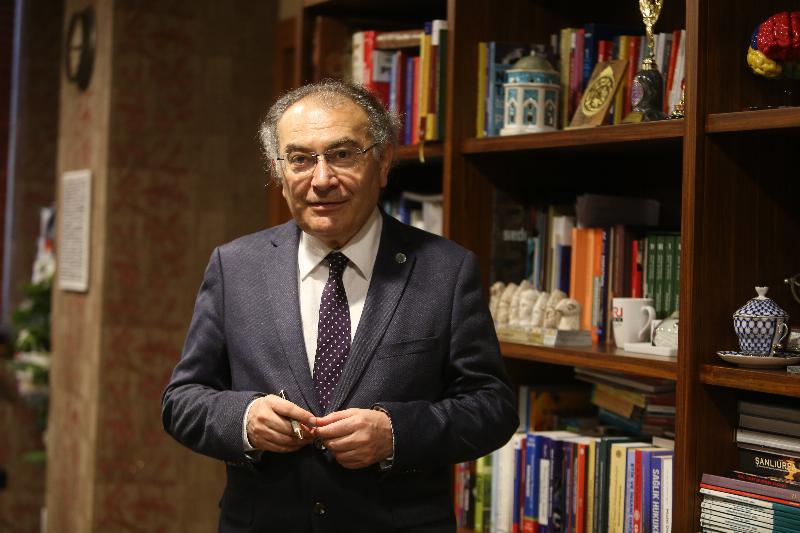
Üsküdar Üniversitesi Founding Rector, Psychiatrist Prof. Dr. Nevzat Tarhan, made special statements to Anadolu Agency's Arabic service regarding the earthquake disaster that affected 10 provinces and plunged all of Turkey into mourning. Emphasizing that disasters like earthquakes are social traumas, Tarhan said; “Social traumas increase social solidarity. They have the effect of strengthening social ties. Traumas lead to the psychological maturation of society. A society that experiences trauma and overcomes it correctly emerges stronger and more mature.”
Content
Prof. Dr. Tarhan: “Social traumas increase social solidarity”
“Those who experience earthquake shock recover more easily when they feel safe”
After the earthquakes that deeply affected all of Turkey, Tarhan made statements about the psychology of those directly affected by the disaster and their relatives, pointing out that these individuals can overcome the shocks they experience more easily with support. Tarhan said; “The earthquake had a severe shock effect. After the earthquake, all perceptions regarding earthquakes in Turkey were turned upside down. Even geoscientists state that the intensity of the experienced earthquake is a very rare probability. This is very important in terms of the earthquake's characteristics and its shock value. In Kahramanmaraş alone, there are 960 buildings reduced to rubble. The fact that the earthquake was severe in terms of intensity, occurred at night, and during winter means great loss of life. There are also relatives of those who lost their lives. There are those who saved lives by digging with their hands for 16-17 hours. All of these aspects—what happens to a person under the shock of an earthquake, the psychology of the victims, the psychology of their relatives, and the psychology of those who go there to help—need to be addressed separately. People trapped under rubble in an earthquake usually experience an initial shock effect and intense fear. In such situations, the brain sometimes goes into self-defense mode. In that state of shock, the brain gets blocked. That is, the person stares blankly, acting as if nothing happened. We see this in earthquake victims or those whose relatives are under the rubble. In such cases, one should not make comments like 'carefree person'. Their state actually stems from the intensity of the pain, from the brain blocking itself to prevent self-disintegration. Later, when they see the reality, these people start to feel more pain. If people in that state of shock feel that they are not alone, if a sense of security develops, if they feel there are people who can help them, and if they feel secure support, their suffering eases.”
“Earthquakes are a reality of this geography, children must face this reality”
Tarhan stated that earthquakes are an opportunity for psychological resilience education in children, emphasizing that earthquakes are a reality of this geography. Tarhan said; “Natural disasters like earthquakes are a reality of life. In such situations, there are those who turn off televisions, not letting their children watch or listen, thinking 'oh, don't let the child's morale be disturbed, don't let anything happen.' These people are doing it wrong. This is stress, it's trauma. This trauma is a reality of this geography. It is an opportunity for them to face this reality, to produce solutions for it, and to develop a mental strategy regarding it. These should be considered as an opportunity for the child's developing psyche. It is not wanted, not expected, but if it happens, the child should be prepared for it in such situations. When you raise a child too protectively, they don't receive resilience training later in life. When they are left alone in life events, they become a child who easily falls into depression with a small incident. That is, their psychological resilience is weak. So, such situations are an opportunity for psychological resilience education in children. For the child; ‘There is the reality of earthquakes, and this is an unavoidable situation. In such a situation, there are things to do before an earthquake, and things to do after an earthquake. We are lucky not to have experienced the earthquake firsthand, but we have a responsibility to help them. What can we do for them?’ By saying this, the earthquake is also an opportunity to teach them sharing.”
“Social traumas increase social solidarity and strengthen social ties”
Tarhan stated that natural disasters like earthquakes are social traumas, emphasizing that these traumas increase social solidarity and enable the psychological maturation of society. Tarhan said; “It is not the right way to remove children experiencing social traumas like earthquakes from the earthquake zone. Establishing a secure bond with those children is very important. A secure bond, meaning with the mother, father, and people they live with; they should not be separated from them in this situation. Let them experience the pain together; taking them to a sterile area is not good for the child. Even the uncertainty a child experiences regarding their mother and father can have a traumatic effect. Not being able to get news, not knowing what happened—as we inform children here, children look at events through the eyes of their mother and father's reactions. If the parents are calm, the child will also be calm. If they panic, the child will also panic. Here, especially with children under 10, act this way. Adolescents, however, need to be trained for help. Here, they should be informed about how to act in a disaster situation, discussing what we can do together with their parents. These are social traumas. Social traumas increase social solidarity. They have the effect of strengthening social ties. Therefore, traumas of this kind that concern everyone actually lead to the psychological maturation of society. This situation we call post-traumatic growth emerges. This situation we call post-traumatic development emerges. A society that experiences this trauma and goes through it correctly emerges stronger and more powerful, emerging more mature.”
“Hopelessness blocks the brain”
Tarhan pointed out that various traumas can be triggered after an earthquake, stating that the most important thing in shock situations is to maintain a sense of hope. Tarhan said; “In the disaster area, secondary and tertiary traumas occur. After the recent earthquakes, the traumas of those who experienced previous earthquakes were re-activated. For example, there are people currently applying to us in this way. Some started their treatment again, saying 'I'm experiencing the same things again' even though they had recovered. This is expected, but someone who has overcome their previous traumas will somehow overcome this one too. But they remember their losses every day, inevitably facing these news. This is a solvable situation for them. Someone who resolved the first trauma will resolve the secondary trauma more easily. Therefore, the most important thing in shock situations is not to lose feelings of hope. Those who fall into despair secrete more stress hormones in their brains. They suppress their brains more and, so to speak, alienate their brains. Hopelessness is something that blocks and suppresses the brain. Hopelessness and pessimism weaken the healing potential. Here, currently, it's not despair or pessimism, all of Turkey has mobilized. This is a beautiful feature of our local culture. This culture of sharing and helping does not try to escape, but tries to help. This is a good thing, and it needs to be encouraged.”
“We cannot control natural disasters, but natural disaster preparedness is a reality we can control”
Tarhan stated that it is impossible to control natural disasters, emphasizing that humanity must know its limits. Tarhan stated that those working in the disaster area must remain calm; “Those who work in disasters, having received training for it, must be resilient to surprises they might encounter in such situations. But they are also human, and they can be affected. Hearing a cry for help but being unable to assist is naturally expected; they will experience this pain, but the important thing is for them to do everything within their power. Because the outcome is something we cannot control. Natural disasters are something we cannot control. But natural disaster preparedness is something we can control. The destruction that occurs after an earthquake is something we cannot control. If a person grieves and demands for something they cannot control, they will suffer. One must know the limits of their own power. Rescuers should not attribute a divine power to themselves. They should not act like an earthly god; such an attitude will destroy a person. For this reason, those in the field must have psychological composure. Those who lack it make more mistakes in times of crisis. The most important thing in crisis management is the ability to remain calm under stress. A person who lacks the ability to remain calm under stress should not operate in search and rescue. If they sit and cry with someone who is crying, they are not a rescuer. They must maintain their own emotional state and manage to understand the other person; this is empathy. Empati, oturup ağlayanla ağlamak değil, onun adı sempatidir. Sempati, however, is a weakness for a rescuer.” he explained about the reality of earthquakes and the disaster area.
Share
Update Date: March 01, 2026
Creation Date: February 17, 2023
Request a Call
Other News
- The book that read today's digital threats in 2014: Being a Conscious Family
- Experts warn: 'Instead of memorizing letters, teach pencil grip, scissor use, and coloring'
- School fear and school love both start in the family!
- Family is not merely transforming, it is being battered under a serious assault
- Artificial intelligence opens the door to early diagnosis in autism!