

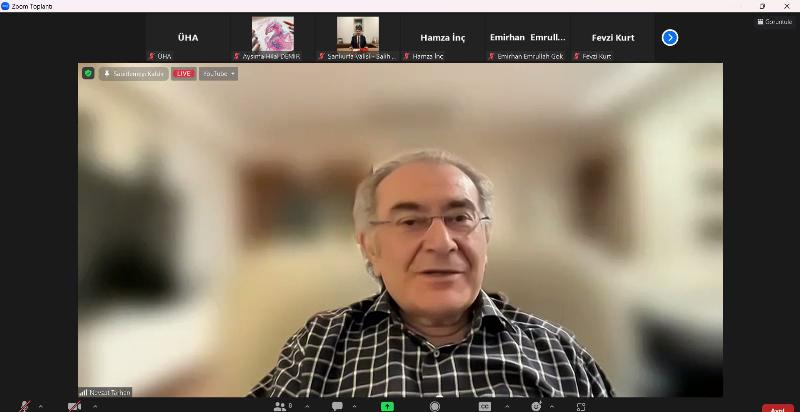
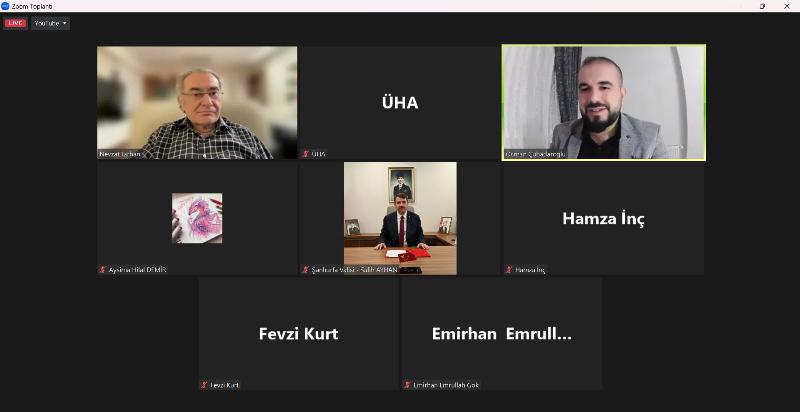
Üsküdar University Founding Rector, Psychiatrist Prof. Dr. Nevzat Tarhan, took part as a speaker in the Disaster Support Program for Educators and Parents organized by the Şanlıurfa Teacher Development and Training Center. Tarhan, making evaluations under the title “Earthquake and Its Traumatic Effect,” stated that the earthquake caused great fear throughout society. Tarhan, stating that it is necessary not to mummify the experienced trauma, but to miniaturize it, said; “If we experience a trauma that happened a month ago as if it happened yesterday, we are mummifying it. However, we need to miniaturize the trauma. We will not ignore it, we will not forget it, we will ask what it taught us, and after saying this, we will look to the future and normalize our lives. If we don't do this, our mental health as a society will deteriorate. This is the biggest risk currently awaiting us.”
Content
Prof. Dr. Tarhan: "It is Necessary Not to Mummify Traumas, but to Miniaturize Them"
“Coping with trauma can vary from person to person”
Tarhan, making evaluations regarding ways to cope with traumas, stated that a great fear was experienced after the earthquake and that individuals coped with this trauma in different ways. Tarhan said; “After the earthquakes that shook our country, ‘earthquake fear’ emerged as the first stage, and ‘avoidance behavior’ as the second. It is normal to have such fear right now. Such a severe earthquake is an event that can happen once in five hundred years in our history; perhaps the earthquake five hundred years ago was not over such a wide area but a narrower region, we do not know. But such a major earthquake is defined as a 'catastrophe of the age.' It would be strange, even selfish, not to fall into fear during such an earthquake. But everyone has their own method of coping with this fear. This varies from person to person. The most well-known coping methods we see currently, for example, veteran soldiers in America cope by resorting to alcohol during any trauma. This is a coping method, but not a very healthy one. Another coping method is ‘passivity and avoidance.’ In a way, it's like trying to live by ignoring the fear. This causes a person to face another problem while trying to escape from one. But some people try to cope by changing their interests and focus of attention. A natural disaster is a trauma that humans cannot control, are not powerful enough to change, and cannot alter. In such a trauma, the method used in our culture, in local culture, is the ‘religious coping method.’ We see that in that region, the great majority try to cope with this type of approach. In the religious coping method, a person has a mental refuge. This varies according to the belief system. With the belief in oneness (Tawhid), we accept and surrender to a higher power that controls everything, a value, a high wisdom, and apply the religious coping method.”
“It is Necessary Not to Mummify Traumas, but to Miniaturize Them”
Tarhan stated that a ‘period of acute stress’ lasting a few weeks would be experienced after trauma, and emphasized that the important thing is not to mummify the experienced trauma. Tarhan said; “In the 1-4 week period, there is an acute stress phase of the earthquake. During the acute stress period, the person constantly thinks about this topic; fifty minutes out of sixty minutes are spent thinking about it, they can't sleep properly at night, it enters their dreams, and someone who experienced the shock and tremors of the earthquake, which we call re-experiencing, lives it as if it happened yesterday, with the same horror and intensity, even though a month has passed. This situation is no longer acute stress disorder; it is shifting towards chronic stress disorder. It is called Post-Traumatic Stress Disorder. If it exceeds 8 weeks, then help is needed. Here, if we mummify this trauma and experience a trauma that happened a month ago as if it happened yesterday, we are mummifying it. However, we need to miniaturize the trauma. We will not ignore it, we will not forget it, we will ask what it taught us from now on, and after saying this, we need to look to the future and normalize our lives. If we don't do this, our mental health as a society will deteriorate; this is the biggest risk currently awaiting us. Especially after four weeks, it is necessary to respect people's grief reaction within one week. Let them experience this for eight weeks; it is worse if they don't.”
“Those with psychological resilience overcome earthquake trauma more easily”
Tarhan pointed out that those with psychological resilience overcome earthquake trauma more easily; “Just as a building collapses in an earthquake, if it has completely collapsed, its foundation is removed and rebuilt after the foundation. People will also experience this pain after the earthquake. When some people experience trauma like this, there are only small cracks in their structure; in some people, it is shaken and destroyed down to the foundation. In such individuals, we call them mental schemas; they have mental designs in their brains that make them durable and resilient. People with good mental health are shaken but not destroyed. However, in such traumas, individuals with weak mental schemas and psychological resilience cannot overcome the trauma and cannot rebuild and recover. In such cases, it is necessary to go down to the root of the building and re-schema it; this usually happens with expert help. Those who experience mild tremors can return to their normal lives after a certain period, just as they would continue their lives in solid buildings. Earthquake trauma has a similar effect on our psychological integrity as building trauma. It's like the deterioration of physical integrity. Therefore, those with psychological resilience overcome it more easily.”
“Those in managerial positions have higher responsibilities”
Tarhan emphasized that after traumas like earthquakes that deeply affect society, a great responsibility falls on leaders, and highlighted the need to provide a sense of security. Tarhan said; “Here, especially those in managerial positions have higher responsibilities, and in such a trauma, being with the community, making them feel safe, not in business suits and ties but being on the ground, in the field, provides immense confidence. It instills trust, makes them feel they are not alone, and in such a situation, the most important thing to do first is to meet people's basic security needs. Like food, drink, and shelter. After meeting these, the first step is achieved, and then that person begins to recover. That's why, even though a month has passed, there is a serious need for shelter because an unforeseen major shock was experienced. These things taught us something. We call it post-traumatic growth. Our university hosted the 5th International Positive Psychology Congress. A Professor from Harvard University, Howard Gardner - the person who discovered multiple intelligences - is eighty years old now but quite dynamic. He joined and offered his condolences. This year, we chose 'Post-Traumatic Growth' as the topic of the congress, specifically as earthquake trauma. The main topic of the congress was chosen as the science of well-being in positive psychology, and we held a session on post-traumatic growth. The feeling of trust is very important. Experts say that it takes some time for individuals to provide themselves with this feeling and recover. It will take time to recover from such a major event, but in such situations, it's not about stopping, but moving forward. It is being determined that it is time to transition to a normalization process.”
“Fear is normal, but the inability to manage fears is a weakness”
Tarhan stated that as the earthquake debris began to be cleared, psychological damages emerged, and conveyed that while earthquake fear is normal, it is necessary to manage these fears. Tarhan said; “We need to make our children feel that we have taken precautions regarding the earthquake. Except for suspicious buildings, it is necessary to quickly return to normal in this regard. We need to know 'drop, cover, and hold on' type of training. We will prepare ourselves for the worst-case scenario but expect the best-case scenario. This should be our life philosophy. If we always act as if we will live through the worst-case scenario, no nervous system or psychological structure can sustain this for long. We will take precautions for the bad scenario and expect the good one. We will ask, 'What will I do if there is an earthquake where I am?' Instead of living with fear about this, one should say 'I have taken my precautions regarding this' and immediately shift their focus of attention. To be able to do this, one needs to manage fears. Fear is normal, but the inability to manage fears is a weakness. We cannot live with 'what ifs.' Precautions also need to be taken. Very fast reactions were taken regarding psychological support. We established psychological support lines. Psychiatric problems have just begun to emerge. As the damages of the earthquake start to clear, psychological damages begin. We are strong and resilient compared to many societies. Let's draw lessons now. Let's be strong within ourselves. You must spread feelings of brotherhood and friendship in society so that you can achieve global brotherhood. Without unity within, we cannot achieve regional unity outside. This is one of the most important lessons given by destiny.”
“We should not raise our children like greenhouse flowers”
Tarhan, addressing the need not to isolate children from disasters like earthquakes, but to talk with them and ensure they understand, said; “We should not raise our children like greenhouse flowers.” Tarhan said; “Parents will be by their children's side but will also ensure they learn lessons from this earthquake. We should not raise our children like greenhouse flowers. You raise a greenhouse flower, and it collapses with a small storm or a gust of wind. We harm the child's psychological maturation; we need to raise our children to be resilient. Motherhood and fatherhood are not about making the child happy. It is about preparing the child for life. Therefore, it is necessary to act in this way. In such situations, it is necessary to say 'I love you, we are all experiencing these difficulties, there was a storm in the country, we will overcome it together somehow.' Such situations are a kind of opportunity to provide resilience training for children. One of life's hidden laws is to reward those who endure and persevere. This disaster is an opportunity to teach children the skill of delaying gratification; during that process, a child immediately wants to do what they want, to satisfy their pleasures. If we teach this to our child, we ensure their maturation on the path of wisdom, and if we face the positive and negative aspects of life, just as the body's immune system learns to fight microbes, our psychological immune system learns to manage life events.”
“Pain and difficulties are part of growth”
Tarhan stated that great sadness was experienced after the earthquake, and conveyed that this pain and these difficulties will contribute to human growth. Tarhan said; “We saw at the university that students are not smiling at all; believe me, our old cheerfulness is gone, we are aware of this. This is a pain, but a pain that will mature us; indeed, life's pains and difficulties are part of growth; without them, there is no growth in humankind. Experiencing pain and hardship is part of growth. The magic words here are ‘to persevere and be tolerant.’ Perseverance here is not to step aside but active patience, meaning patience in motion. Patience is a meditative act; it means adapting to the speed and rhythm of nature, not stopping. Our ancestors said, 'Patience is bitter, but its fruit is sweet;' we will do this, and at the end of this period, we will see good results. Like resilience training, psychological fortitude training, and as a society. You also encounter people who have lost loved ones in the earthquake region; we will experience this pain, but this pain will lead us not to bad, but to good. I remember two cases from the 1999 Yalova earthquake: a businessman there said, 'From now on, I will treat my workers better.' After the earthquake, as psychological growth and maturation, another lady, on the contrary, said, 'I hate nature now, I won't even plant flowers anymore.' The event is the same, the perspective is different. One arouses feelings of anger, grudge, and hatred within oneself. The other arouses feelings of compassion. We need to be like the latter because those who are like this gain more, protect their mental health more, but those who harbor anger and hatred, who see nature as an enemy, only fight with shadows. One should not be angry at the realities of life; we must make peace with and accept those realities.”
Share
Request a Call
Other News
- The book that read today's digital threats in 2014: Being a Conscious Family
- Experts warn: 'Instead of memorizing letters, teach pencil grip, scissor use, and coloring'
- School fear and school love both start in the family!
- Family is not merely transforming, it is being battered under a serious assault
- Artificial intelligence opens the door to early diagnosis in autism!