

This month's guest at the monthly talks held by the Risale-i Nur Research Platform (RİNAP) was Üsküdar Üniversitesi Founding Rector and Chairman of the Executive Board Prof. Dr. Nevzat Tarhan.
Content
Prof. Dr. Tarhan: “My Teachers Are My Patients…”
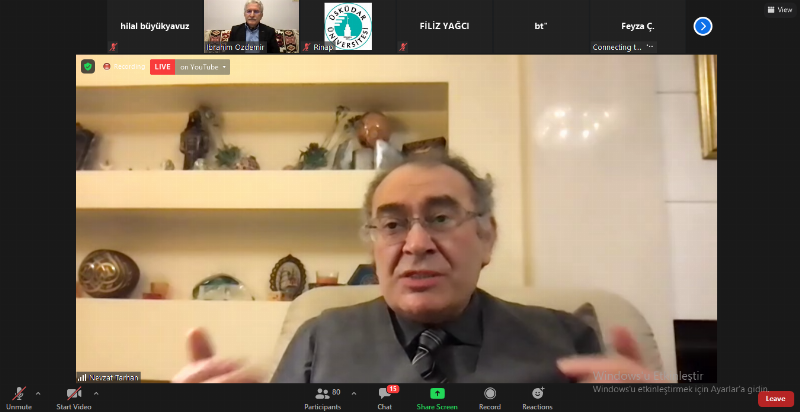
In the program where the topic of “Holistic Approach to Sciences” was discussed, it was emphasized that the purpose of science is to ask questions and to inquire. Emphasizing the importance of abstract thinking, Tarhan noted that we should see the unseen, what is behind the wall, and draw conclusions through reasoning. Giving the apple metaphor as an example, Tarhan said, “Everyone can see the apple and the seed inside the apple. The real essence is to see the apple tree in the seed, the apple itself, and its connections with all life and our planet as a whole; it is to envision the power behind this magnificent system.” Tarhan stated that when acting with this logic, science will lead humanity to truth, adding that he pondered over the reasons and whys, and his greatest teachers were his patients.
“In a holistic approach, whoever sees the big picture finds the truth”
In the program moderated by Prof. Dr. İbrahim Özdemir, Head of the Philosophy Department at Üsküdar Üniversitesi's Faculty of Humanities and Social Sciences, Prof. Dr. Nevzat Tarhan, who touched upon the greatest purpose of science being inquiry and made evaluations regarding the holistic approach, said:
“The purpose of science is to ask questions and to inquire. Critical thinking emerges here. In the field of psychiatry, asking ‘why’ is also very important. In psychiatry, we aim to see the broad scope and the whole. Our education system says, ‘These are absolute truths: don't question, don't think, obey.’ Not questioning an existing thing, merely being obedient, and not being curious is an old understanding. It blunts our sense of curiosity and wonder. Absolute truths do not exist in science; impositions have no place in scientific thought. This approach blunts our sense of curiosity. ‘Curiosity is the teacher of knowledge.’ Mental conditioning is the greatest enemy of the advancement of thought. It is necessary to see not the seed within the apple, but the apple within the seed. This is an abstract thinking skill. A thought inherent in humans. In a holistic approach, whoever looks at the big picture finds the truth,” he stated.
“Science leads to truth”
Tarhan continued with explanations regarding the concept of science:
“The Earth's roundness was discovered through reasoning. There are six evidence-based paths that lead to truth. These methods, used to find truth, are laboratory experiments, observations, thought experiments, social experiments, rational intuition, and rational belief. Five of these are directly related to reasoning. Among scientific methods, distinct from ‘verification evidence,’ the ‘falsification evidence’ method, as conceptualized by philosopher of science Karl Popper, can also be used. They ask Nasrettin Hodja why he rides his donkey backward, and he replies, ‘To see the threats coming from behind.’ When asked what about those coming from the front, he says, ‘My donkey sees them.’ In fact, Nasrettin Hodja taught us abstract thinking and the use of the mind's eye; now we understand.
For this reason, I attach importance to the investigation of abstract thought that goes beyond visible objects and those subject to our experience. Scientific thought suggests data mining and directs us to find evidence. A scientist should be like a diver. First, they must educate themselves intellectually, and then they can dive deep. A scientist should be like a bee, landing on every flower to collect honey and producing their own product. A scientist should be like a chemist, able to synthesize. They must be very diligent. Because truth reveals itself to those who strive. Therefore, we will also see the unseen, see what is behind the wall, and draw conclusions through reasoning. Science leads to truth.”
“My teachers are my patients”
Tarhan stated that while carrying out his studies, he benefited from all branches of science and embarked on his path with solid steps, employing a multidisciplinary understanding; “My aim is to prioritize the patient's highest benefit. I have utilized various scientific fields and learned something from everyone. My teachers are my patients. I have learned a great deal from them in particular. In cases of treatment-resistant patients, instead of just listening to the patient and sending them away, I ask what else can be done for their treatment. Our entire team knows the saying, ‘A physician is responsible not only for the treatments performed but also for those not performed,’ as our motto. In our practice model, we first conduct a systematic assessment, listen, and try to understand. We ponder over the reasons and whys. We analyze and create a treatment plan, setting treatment goals; using all the tools in our treatment bag is among our objectives. It is very important to approach with a pluralistic and holistic perspective. I use this approach in all treatments I apply,” he said.
“Man is a feeling being”
Responding to the moderator's question about the meaning of the ‘Feeling Human’ sculpture in front of Üsküdar Üniversitesi, Tarhan drew attention to the scientific fact that humans are not just thinking beings; “Man is not just a thinking being. He is also a feeling being... The wisdom teaching says you become human by sharing and being happy. Humans must also live for the biological and social ecosystem they inhabit, not just for themselves. There should be no narcissistic thinking. There should be moral success, not material. Otherwise, dissatisfaction arises; desires and limits are endless. Resource management is very important. We have social, psychological, and emotional capitals. We placed the feeling human sculpture at our university for the universe, creation, existence, and imagination. We are not just thinking beings; humans are feeling beings. In fact, one of our neuroscience professors, Prof. Oğuz Tanrıdağ, wrote a book titled ‘I Believe, Therefore I Am,’ stating that the human brain is actually an organ of belief,” he said.
‘Risale-i Nur is a shortcut to finding the truth…’
Tarhan drew attention to the fact that recently, teachers, families, individuals, and even society focus more on academic success than moral success, and continued his words as follows:
“Unfortunately, modernism imposes this on us. The doctrine of the education system should be questioned. There is an increase in the number of narcissistic people. No thesis that teaches only this worldly system is valid. Investment should be made in spiritual trade as much as in material trade. Being intelligent and hardworking alone is not enough; one must be able to succeed in being a good person. Otherwise, a person can use their intelligence and success for things that could be bad for humanity. It should not be forgotten that the world has an invisible reality; Risale-i Nur is a shortcut that leads people to the truth… Risale-i Nur, which I encountered at a young age and tried to read and understand, answered my metaphysical questions and gave meaning to my life. As they say: ‘I read a book, and my life changed.’ It was the same for me: the Risale-i Nurs changed my life. These works are ‘evidence-based belief’ works. However, this must be a reading and transformation based on searching, researching, reading, and deep contemplation.’ We know that its language is heavy, with many Ottoman-origin words. Initially, this seems like a difficulty, but it extraordinarily develops our vocabulary. This is very necessary for conceptual learning. They ask Confucius what he would do to build a society. His answer is ‘I would start with concepts.’ Ultimately, these works offer us shortcuts and brief paths in searching for unseen truths. For humankind, there is nothing more important than gaining eternal life, proving and understanding the reality after death. I believe that the Risale-i Nur methodology succeeds in reducing a journey of discovery and attainment, which used to take 10-15 years of religious education in olden times, to 15 weeks.”
Share
Update Date: February 27, 2026
Creation Date: February 25, 2021
Request a Call
Other News
- The book that read today's digital threats in 2014: Being a Conscious Family
- Experts warn: 'Instead of memorizing letters, teach pencil grip, scissor use, and coloring'
- School fear and school love both start in the family!
- Family is not merely transforming, it is being battered under a serious assault
- Artificial intelligence opens the door to early diagnosis in autism!