

Üsküdar Üniversitesi Founder Rector, Psychiatrist Prof. Dr. Nevzat Tarhan, was a guest at the event titled “Life Success or Academic Success in Child Education?” organized by Dicle Çocuk Üniversitesi. In the program moderated by Lecturer Esra Kuz, Tarhan stated that child education should be two-sided; “It is sufficient for leader candidates to be intelligent and hardworking for academic success, but if there is no moral success, a person cannot be successful in life. Neither academic success alone nor moral success alone is sufficient. Children should be enabled to succeed in life through moral and academic success.”
Content
Prof. Dr. Tarhan: “Life success comes from the combination of academic and moral success”
“Globally, we are experiencing a change for the worse in this period”
Tarhan stated that children and young people are the group most affected by the pandemic process, and this group had to experience an unexpected crisis like COVID at this age. Tarhan said; “In such a period, it is necessary to discuss whether deprivations and isolations will be a threat or a gain for children and young people. Questions like ‘How do I educate my child, is it life success or academic success?’ are old questions. It is necessary to give new answers to these questions. In today's reality, there are advanced drugs, inadequate health, countless relationships, zero love, high income, less peace, many friends on social media, zero true friends, more people, less humanity, more material prosperity, less peace. Sociological changes occur in these criteria. Globally, we are experiencing a change for the worse in this period.”
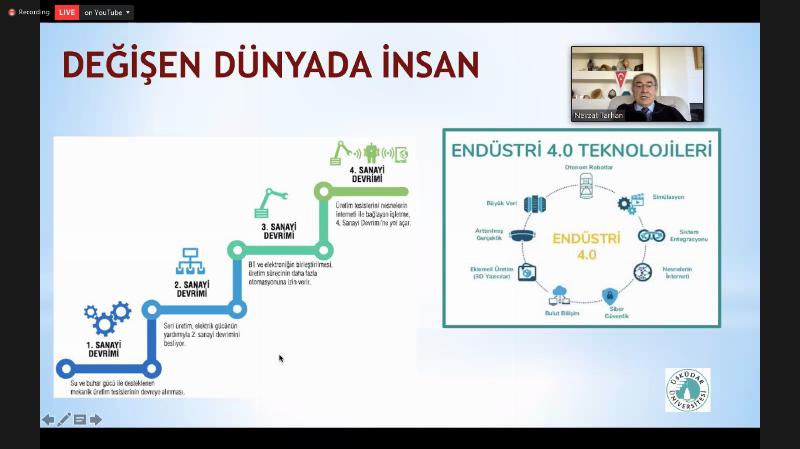
“We must catch Industry 4.0 as soon as possible”
Tarhan stated that Industry 1.0, 2.0, 3.0 were experienced in the changing world, and currently 4.0 is happening; “The Ottoman Empire missed Industry 1.0 and 2.0. Unfortunately, we also missed 3.0 in the 20th century. Currently, Industry 4.0 is taking place, let's not miss this one at least. If you are an object of a process, not a subject, and there is only consumption, it becomes impossible to catch the industrial revolution. To catch the industrial revolution, one needs to be productive. All power, capital, and dominance are gathered in the hands of those who succeed in this. We have not yet established this balance. Priority needs to be given to science and innovation. A synthesis of religion and science has started now. In Industry 4.0, young people can do great things with supercomputers; the important thing is that there should be no state hindrance in this regard. The state will pave the way for R&D. Amazon company invests 80 percent of its revenue in R&D. China and South Korea invest more than 10 percent in R&D. Türkiye still could not exceed 3 percent. We invest in mountains and stones, but we cannot produce anything new because we don't do R&D.”
“While teaching physics and mathematics to children, human values should also be taught”
Tarhan stated that the COVID pandemic brought mandatory digitalization to the whole world; “With digitalization, a new situation emerged; ‘21st-century skills.’ In 21st-century skills, children's emotional and social skills need to be developed through education. Children should be taught not only academic success but also emotional and social success. Secondly, connectivity is important, not randomness. According to quantum mechanics, there is no randomness in the universe, there is connectivity. Everything is interconnected. According to quantum mechanics, errors and mistakes that occur through the butterfly effect in the universe are part of perfection. Neuroscience-based learning has emerged. Children should be given education focused on innovation, entrepreneurship, and values. At every point in life, while physics and mathematics are taught, human values should also be taught. Values such as honesty, diligence, being a good person, having empathy, and considering the rights of others need to be taught.”
“Global Civilization Syndrome: Hedonism, narcissism, loneliness”
Referring to a study conducted in America regarding the world's current state, Tarhan said; “According to a statistic conducted in America between 1950 and 2000, they measured happiness scores and also the gross national product. Although there was a great development in the gross national product, happiness remained the same. This statistic revealed a result that confirms the saying ‘money cannot buy happiness.’ The first step in the Global Civilization Syndrome is the crisis of hedonism, pleasure-seeking. Hedonism says the purpose of life is ‘to chase pleasure.’ The second is narcissism. Narcissistic individuals lack empathy; they see everyone as extensions of themselves. Later, these two characteristics give rise to a third characteristic: ‘loneliness.’ People who evade social responsibility, become alienated, and only think of their own interests multiply and become lonely. As a result, unhappiness, depression, and suicides increase. These increases among young people are not coincidental. The UK established a Ministry of Loneliness in 2018. Japan also established one on March 3rd because suicides increased significantly during the COVID period.”
“Success in life comes as a result of academic success and moral success”
Tarhan stated that every child and young person is a leader candidate; “When raising leader candidates, it is desired for them to be intelligent and hardworking. According to the new scientific view on leadership, there is a type called neuro-leadership. Accordingly, a person is their own leader. One who cannot manage themselves cannot manage others. If a person cannot manage emotions such as resentment, anger, hatred, jealousy, which we know as the five horsemen of darkness, they are not their own leader. In the second stage comes parenthood, leadership at home. The third is classroom leadership in education. If we perform these leaderships correctly, we raise leader candidates correctly. It is sufficient for leader candidates to be intelligent and hardworking for academic success, but if there is no moral success, a person cannot be successful in life. Neither academic success alone nor moral success alone is sufficient. Children should be enabled to succeed in life through moral and academic success,” he concluded his words.
Share
Update Date: February 27, 2026
Creation Date: May 11, 2021
Request a Call
Other News
- Prof. Nevzat Tarhan: “Those with a mental filter are not afraid of the digital”
- Artificial intelligence doesn't eliminate the translator, it transforms their expertise!
- Social responsibility courses moved to the field
- Erasmus+ Orientation Week completed at Üsküdar
- Prof. Nevzat Tarhan: “Brain secretes ‘dark glue’ in social media lynchers!”