

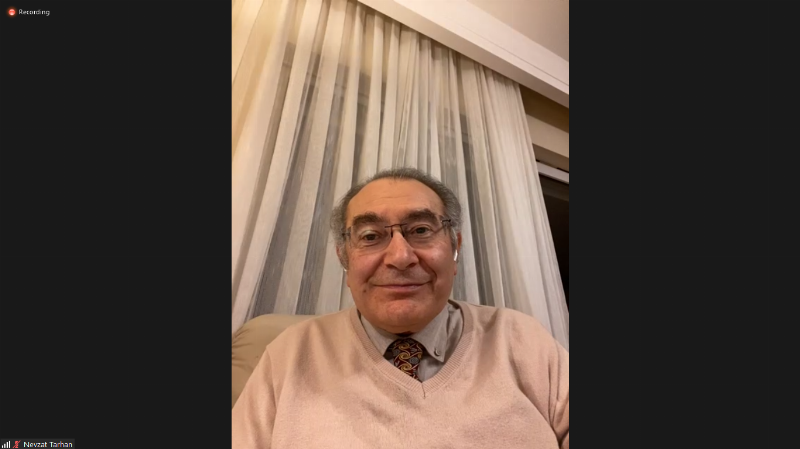
Uskudar University Founding Rector Prof. Dr. Nevzat Tarhan was a live broadcast guest at the event titled “Our Values with Yunus Emre”, organized by the Burdur and Eskisehir Provincial Directorates of National Education. The event, which began with the opening speeches of Burdur Provincial Director of National Education Erdem Kaya and Eskisehir Provincial Director of National Education Hasan Cırıt, attracted significant interest from teachers, parents, and students within the education community. Pointing out that the moral and intellectual mentors who existed in every neighborhood in Anatolia in the past are not present today, Tarhan stated that Yunus Emre was one of those who had a protective mental health effect on society. Tarhan conveyed that Mesnevi and Yunus should be read today because there are no people in our society to consult, and he noted that there is no need to go back 700 years; we can synthesize the truths of that day with today's knowledge and guide our lives.
Content
Prof. Dr. Tarhan: “Friends of God in Anatolia served a protective mental health function…”
“The source of Positive Psychology is Mevlana and Yunus Emre”
Tarhan emphasized the importance of transferring historical figures to future generations, highlighting that Turkey holds a great treasure in this regard. Tarhan said; “It is very important to carry out a project about Yunus Emre and explain it to our students and society, especially for our future. Because what connects people between the past and the future are experiences, stories, and narratives. We grew up with important figures like Mevlana and Yunus Emre. In the Western world, Mevlana held a very significant place. After seeing this, questions arose in my mind as to why we weren't interested. When the Western world began to experience unsolvable problems in ethics and family life, they introduced the term ‘positive psychology’ in 2009 as a result of their research. When I investigated the source of this new science, I saw that they systematized Anatolian wisdom and Eastern wisdom and established a new methodology. Moreover, I noticed that they did not reference Mevlana and Yunus Emre, whom they took as their source. I said that this is our fault; we are sitting on a treasure without knowing it, and others are extracting and using it. I examined the modules: forgiveness works, gratitude works, empathy and conciliation, etc. They used the scientific methodology values expressed by Yunus and Mevlana. I said I needed to synthesize this information with the science of psychiatry. I wrote the book Mesnevi Therapy for these reasons.”
“Yunus Emre healed society's wounds with his poems”
Tarhan stated that Yunus Emre healed people with his poems during a desperate period in Anatolia, and Mevlana achieved this through metaphors. Tarhan said; “The years Yunus Emre and Mevlana lived were the 1200s-1300s. This was a period in Anatolia marked by a power vacuum, the dominance of Templar knights, and Mongol raids. During this period, a pessimistic mood prevailed in Anatolia; a period of trauma was experienced due to the birth pangs of the Ottoman Empire. It was necessary to dispel this negative mood in society and provide motivation for the future. Haci Bayram Veli, Yunus Emre, Mevlana all did this. Everyone, in their own way, conveyed human values to people. They found solutions to pessimism and unemployment in society. The seeds sown at that time gave birth to the Ottoman plane tree. Mevlana used metaphors to liken stories to real-life events, causing individuals to develop behaviors. Providing behavioral development in daily life through the analogy of metaphors is a method used in literature. Yunus also treated wounded, troubled, and sorrowful people with the language of poetry. Poetry has the feature of stirring emotions. We are emotion-based societies. Western societies, on the other hand, are thought-based. Most philosophers have emerged from the West. Since the East is emotion-based, prophets emerged from here. Yunus Emre healed wounds with his poems, transforming unresolved traumas into resolved ones.”
“In Anatolia, 'Çelebis' worked to earn their living and also practiced dervishhood”
Tarhan drew attention to Yunus Emre's alp-eren spirit, a Central Asian tradition, alongside his heart-touching poems; “When Yunus reached eighty years old, he encountered a shepherd. He saw that the shepherd was reciting his poem, and saying 'I have done my duty, I have left a mark on people's hearts and contributed somewhat to their embracing and self-development,' he wrote the Risale-i Nasihat (Treatise of Counsel). Yunus Emre was not an idle dervish who sat still but an active dervish. Although his homeland was Eskisehir, he has shrines in many places and touched hearts in every geography. But he never put himself forward; if a community gathered around him, he would immediately leave that place. He established a very strong bond with his Sheikh Tapduk Emre. He embarked on a journey of inner discovery thanks to his Sheikh, similar to Mevlana's journey of inner discovery with Shams. Yunus Emre has an Alperen spirit. In Anatolia, there was a group of dervishes called 'Çelebi' who worked during the day and practiced dervishhood at night. They lived without being beholden to scoundrels. Yunus became a serious example in our society, acting sincerely, simply seeking what is in accordance with the divine goal. Both Yunus and Mevlana were examples of a completely spiritual way of life, without hidden agendas in their minds, and not worldly.”
“Yunus healed souls by instilling hope with his poems”
Tarhan stated that he found methods used in psychology in Yunus Emre's poems and said that these poems were a vaccine of hope for people. Tarhan said; “Understanding Yunus's poems may seem difficult at first, but when you delve deep, it draws you in from 700 years past. After reading his poems, I realized that they contained various scales we use in psychiatry. For example, there are emotion regulation scales. For instance, someone who experienced trauma 10 years ago relives that trauma as if it happened 3 days ago. I look at Yunus Emre's poems, and they instill emotional hope. The most important thing is the feeling of hope, and it overcomes pessimism in people. In fact, the true reason for life is death. To change this, a feeling of hope and self-confidence work is done in the person, enabling them to analyze the event objectively. Yunus did this with poems. The advantage here is that because poems stir emotions, people who can use their emotions solve problems more easily. Solving problems with thought is more difficult. Solving them by making logical inferences and establishing cause-and-effect relationships is important but harder. When you heighten emotions, a person can push something away in an instant. Here, Yunus used emotions to make people look to the future with more hope. He explained the meaning of life in the world very beautifully.”
“Everyone should have a Molla Kasım who speaks the truth in their life”
Tarhan emphasized that criticism through Molla Kasım in Yunus Emre's life was a great gift and focused on Yunus's exemplary character. Tarhan said; “If you fill a room with all the goodness in the world, the door will be opened by truthfulness. You see this always present in Yunus's life. He never condescended to self-interest and never abandoned truthfulness. For example, in his poem, he said, 'A Molla Kasım will come to question you too.' Yunus did not disrespect him; he beautifully expressed his place in his poem. Everyone needs a Molla Kasım who can give fair criticism. We, too, at the university and hospital, have made the saying 'Criticism is a gift' our slogan. When we are criticized, if the other party points out our mistake, we correct it and adjust our path accordingly. If it is an unfounded criticism, we do not dwell on it, so we need to see criticisms as gifts. We see that Yunus also respected it despite being criticized. This is one of the beautiful representations of Yunus being an example through his strength of character.”
“Friends of God in Anatolia served a protective mental health function”
Tarhan stated that to follow great figures like Mevlana and Yunus Emre, who lived 700 years ago, their works should be read; “In the past, moral and intellectual mentors existed in every neighborhood in Anatolia; they do not exist today. There, they actually performed protective mental health functions. This is what Yunus did. Since there are no such people to consult in our society today, we will read Mesnevi, we will read Yunus, and we will find the truth with them. We don't necessarily have to go back 700 years. We need to take the truths from 700 years ago, synthesize them with today's knowledge, and guide our lives within that synthesis. In this era, scientific soundness has replaced religious soundness; we must accept this fact. Before, everyone accepted that 'such-and-such religious elder says this, so it's true.' But now, because exemplary religious elders have greatly decreased, people do not refer to them. We need to approach these values with scientific soundness. After the science of positive psychology emerged, as Uskudar University, approximately 23,000 students graduated in 2013, and currently, we have 22,000 students. We taught this course to all students as a rectorate course, a mandatory course. We conducted pre-tests and post-tests. At the end of these tests, we saw that our students' emotional intelligence increased by 20 percent.”