

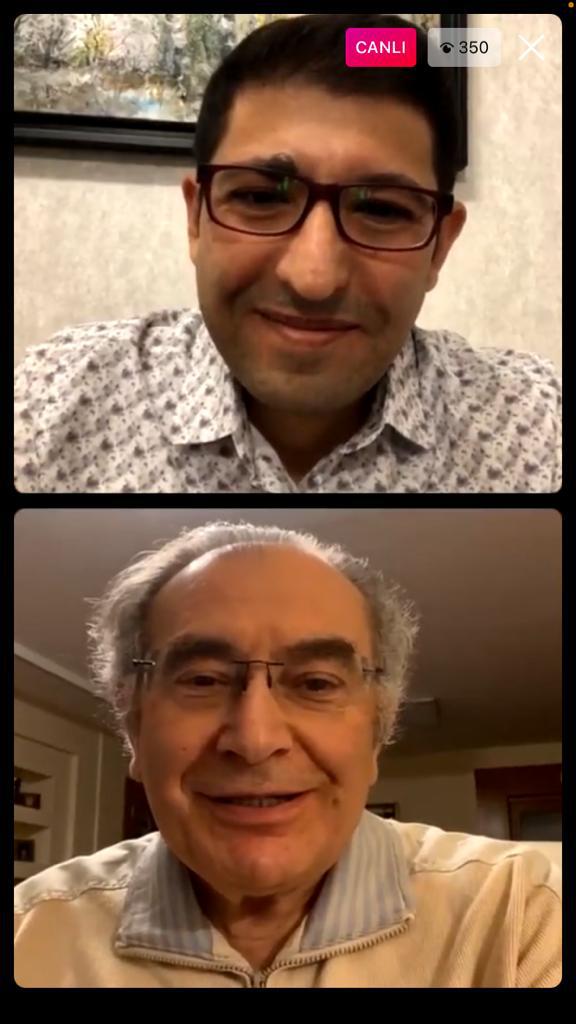
Üsküdar Üniversitesi Founding Rector, Psychiatrist Prof. Dr. Nevzat Tarhan made striking statements about “Patient Psychology” during his guest appearance on an Instagram live broadcast. In the program moderated by Assoc. Dr. Adem Küçük, an Internal Medicine Specialist from Necmettin Erbakan Üniversitesi, Tarhan touched upon the effects of chronic diseases on patient psychology, stating; “As physicians, especially with seriously ill patients, we must pay attention even to our micro-expressions when communicating with their relatives. In children with chronic diseases, parents, in particular, can infer conclusions from the physician's facial expressions, body language, tone of voice, and subliminal emphases. Therefore, we must honestly inform patients openly and transparently, tirelessly.”
Content
Prof. Dr. Tarhan: “Even Physicians’ Micro-Expressions Are Important”
 “Acceptance of chronic diseases can take many years”
In the program conducted via the Rheumatology Clinic's Instagram broadcast, Tarhan drew attention to the importance of the patient's reaction after first learning about their chronic condition, stating that not accepting the disease is a serious problem. Tarhan said; “Some disease groups are chronic. Patients understandably struggle to accept a chronic illness at first. Elderly patients generally think, 'I've lived this long, never had an illness, where did this come from?' while younger patients complain, 'I'm still so young, why did such a disease happen to me?' However, chronic diseases have no age limit. The functionality and function of our body can deteriorate in old age as well as in young age. In medical illnesses, patients' non-acceptance of the disease is a serious problem. When a patient learns about their illness, a trauma first occurs. They usually initially reject and protest the disease, not accepting it. But over time, when they see concrete evidence that it is real, a process leading to depression follows as the second stage. The third stage is like bargaining with death begins, and precautions regarding the disease are postponed with various excuses. Finally, acceptance and living a life according to the disease emerge. However, it can take a very long time for some people to overcome this process. This is related to a philosophy of life.”
“In the treatment of chronic diseases, what is important is not the scientific aspect of medicine, but the artistic aspect”
Tarhan stated that there are great subtleties in explaining chronic diseases to patients, and a doctor should explain this situation to their patient with the demeanor of a wise artist. Tarhan said; “Medicine does not only have a scientific aspect; it also has an artistic aspect. In chronic diseases, what is important is that if a physician is professionally wise, skilled, and like an artist, and has incorporated aesthetics and deep thought into their work, they do not suddenly tell the patient. First, they mentally prepare the patient, explaining the pros and cons of the disease. Let's not be afraid of chronic diseases. If we arrange our lives according to the disease, if we learn to live with it, no problems will arise. Most chronic diseases are like diabetes, and living with them is not as difficult as it seems. However, when people hear 'living with it,' they might think of staying in the same room with a snake. Whereas, living with it means not entering into a defensive relationship, not fighting against it. One of the most common mistakes is to see the disease as an enemy. This leads to non-acceptance of the disease and increased anxiety.”
“It cannot be said that there is no treatment for any disease”
Tarhan stated that no disease can be diagnosed as 'untreatable', and that patients losing hope of recovery negatively affects the treatment. Tarhan said; “Regarding the recovery of a disease, no one can say 'this disease is scientifically incurable'. Because there are patients who were said to be incurable, but they recover and stand on their feet completely healthy. A friend of mine used to say; 'When the patient gave up hope saying I won't recover, we pulled the plug.' When there is no motivation for recovery, the body rapidly collapses. It's very interesting, it starts to fade as if its battery is dead. This is something that truly proves the saying; 'Watch your beliefs, they may become your realities.' They explain this as perception, but beliefs, not perceptions, are what primarily affect a person. Later, these beliefs influence perception, and wrong perceptions turn into reality. Therefore, it is necessary to always keep the hope of recovery alive.”
“Patients should be informed about the literature before starting treatment”
Tarhan stated that patients should be given the opportunity to get a second opinion before starting treatment and touched upon treatment algorithms. Tarhan said; “The side effects of drugs have been minimized with today's developing technology. However, it is still quite normal for a patient to have questions in their mind. In such cases, if there are questions, we open the literature to the patient. There are treatment decision stages and treatment algorithms. People in an age where information is easily accessible also need to question. Unfortunately, not every physician thinks only of the patient's benefit; some may pursue their own interests. Therefore, if a patient has questions, they should consult other physicians and definitely look at the literature. A patient trusting and coming to a physician is like making a health security agreement with the physician. The patient needs your professional knowledge, your knowledge set. You need to explain the knowledge set to them correctly. We have a saying; we cannot treat everyone, but we can strive for everyone's treatment. As physicians, we attempt all measures for the patient's well-being.”
“Happiness changes the course of treatment”
In his speech, Tarhan stated that a person's state of happiness changes the course of treatment, and that patients should receive psycho-social support during treatment. Tarhan said; “Psycho-social support is very important in the patient's treatment. We observe that when a patient feels lonely, helpless, and weak, it can negatively affect the course of treatment. Many patients receive antidepressant treatment during this process. Humankind shows tolerance to chronic diseases to make sense of death. There are even those who talk to and converse with their illnesses. Some even write poems to their illness, saying; 'you are a guest in my body, we will live together.' This, of course, is a deeply profound emotion.”
“Physicians should pay attention even to their micro-expressions when communicating with patients”
Tarhan stated that chronic diseases in children wear out parents greatly, and that physicians should pay close attention to their demeanor and micro-expressions when meeting with patient relatives. Tarhan said; “When chronic diseases are learned about in children, parents become very worn out. Since this disease will affect the child throughout their life, many questions arise in families, such as 'what will their profession be, will they get married or not?' In such situations, these kinds of impacts are quite natural, a human condition. As physicians, in child patients, we often first comfort the mother and father. When the parents relax, the child automatically relaxes. In such a treatment, keeping the feeling of hope high is very important. The physician must be open, transparent, and clear with the patient and their relatives regarding the treatment. Because only in this way can a feeling of trust be established. When the physician speaks based on evidence regarding the treatment, the parents' anxiety decreases. Some physicians may make definitive positive or negative judgments about recovery before starting treatment. Especially in seriously ill patients, even our micro-expressions as physicians are important. Parents, in particular, can infer a conclusion from the physician's facial expression, body language, tone of voice, and subliminal emphases. Therefore, we must honestly inform patients openly and transparently, tirelessly.”
Reporter: Esmanur Tuna