

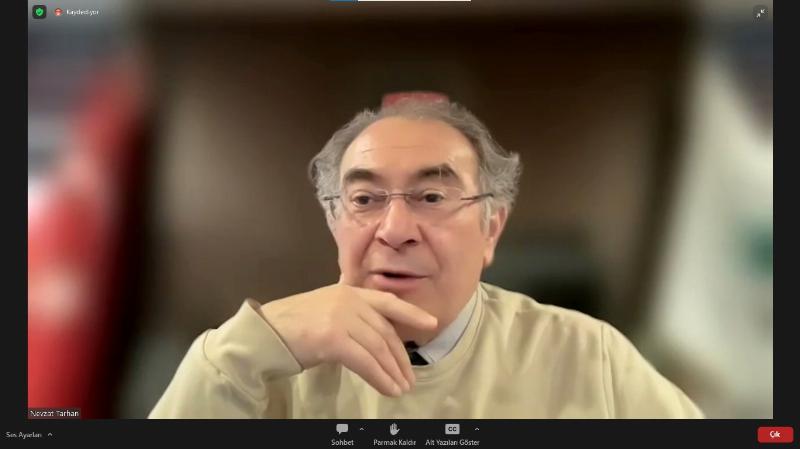
With the support of Üsküdar University Department of Health, Culture and Sports (SKS), the “Psychology Talks from Existence to the Search for Meaning” organized by the Conscience of the Age Club continues. This week, the program was held in the shadow of the pain of the earthquake that plunged Turkey into mourning. In the program, which addressed the topic of “The Story of Prophet Yusuf and Approaches to Calamities”, Tarhan noted that disasters such as earthquakes are calamities, and training in patience in the face of calamities is important.
Content
Prof. Dr. Tarhan: Calamities are a lesson in patience…
“Natural disasters are also calamities”
Making statements about the earthquake that deeply shook all of Turkey and caused great damage in 10 provinces, Tarhan drew attention to the fact that this earthquake was a great calamity. Stating that prophets experienced many calamities in their lives, Tarhan explained how one should act in the face of calamities, drawing from the stories of Prophet Yusuf and Prophet Yaqub, and provided information about the concept of ‘calamity management’. Tarhan said: “Indeed, the Maraş earthquake is a bigger earthquake than the Marmara earthquake. An unforgettable earthquake. This week, we were going to discuss calamity management based on the stories of Prophet Yusuf and Prophet Yaqub. A natural disaster is also a calamity. A calamity that affected perhaps several million people living in that region occurred. This is a calamity that affected almost one-third, one-fifth of Turkey. How should calamity management be in the face of such calamities? For example, Prophet Yusuf’s imprisonment is a calamity, Prophet Yaqub’s loss of his child is a calamity. Here, people losing their loved ones, deaths due to natural disasters carry trauma and are called calamities. Here, we will focus more on the psychological aspect. The stories of Prophet Yaqub and Prophet Yusuf are mentioned in the Holy Quran in more than twenty places. This means that divine destiny tells mankind, ‘Take as an example what Allah’s good servants did after what befell them.’ It tells us to take them as an example. It says, decide whether you want to be among the good or among the bad. It says you will always make choices here, life is a choice. Every moment, every minute, for example, listening to this program is a choice, a preference. As a result of these choices, we reach a point at the end of our lives. That is why we need to analyze events as calamities.”
“Prophet Yaqub's reason for trial is in ensuring justice in love”
Drawing attention to the fact that Prophet Yaqub was tested in ensuring justice in love among his children, Tarhan made important evaluations in the context of an analysis of compassion and affection. Tarhan said: “Bediüzzaman Hazretleri makes an analysis of compassion and affection in the story of Prophet Yusuf. A calamity comes upon Prophet Yaqub and Prophet Yusuf through compassion and mercy. Unknowingly, a trial begins with excessive and unconditional love, affection, and compassion. According to narrations, Prophet Yaqub’s wife Rachel did not have children until old age. Later, ten children were born. Allah blessed Prophet Rachel with children. The woman was a very envied wife. In fact, Prophet Yusuf’s beauty also comes from there. His other brother is Benjamin, younger than him. He is also from the same mother. Prophet Yaqub feels a difference in him after these children are born. Prophet Yaqub’s interest in him is noticed among his other wives and among his other children. It doesn’t matter whether we call it affection or compassion here. An affection and compassion connected with the names Rahman, Wadud, and Rahim. Prophet Yaqub showed compassion to all his children. However, he shows his compassion for Prophet Yusuf. Prophet Yaqub has 12 sons. Prophet Yusuf sees a dream, in the dream, 11 stars, a sun, and a moon prostrate before him. The 11 stars are the other brothers. The sun and moon are his mother and father. They prostrate before him. This is mentioned in the Holy Quran. His father says, ‘Don’t tell this to your brothers, they will become your enemies.’ In the Torah, it is mentioned that Prophet Yusuf told his brothers and jealousy arose when he told them. He was about 17 years old at that time... He tells this at that time, and the trial of both of them begins. Prophet Yaqub’s trial involves whether he can ensure understanding from the children’s perspective while expressing a sincere feeling related to the expression of love. In such a trial, he shows an awareness like loving equally. But Prophet Yaqub inevitably shows his expression of love very clearly, constantly urging for Prophet Yusuf’s (PBUH) protection, at least showing his protectiveness. He doesn’t discriminate among the brothers but shows his protectiveness towards Prophet Yusuf. In such a situation, Prophet Yaqub’s trial begins with the jealousy that arises among the brothers. Destiny takes this as the reason for the trial in ensuring justice in love, and the trial begins. When Prophet Yusuf leaves, his brothers unite and want to kill him. In some narrations, they even say, ‘Let’s not kill him, let’s throw him into a well,’ and that’s what happens. He is thrown into a well, and while they are there, they sell him as a slave. Then they slaughter a sheep and tell Prophet Yaqub that wolves took him, and they found his shirt. Prophet Yaqub doesn’t believe it, of course. But a tremendous sorrow begins this time. According to narrations, that separation lasted for about 17 years. So, Prophet Yaqub’s calamity began in this way.”
“The biggest lesson we will draw from a calamity: training in patience”
Emphasizing the importance of patience in the face of calamities, Tarhan said: “In the face of the calamities that began with the disappearance of Prophet Yusuf, Prophet Yaqub’s eyes became blind from grief. Yet, he did not resent Allah, nor did he object to Allah at the moment of calamity. He did not show ingratitude to Allah. He tried to raise his children well, he did not punish the others, he did not treat the others badly. He endured, saying it came from Allah. What happens with patience here is that he knows where it comes from, and in such a situation, he uses the concept of patience and waits. He waits without losing hope in Allah. Therefore, the greatest lesson we can draw from a calamity is training in patience. What is in patience? Patience does not mean withdrawing to a corner and waiting, nor crying; patience is a meditative act. Acting in accordance with the speed and rhythm of nature. He knows where such a calamity comes from. It comes from the Owner of the universe. He says, ‘There is a reason for this that I do not know, there is a cause.’ He says, ‘There is a reason I cannot see, there is wisdom,’ and he endures, he is patient. Now, Hacı Bektaşi Veli divides intellect into four in his work Makalat. One is the intellect with the light of night. How much can you see at night? If you want to travel at night, you move very limitedly in the darkness. The second is the intellect with the light of day. During the day, you travel better when going to a destination. The third, he says, is the intellect with the light of the Sidra (Lote Tree of the Utmost Boundary). Sidra means the highest place. For example, you have climbed the Himalayas or the highest point of your city, and you see more places. This is data-driven intellect. The fourth, he says, is the intellect based on the Arsh (Throne of God). He calls it the intellect with the light of the Arsh, with the light of the Arsh, meaning the intellect from Allah. So, here Prophet Yaqub looks at the event with the intellect at the level of the Arsh. He looks at it from a bird’s eye view; the intellect with the light of the Arsh, Prophet Yaqub sees this. When he sees the intellect with the light of the Arsh, he says there is wisdom in it and does not rebel or object.”
“It is important to look at calamities not only with worldly intellect but also with otherworldly intellect”
Stating that it is not enough to look at calamities only with worldly intellect, Tarhan emphasized that it is also necessary to look with otherworldly intellect and evaluate them in that way. Tarhan said: “For example, the death of a child is the greatest trauma for parents, the pain of losing a child. When we look at things with the highest trauma value, the death of a spouse comes first. Even before that, a spouse’s infidelity comes with the highest trauma value score, and then the pain of losing a child. When we list and score what is the event with the highest stress value in the life events stress scale, this comes up on average. Now, such a severe pain of losing a child, whom he loved so much, is a serious trauma. Prophet Yaqub can endure this trauma when he looks at it from the position of prophethood, as if looking from the Sidra and the Arsh. What we should take away from this is being able to look at calamity with this intellect. You don’t just look with worldly intellect, you also look with otherworldly intellect. When you look with the intellect of the Arsh, the intellect of the Arsh means it shows not only this world but the entire universe, what comes after death, what comes after the black hole. In quantum mechanics, after the black hole, the universe seems to end, but beyond that, a reality called a realm independent of time and space begins. We are currently living in an illusion in this world. What is an illusion? It is referred to as a delusion, a kind of simulation, like a dream. We are currently living in a dream, and we will wake up when we die. We will wake up after death; Prophet Muhammad says that after death, another life, the true life, is the afterlife, and we will go there. Someone who knows that this life in the world is an illusion, a simulation, and even like a dream from which we will wake up with death, looks at these events as if looking from the Arsh, and when they look in this way, their power of endurance emerges. Prophet Yaqub managed the calamity in this way and achieved endurance for 17 years according to narrations.”
“Allah puts even those He chooses as prophets through a trial process”
Drawing attention to the patience shown by Prophet Yusuf in the face of various calamities, Tarhan stated that this behavior set a great example for calamity management. Tarhan said: “If we consider this story from the perspective of Prophet Yusuf, Prophet Yusuf is sold as a slave, then when he is in a good position in the palace, Zuleikha harasses him, trying to attract him for about a year. Yet, the entire administration of the palace was under him; he was the person who came after the pharaoh, meaning he was such a powerful and authorized person. At the very last moment, Zuleikha sets a trap for him with persuasion, and with that trap, it is even said in the holy verse, ‘She desired his self.’ But according to narrations at that time, Prophet Yaqub and some family members appear because Prophet Yusuf, after a year of effort, does not succumb to such evil suggestions, does not give in to his lower self from that persuasion, and succeeds in avoiding it. What is there actually, destiny tells him not to yield to self-indulgence. In Prophet Yusuf’s (PBUH) case, it says, ‘Because you did not break your intention, because you did not succumb to your lower self and Satan, I helped you here.’ It says, ‘I helped you,’ but there are 7 years of imprisonment. For example, in that prison, Prophet Yusuf sees a dream there, and he tells the jailer, ‘Tell this dream.’ The imprisonment is prolonged a bit, for example. Prophet Yusuf realizes that submission, and then Allah helps him. Prophet Yusuf’s trial also begins from the start. Even in the most difficult conditions, he did not succumb to his lower self and Satan; according to narrations, he goes to prison for 7 years. For example, he stays there, but he builds a tremendous friendship and relationship there, turning it into a beautiful life. After 7 years, he is released, meaning his ‘cooking’ there is over. It means that the Almighty desired his maturation there; it is not like a punishment but a journey to maturity. That is why Allah puts many things in the world, even those He chooses as prophets, through a trial process in accordance with worldly laws. He will control his self and not lose control of his self against Satan. If he can do this, Allah helps him. But one must not spoil the intention; here, Prophet Yusuf and Prophet Yaqub are very beautiful examples in calamity management.”
“Instead of fighting calamities and seeing them as enemies, the accept-destroy method should be applied”
Drawing attention to new approaches developed in psychology against trauma and calamities, Tarhan highlighted the ‘accept-destroy’ method. Tarhan said: “Regarding how we should act against calamity, what did old schools of psychiatry do? When a calamity came, for example illness, it would say, ‘This calamity is your enemy, fight it.’ How do you fight? Can one fight death? It says, ‘Fight death,’ for example; by saying so, people fight and fight and then just die. But this could be a calamity of illness, a calamity that will make us face death, it could be Prophet Yaqub’s calamity, Yusuf’s prison calamity, or an earthquake; all of these are calamities. When a calamity occurs, to manage that calamity, there are currently third-generation psychotherapies, translated into Turkish as mindfulness. In these therapies, instead of taking the calamity head-on, fighting it, and seeing it as an enemy, instead of destroying it, the ‘accept-destroy’ method, ACT (Acceptance and Commitment Therapy) is the name of the treatment. Every calamity is a trauma. It shows us the method of how we should act against trauma. Prophet Yusuf accepts the calamity, saying there is wisdom in Allah’s plan. He says, ‘I don’t know where it came from,’ appearing as injustice. For example, Prophet Yusuf’s imprisonment is oppression, injustice. He accepts this pain, he waits; he doesn’t abandon the world after accepting it. He accepts and manages it. The method in trauma treatment should also be this way. That is, there is acceptance; you accept it, and then you manage it. When necessary, you sometimes forgive those who have wronged you. Forgiveness, in calamity management, actually means taking a burden off our backs and putting it down. It also evokes the feeling in someone who has wronged you, ‘I am not your enemy.’ You did this injustice to me, but I am not your enemy. You say, ‘I chose not to be your enemy; I chose to continue a normal life with you.’ You accept and use forgiveness. For example, if you have a serious illness, you have cancer and are bedridden, the moment you say, ‘Why did this happen to me?’, you suffer. However, in such a situation, if you look with the intellect of the Arsh and the light of the Arsh, you consider that the One who gave you this life, you could not be a tree, you could not be a bird, you became a human. It is necessary to approach it with this perspective.”
Share
Update Date: March 01, 2026
Creation Date: February 07, 2023
Request a Call
Other News
- Social responsibility courses moved to the field
- Erasmus+ Orientation Week completed at Üsküdar
- Prof. Nevzat Tarhan: “Brain secretes ‘dark glue’ in social media lynchers!”
- Prof. Nevzat Tarhan: “Every segment of society should be able to say, ‘This constitution is my constitution!’”
- OHS releases guide for safe operation of industrial robots